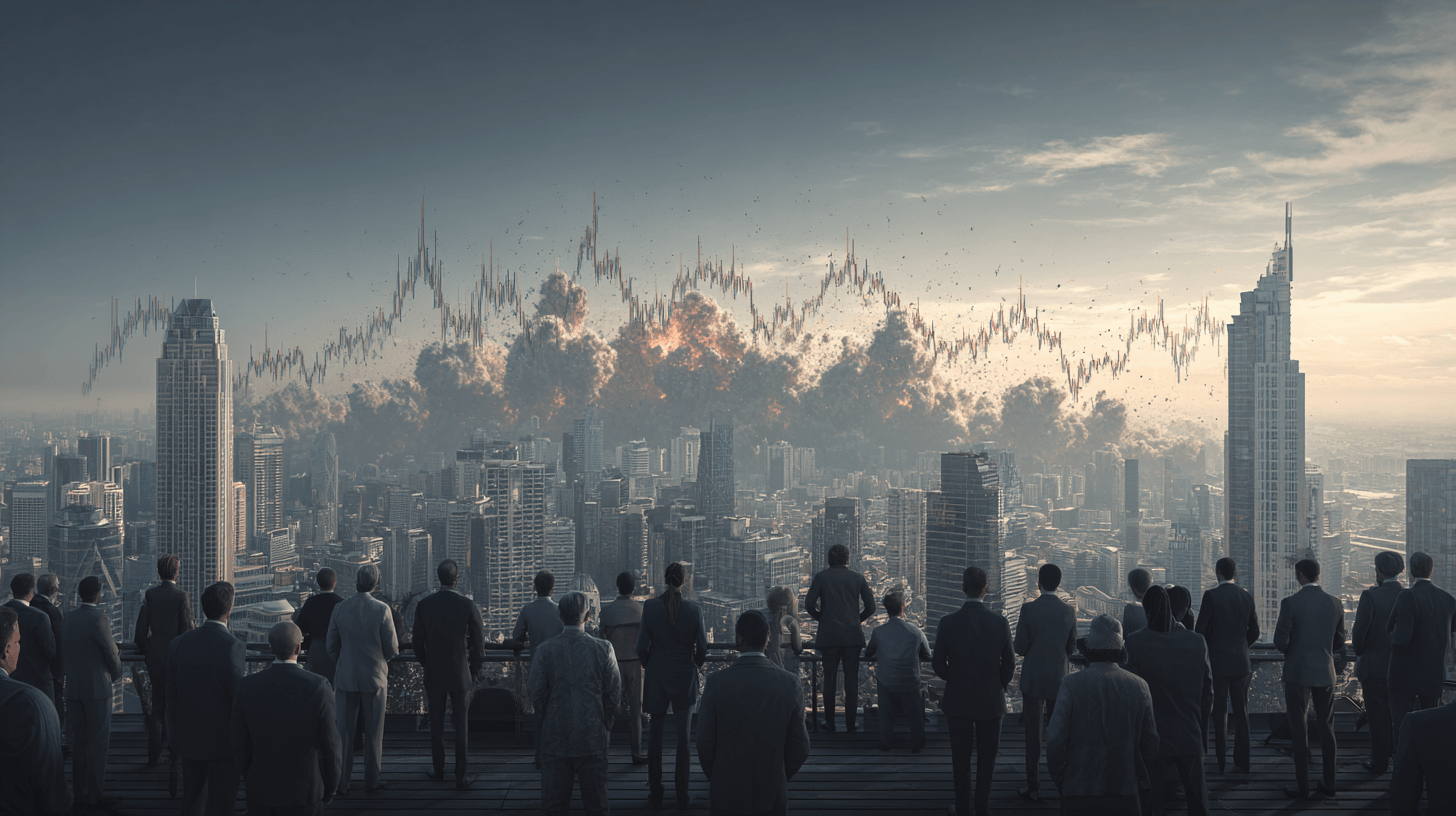
How Does a Bubble Economy Collapse?
In December 1989, Japan’s Nikkei stock index closed at an all-time high near 38,900. Land under the Imperial Palace in Tokyo was, by some estimates, worth more than all the real estate in California. Banks lent freely against inflated collateral, and ordinary households believed property values could only rise. Fifteen years later, the Nikkei had lost more than 70 percent of its value, and Japan was still climbing out of a slump economists would later call the Lost Decade.
Bubbles like this one do not collapse randomly. They follow a recognizable pattern, one that has repeated itself in Dutch tulip markets, British railway shares, American housing, and dot-com startups. Prices rise far beyond what the underlying asset can justify, credit expands to support the climb, and then something breaks the confidence holding the whole structure together.
The central question is not simply why prices fall. Prices fall constantly in normal markets. The real question is why a bubble’s collapse tends to be sudden, severe, and self-reinforcing, turning a price correction into an economic crisis that outlasts the boom itself by years.
Understanding that mechanism means understanding four things: how bubbles form, why they cannot be sustained, what typically triggers their collapse, and why the damage from a burst bubble tends to spread so much further than the original speculation.
The Conditions That Make a Bubble Possible
A bubble needs more than optimism. It needs cheap and abundant credit.
When borrowing is inexpensive, more people can bid on the same assets, whether those are stocks, houses, or tulip bulbs. Rising prices then make those assets look like good collateral, which encourages banks to lend even more against them. Economists call this a credit-asset price spiral: cheap credit inflates prices, and inflated prices justify more credit.
Japan’s bubble in the late 1980s formed this way almost textbook-perfectly. The Bank of Japan kept interest rates low through much of the decade, partly to support the yen after the 1985 Plaza Accord. Banks, facing new competition and deregulation, expanded lending aggressively into real estate and stocks. Land prices rose so high that some Japanese firms borrowed against their property holdings simply to buy more property, a practice that made sense only if prices kept climbing forever.
The same pattern reappeared in the United States two decades later. Mortgage lending standards loosened through the mid-2000s, and lenders increasingly approved loans with little verification of a borrower’s income. Rising home prices made these loans look safe, since a lender could recover its money by repossessing an asset that seemed destined to appreciate. That assumption held until it didn’t.
Why the Climb Cannot Continue Indefinitely
A bubble’s core problem is mathematical, not psychological. Asset prices are supposed to reflect the income or value an asset will realistically produce over time. When prices detach from that anchor, someone eventually has to pay a price that exceeds what the asset can justify through normal means.
Economists describe this as a widening gap between price and fundamental value. In a healthy market, a stock’s price roughly tracks a company’s earnings potential; a home’s price roughly tracks the rent or utility it can generate. In a bubble, prices rise because buyers expect that someone else will pay even more later, a dynamic researchers call the “greater fool” mechanism. It works only as long as new buyers keep arriving with fresh money and confidence.
That is not a stable equilibrium. It depends on continuous inflows of both credit and belief, and both are finite. As prices climb, the initial reasons for buying, whether income growth, low mortgage rates, or genuine economic promise, matter less than the pure expectation that prices will keep rising. This is why late-stage bubble participants are often described, fairly or not, as speculating rather than investing: they are betting on other people’s expectations rather than on the asset’s underlying worth.
What Actually Triggers the Break
Bubbles rarely collapse because of one single cause. They usually break when a relatively ordinary event removes the confidence that had been propping up an unsustainable structure.
In Japan, the trigger was largely policy-driven. Concerned about inflation and speculative excess, the Bank of Japan raised its policy rate from 2.5 percent in 1989 to 6 percent by mid-1990, while regulators simultaneously restricted real estate lending. Credit growth slowed almost immediately. Prices, no longer supported by an expanding pool of buyers with easy financing, began to fall. Once land and stock prices stopped rising, the entire logic that had justified using property as loan collateral collapsed with them.
In the United States in 2007 and 2008, the trigger was more distributed. Rising interest rates increased monthly payments on adjustable-rate mortgages just as home price growth began to slow. Homeowners who had counted on refinancing before their rates reset found themselves unable to do so. Defaults rose, first modestly, then sharply, exposing how many mortgage-backed securities, sold to investors around the world as low-risk assets, actually depended on borrowers who could not realistically repay them. The failure of Lehman Brothers in September 2008 did not create the underlying problem; it revealed how deeply that problem had already spread through the global financial system.
This is a consistent feature of bubble collapses: the trigger is often smaller than the damage that follows. A modest rate increase or a single failed institution does not usually justify a global recession on its own. What turns a trigger into a crisis is the second phase of collapse, which has less to do with the original asset and more to do with fear.
Why the Fall Accelerates Once It Starts
A rising bubble is self-reinforcing on the way up. It is self-reinforcing on the way down as well, which is why collapses tend to be faster and more violent than the booms that preceded them.
Once asset prices start falling, lenders who accepted those assets as collateral face a problem. The collateral backing existing loans is now worth less than the loan itself, which forces banks to either demand more collateral, call in loans, or absorb losses directly. Any of these responses tightens credit exactly when borrowers need it most. Households and firms that could easily refinance during the boom suddenly cannot, which forces some of them to sell assets to raise cash. Those sales push prices down further, creating more distressed collateral, more tightening credit, and more forced selling. This feedback loop is often called a debt-deflation spiral, a term economist Irving Fisher used to describe the collapse that followed the 1929 stock market crash.
Panic compounds the mechanical problem. Investors and depositors, unsure which institutions are exposed to bad assets, often withdraw from all of them rather than investigate each one individually. This is precisely what drove bank runs during the Great Depression and, in a more modern form, the freezing of short-term lending markets in 2008, when banks became reluctant to lend to each other overnight because no one could be certain which counterparties were solvent.
What Popular Memory Gets Wrong
Public discussion of bubbles often focuses on villains: greedy bankers, reckless borrowers, or a single warning that regulators supposedly ignored. These narratives are emotionally satisfying, but they tend to obscure a more uncomfortable truth.
Bubbles are usually enabled by decisions that seemed reasonable at each individual step. A bank extending a mortgage to a borrower with a stable job and a rising home value was not behaving irrationally in isolation. A household buying a home before prices rose further was responding sensibly to the incentives in front of it. The danger of a bubble lies less in individual bad judgment than in the aggregate effect of many reasonable-looking decisions made under the same optimistic assumptions at the same time.
It’s also a common misconception that regulators and economists never see bubbles coming. Some do. Robert Shiller, an economist who later won the Nobel Memorial Prize in Economic Sciences, warned publicly about overvaluation in both the dot-com stock market and the U.S. housing market well before each collapsed. The harder problem is not identification but action: raising interest rates or tightening credit early enough to deflate a bubble gently risks triggering the very recession that policymakers are trying to prevent, which makes early intervention politically and economically difficult.
Why the Damage Outlasts the Boom
A bubble’s collapse rarely stays confined to the market where it began, because credit connects sectors that otherwise have little to do with one another.
When Japanese banks absorbed massive real estate losses in the early 1990s, their damaged balance sheets made them reluctant to lend broadly across the economy, not just to property developers. That reluctance, sometimes called credit crunch behavior, dragged down manufacturing, retail, and employment for years after land prices had already stopped falling. Similarly, the 2008 U.S. housing collapse spread into unemployment, retirement savings, and consumer spending well beyond the mortgage market itself, because pension funds, money market funds, and insurance companies had all invested in mortgage-backed securities.
This is the deeper reason bubble collapses cause recessions rather than simple market corrections. A stock that loses half its value affects the people who owned it. A credit system that loses confidence in its own collateral affects nearly everyone who depends on borrowing, lending, or being paid by someone who does.
The Question Bubbles Keep Asking
Every generation tends to believe its bubble is different, supported by a genuinely new technology, a permanently changed policy environment, or a market that has learned from past mistakes. Sometimes elements of that belief are true. The underlying mechanism, however, has proven remarkably durable across centuries and asset classes.
What separates a healthy expansion from a dangerous bubble is not enthusiasm itself, but the point at which price appreciation becomes the primary reason people are buying, rather than a byproduct of genuine value. That distinction is difficult to see from inside a boom and easy to see afterward, which is precisely what makes bubbles so hard to prevent and their collapses so hard to forget.
The lesson bubbles leave behind is not that markets are irrational. It’s that confidence and credit can, for a while, make almost any price look reasonable, right up until they can’t.