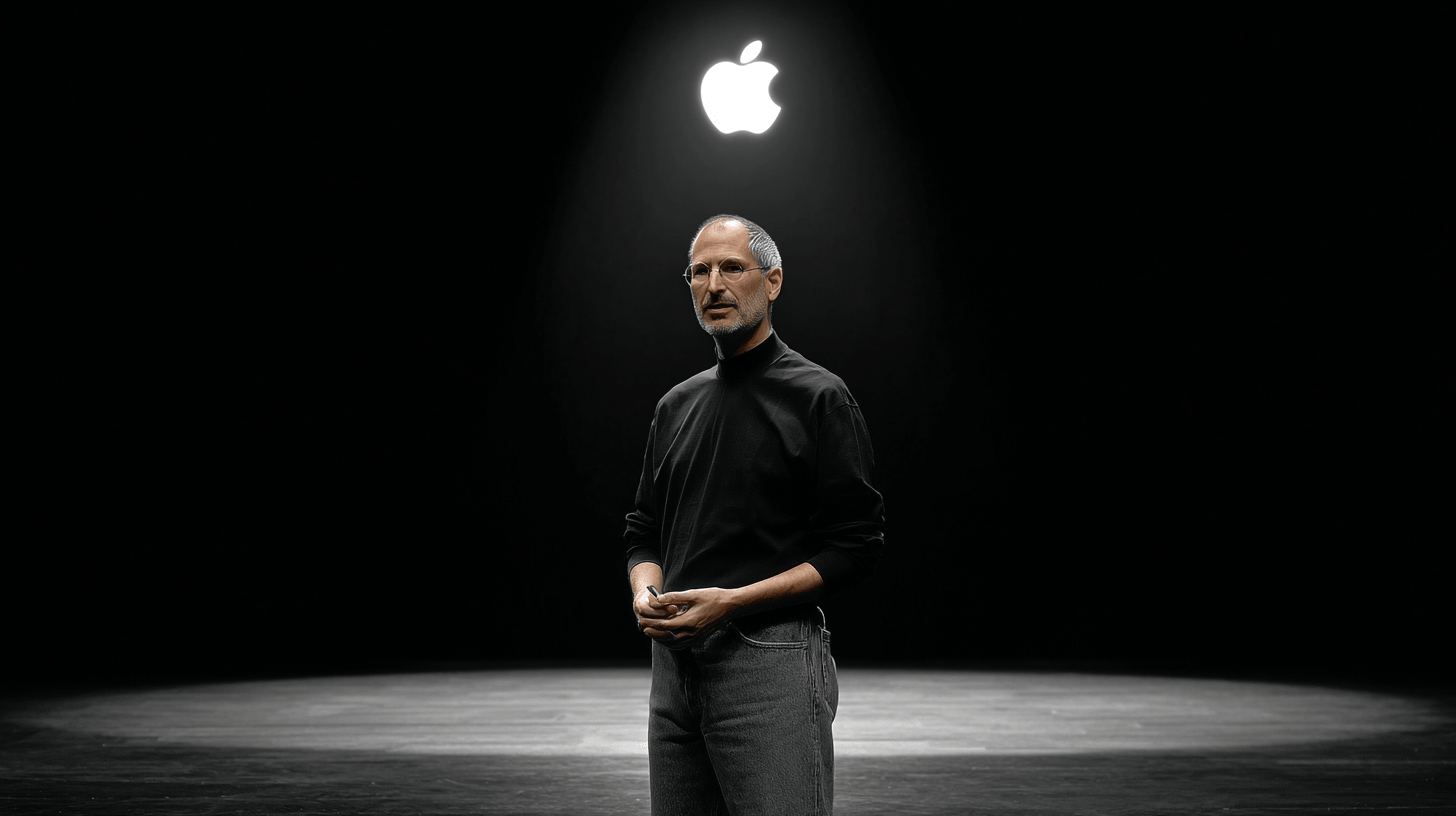
How Steve Jobs Turned Apple Into One of the World’s Most Valuable Companies
In the spring of 1997, Apple Computer had roughly ninety days of cash left before it would need to consider bankruptcy. The company that had once defined personal computing was losing money on nearly every product line it sold, and analysts openly debated who might buy its patents once it folded. Twenty-five years later, Apple would become the first American company to be valued at three trillion dollars, a sum larger than the combined worth of dozens of other major corporations.
The distance between those two facts is usually explained with a single word: genius. But that word explains very little. A near-bankrupt computer maker does not become one of the most valuable companies in history because one person was brilliant. It happens because a specific set of decisions, made under real constraints and real competitive pressure, changed what the company sold, how it made money, and what customers expected from it.
Understanding how Apple’s transformation actually worked requires looking past the popular myth of a lone visionary and toward the strategic choices, institutional conditions, and calculated trade-offs that made the turnaround possible.
The Company Jobs Returned To
When Steve Jobs came back to Apple in 1997, following the company’s acquisition of his startup NeXT, he inherited an organization in disarray. Apple was producing more than a dozen versions of the Macintosh, several failed side projects such as the Newton handheld device, and a licensing program that allowed other manufacturers to build Mac clones, which cannibalized Apple’s own hardware sales without building a sustainable business around it.
The company’s problem was not a lack of engineering talent. Apple had genuine technical strengths and a loyal, if shrinking, customer base. Its problem was strategic incoherence. It was trying to compete in too many markets at once, with too many products, none of which had a clear identity or a clear customer.
Jobs’s first major decision was subtraction. He canceled the clone licensing program and cut Apple’s product lineup down to four core computers, organized along two simple axes: consumer or professional, desktop or portable. It was an unglamorous decision, but it solved the company’s most basic problem before any new invention could matter: a company that cannot explain what it sells cannot convince anyone to buy it.
Design as a Business Strategy, Not a Look
Apple’s reputation for design is often described as an aesthetic preference, as though the company simply cared more about how its products looked. That framing misses the actual strategy. At Apple under Jobs, design functioned as a form of vertical integration.
Unlike most personal computer manufacturers, which assembled machines from components made by outside suppliers running Microsoft’s operating system, Apple controlled both the hardware and the software running on it. This meant Apple could design a machine and its operating system together, rather than negotiating compatibility after the fact. The 1998 iMac, with its translucent colored plastic and simplified set of ports, was not merely a stylish object. It was a physical demonstration that a computer could be simple enough for someone with no technical background to set up and use.
That integration came at a cost. Apple gave up the market share advantages of licensing its software widely, the way Microsoft did. It chose a smaller, more profitable slice of the market over a larger, less profitable one. This was a deliberate trade-off, not an inevitable outcome, and it defined Apple’s business model for the next two decades: sell fewer devices, at higher margins, to customers willing to pay for an integrated experience.
Reinventing an Industry Apple Did Not Invent
The iPod, launched in 2001, illustrates a pattern that recurs throughout Apple’s history under Jobs: the company rarely invented an entirely new technology first. Portable MP3 players existed before the iPod. What Apple did was solve the parts of the experience that made existing devices frustrating.
The iPod paired a simple physical interface with iTunes, software that let customers legally organize and, later, purchase individual songs rather than entire albums. That combination required Apple to negotiate directly with major record labels, an unglamorous and difficult process that took years, at a time when the music industry was reeling from piracy and had little reason to trust a computer company’s promises.
The lesson generalizes beyond music. Apple’s most commercially significant products were rarely first movers. They were often the product that solved the coordination problem an entire industry had failed to solve on its own, whether that meant licensing agreements with record labels, carrier contracts for phones, or developer tools for a mobile app marketplace. Being second, but solving the right problem, proved more valuable than being first.
The Decision That Changed the Company’s Scale
The iPhone, introduced in January 2007, is the product most associated with Apple’s rise to the top tier of global corporations, and for good reason. But the decision that mattered most for the company’s long-term value was not the phone’s hardware. It was the creation of the App Store in 2008, a year after the iPhone’s launch.
Jobs initially resisted allowing outside developers to build native applications for the iPhone, preferring that developers build web applications instead. Internal and external pressure eventually changed that position. Once Apple opened the platform to third-party software and took a percentage of sales through its own store, it had built something categorically different from a hardware business: a marketplace with built-in network effects, in which more users attracted more developers, and more developers attracted more users.
This is the point at which Apple’s business model shifted from selling durable objects to operating an ecosystem that generated recurring revenue long after a device was purchased. It is also the point at which Apple’s profitability became harder to explain through hardware sales alone, since a growing share of its income increasingly came from services, subscriptions, and the App Store’s commission structure.
What Popular Memory Gets Wrong
The common version of this story credits one man’s taste and instinct for nearly everything Apple achieved. That account flatters a simple narrative, but it obscures how the transformation actually happened.
Jony Ive’s design studio, largely invisible to the public for years, translated Jobs’s priorities into manufacturable products, often solving problems in materials science and precision engineering that had no obvious solution. Tim Cook, who ran Apple’s operations before becoming its chief executive in 2011, built the supply chain and manufacturing relationships in Asia that let Apple produce tens of millions of complex devices on tight schedules without the chronic shortages that plagued competitors. None of Apple’s design ambitions would have mattered if the company could not actually build and ship what it designed.
It is also worth separating two different things that are often collapsed into one story: Apple’s operational success and Apple’s stock market valuation. A meaningful share of Apple’s rise past the trillion-dollar threshold occurred after Jobs’s death in 2011, under Cook’s leadership, driven partly by services growth and partly by one of the largest corporate share buyback programs in history, which reduces the number of outstanding shares and can raise a company’s share price independent of revenue growth. Crediting a single individual, whether Jobs or Cook, with a valuation shaped by product decisions, executional discipline, market conditions, and financial engineering all at once understates how many different forces had to align.
The Trade-Offs Behind the Success
Apple’s strategy carried real costs, and understanding them is part of understanding the strategy itself. The company’s insistence on controlling its own hardware and software meant walking away from the larger market share that an open licensing model could have captured, the path Microsoft took with Windows. Apple’s premium pricing excluded large segments of price-sensitive buyers, particularly in developing markets, where competitors selling far cheaper Android devices captured most of the unit volume even as Apple captured a disproportionate share of the industry’s profit.
The company’s manufacturing model, which relies heavily on contract manufacturers in China, has also drawn sustained scrutiny over labor conditions and Apple’s exposure to geopolitical risk between the United States and China. A business built for high margins and tight design control is not automatically a business built for resilience against political disruption, and Apple’s leadership has had to manage that tension continuously rather than resolve it once.
Why the Transformation Still Matters
Apple’s rise from near collapse to record valuation is often told as an inspirational story about belief in good design. The more useful version of the story is about strategic discipline under constraint: cutting a confused product line down to something explainable, accepting a smaller share of a market in exchange for higher margins, and being willing to enter industries Apple did not invent by fixing what made them difficult to use.
That combination does not guarantee success on its own. Many companies have tried some version of the same playbook and failed. What made it work at Apple was the alignment of a clear strategic bet, the engineering and manufacturing capability to execute it precisely, and timing that placed the iPhone at the exact moment mobile networks, touchscreen technology, and consumer expectations were ready to converge.
Apple’s value today is not really a monument to one person’s instincts. It is closer to a case study in what happens when a company decides, deliberately and repeatedly, what it will not try to be.