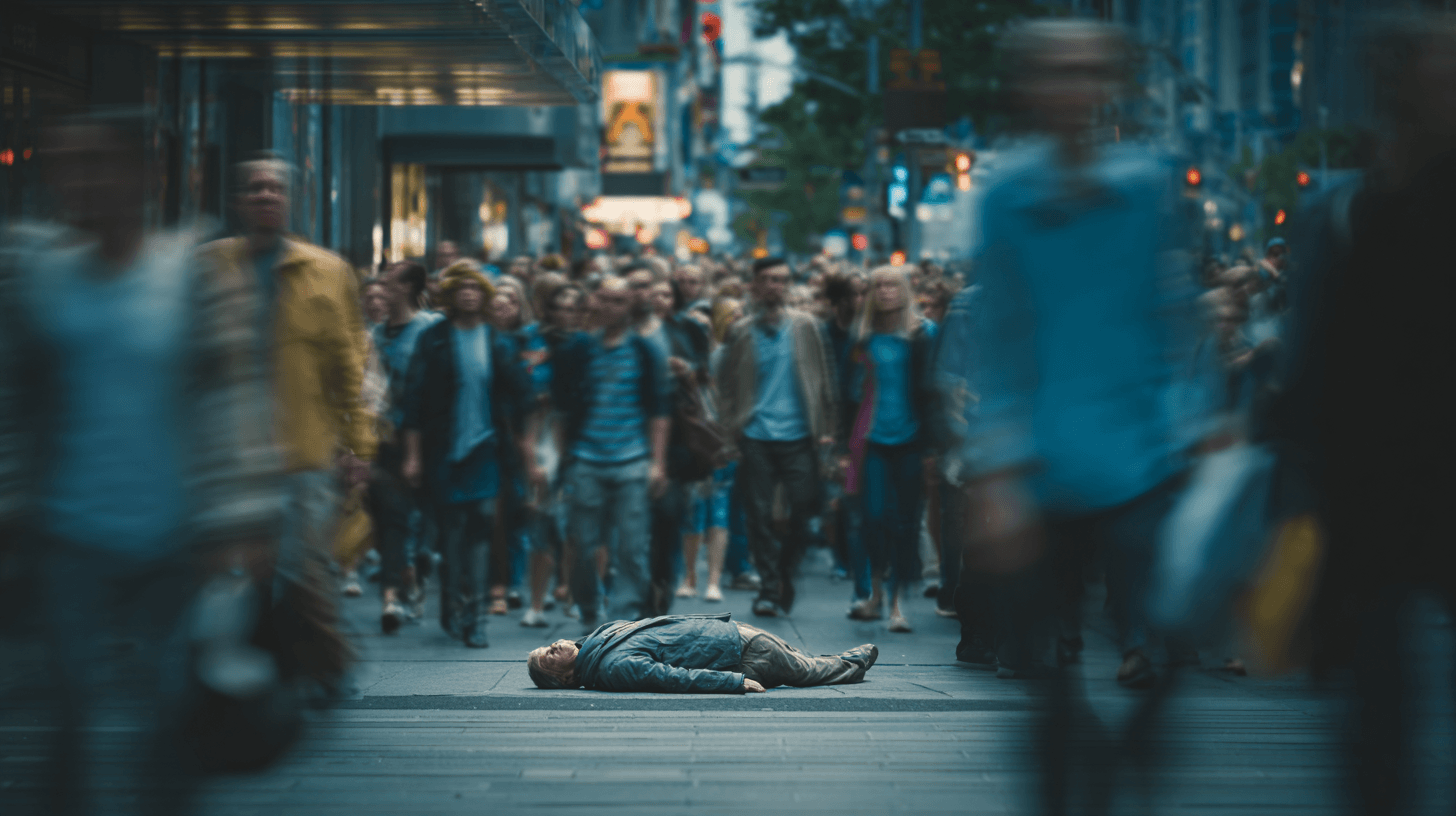
Why Doesn’t Anyone Help? The Psychology of the Bystander Effect
In March 1964, a young woman named Kitty Genovese was attacked and killed outside her apartment building in Queens, New York. Newspaper reports claimed that 38 neighbors heard or saw the assault and did nothing. The story became one of the most repeated case studies in the history of psychology, cited for decades as proof that crowds make people cruel or numb.
There was just one problem. Much of it wasn’t true. Later investigations found no evidence that 38 people watched the murder unfold, and several who did hear something did try to call for help. The exaggerated version of the story spread anyway, because it seemed to explain something real: people often fail to help strangers in trouble when other people are standing nearby.
That real phenomenon has a name, the bystander effect, and it has been tested in laboratories, city streets, and now thousands of hours of security footage. The findings are more precise, more surprising, and in some ways more reassuring than the Genovese legend ever was. Understanding why people hesitate to help, and when they actually don’t, says less about individual cowardice than about how the human mind processes group situations under pressure.
A Murder That Was Reported Wrong but Studied Right
The Genovese case did not create the bystander effect. It provoked psychologists to go looking for it. Two social psychologists, John Darley and Bibb Latané, were struck by how a supposedly heartless crowd of witnesses could be explained by something other than moral failure. They suspected the problem wasn’t indifference. It was the presence of other people itself.
A 2007 review in the journal American Psychologist by Rachel Manning, Mark Levine, and Alan Collins later examined trial records, police files, and press coverage from 1964. They found no solid evidence for the number of 38 witnesses, for claims that witnesses watched the attack unfold, or for the idea that no one tried to intervene. The story, they argued, had become a kind of modern parable, repeated in psychology textbooks less because it was accurate than because it was unforgettable.
This matters for reasons beyond historical correction. The exaggerated Genovese story shaped how an entire field, and generations of readers, thought about crowds and cruelty. The real research that followed told a more precise story, and a more useful one.
The Experiments That Explained the Silence
Darley and Latané didn’t rely on newspaper anecdotes. Starting in the late 1960s, they built experiments that placed ordinary people in staged emergencies to see how the number of bystanders present changed the odds that anyone would act.
In one well-known setup, participants sat alone in a room, believing they were part of a group discussion conducted over an intercom. At some point, one voice on the intercom appeared to suffer a seizure, choking and calling for help. Participants who believed they were the only person who could hear the emergency almost always went for help quickly. Participants who believed several other people were also listening were far slower to respond, and some never responded at all.
The pattern held up across other experiments, including one in which a room filled with smoke while participants sat filling out a questionnaire. Alone, most people got up and reported it within moments. In a group, many kept filling out the form as the room filled with haze, glancing at the other unmoving people around them and concluding, wrongly, that there was nothing to worry about.
Two mechanisms explained most of what researchers observed.
The first is diffusion of responsibility. When one person witnesses an emergency alone, the responsibility to act rests entirely on them. Add other witnesses, and that responsibility quietly splits. Nobody explicitly decides that someone else should handle it. The sense of personal obligation simply thins out as the group grows, until it can feel like someone else’s problem even when it plainly is not.
The second is pluralistic ignorance. In an ambiguous situation, people look to others for cues about how to react. If everyone else looks calm, most people assume the situation must be less serious than it appears, even if everyone privately feels uneasy. A room full of people can end up frozen in shared confusion, each person’s outward calm reinforcing everyone else’s, while no one is actually calm at all.
A third factor, evaluation apprehension, adds social risk to the mix. Stepping forward to help in front of a group means risking public embarrassment if the emergency turns out to be nothing, or if the attempt to help goes badly. Acting alone carries none of that exposure.
Why the Effect Is Not About Callousness
It’s tempting to read the bystander effect as evidence that people become colder or more selfish in groups. The experimental evidence points somewhere different. Participants in these studies weren’t indifferent. Many later reported genuine distress and confusion during the emergency. What slowed them down wasn’t a lack of concern. It was a set of automatic social calculations happening faster than conscious reasoning could keep up with.
This distinction matters, because it changes what actually reduces the effect. Simply telling people to care more does little. What works better is removing the ambiguity and the diffusion, which is why safety training for CPR, workplace emergencies, and public harassment often teaches a specific technique: point directly at one bystander and assign them a task. “You, call an ambulance.” That single instruction collapses a diffused crowd back into one person with unambiguous responsibility, and it reliably increases the odds that help arrives.
What Real-World Footage Later Revealed
Laboratory experiments are useful, but they can’t fully capture how people behave during real danger, since researchers can’t ethically stage an actual violent attack. For decades, the bystander effect rested mainly on simulated emergencies. That began to change once cities filled with security cameras.
In 2020, a team led by Richard Philpot analyzed footage of 219 real public conflicts captured by CCTV cameras in the United Kingdom, the Netherlands, and South Africa, three places with very different levels of everyday street violence and public trust. The question wasn’t whether any single bystander would help. It was whether at least someone in the vicinity would.
The result: in about nine out of ten conflicts, at least one bystander intervened, and often more than one did. The pattern held across all three countries, despite their very different reputations for public safety. More strikingly, having more bystanders present was associated with a higher, not lower, chance that someone would step in.
A related line of research, a large 2011 meta-analysis by Peter Fischer and colleagues covering more than 7,700 participants across decades of studies, found something similar: the classic bystander effect shrinks, and can even reverse, as situations become more clearly dangerous. When an emergency is unmistakably serious, the ambiguity that drives pluralistic ignorance mostly disappears, and the presence of more people can start working in the victim’s favor instead of against them.
None of this erases the original findings. Diffusion of responsibility and pluralistic ignorance are real and well documented, especially in situations that are ambiguous rather than obviously dangerous, such as someone slumped on a subway platform who might be asleep, unwell, or something worse. The newer research adds an important qualifier: the effect is strongest exactly where uncertainty is highest, and weaker once danger becomes unambiguous.
What Popular Memory Still Gets Wrong
Three misconceptions tend to travel together whenever the bystander effect comes up.
The first is the idea that the Genovese case proved the theory, when in fact the theory was developed partly in reaction to a story that turned out to be substantially exaggerated. The research that followed stands on its own evidence, but the founding anecdote does not hold up to scrutiny.
The second is the assumption that bystanders in real emergencies mostly do nothing. The CCTV research suggests the opposite is closer to the truth: outright non-intervention in observed public conflicts is the exception, not the rule.
The third is treating the effect as a fixed law rather than a probability that shifts with context. Ambiguity, group size, perceived danger, and social relationships between bystanders all change the odds substantially. A group of strangers glancing nervously at a slumped figure on a train behaves very differently from a group of friends who instantly recognize that one of their own needs help.
Why This Still Matters
The bystander effect endures as a subject of interest not because it proves people are indifferent, but because it reveals something more unsettling and more useful: good intentions can be silently disabled by the mere presence of other good intentions in the room. Nobody has to be selfish for a crowd to freeze. The mechanism runs through perception and social signaling, mostly below the level of conscious choice.
That is precisely why the fix is procedural rather than moral. Emergency responders, workplace safety trainers, and public health campaigns increasingly teach the same lesson: assign responsibility explicitly, remove the ambiguity, and name a specific person to act. The lesson isn’t that people need to be convinced to care. It’s that clarity, more than character, decides who steps forward when someone needs help.
Frequently Asked Questions
Did 38 people really watch Kitty Genovese die without helping?
No. Archival research published in American Psychologist in 2007 found no solid evidence for that number, or that witnesses observed the attack and remained inactive. The case still helped inspire bystander research, but the popular version of the story does not match the historical record.
Does having more witnesses always make people less likely to help?
Not always. The classic effect is strongest in ambiguous situations, where it’s unclear whether help is actually needed. In clearly dangerous situations, research including large-scale CCTV studies has found that more bystanders are associated with a higher, not lower, chance that someone intervenes.
What is the single most effective way to get help in an emergency?
Reduce ambiguity and diffusion by directly assigning the task to one person, rather than shouting for help in general. Pointing at a specific bystander and giving a clear instruction reliably increases the odds that help arrives quickly.
Is the bystander effect about people being selfish or cold?
No. Experimental participants who failed to act quickly typically reported genuine concern and confusion, not indifference. The delay is better explained by automatic social reasoning, such as diffusion of responsibility and reading calm from others, than by a lack of care.