Why Don Quixote Is Considered the First Modern Novel
A middle-aged man reads too many books about knights, decides he is one, and rides out to fight windmills. On its surface, that premise sounds like a farce, not the founding text of an entire literary form. Yet when scholars trace the novel back to its origins, they consistently arrive at the same place: Miguel de Cervantes’ Don Quixote, published in two parts in 1605 and 1615.
The label “first modern novel” gets applied loosely to many books, so it’s worth asking what it actually means here. Cervantes wasn’t writing the first long prose fiction — epics, romances, and picaresque tales had existed for centuries. What he did was something different: he wrote a book that constantly questioned its own reliability, blurred the line between author and character, and treated its protagonist’s inner delusions as seriously as his outward adventures. That combination — self-awareness, psychological depth, and formal experimentation — is what later writers recognized as the beginning of the novel as we still understand it.
Understanding why requires looking at what fiction looked like before Cervantes, what he was reacting against, and what he built instead.
The World Don Quixote Was Mocking
By the late 1500s, Spain had a booming appetite for chivalric romances — stories of knights, quests, and impossible feats of heroism, descended from medieval tales like Amadís de Gaula. These books were formulaic and unapologetically idealized. Knights were purely noble, villains purely wicked, and the world obeyed a moral logic that had little to do with how people actually lived.
Cervantes had reason to be skeptical of grand narratives. He had fought in the Battle of Lepanto, where he lost the use of his left hand, and spent five years enslaved in Algiers after his ship was captured by corsairs. Later in life, he worked as a tax collector and briefly landed in prison over accounting disputes. His experience of the world was full of bureaucratic frustration, physical hardship, and moral ambiguity — nothing like the clean heroism of the books he had grown up reading.
Don Quixote began, by Cervantes’ own account, as a parody of these romances. Alonso Quixano, an aging minor nobleman, reads so many chivalric tales that he loses his grip on reality, renames himself Don Quixote, and sets out to revive knight-errantry in a Spain that has no use for it. The joke seems simple enough: an old man’s fantasies collide with a mundane world of innkeepers, farmers, and muleteers.
But Cervantes didn’t stop at parody. He kept pulling at the thread until the whole fabric of storytelling started to unravel — in a way that changed what fiction could do.
A Narrator Who Admits He Might Be Lying
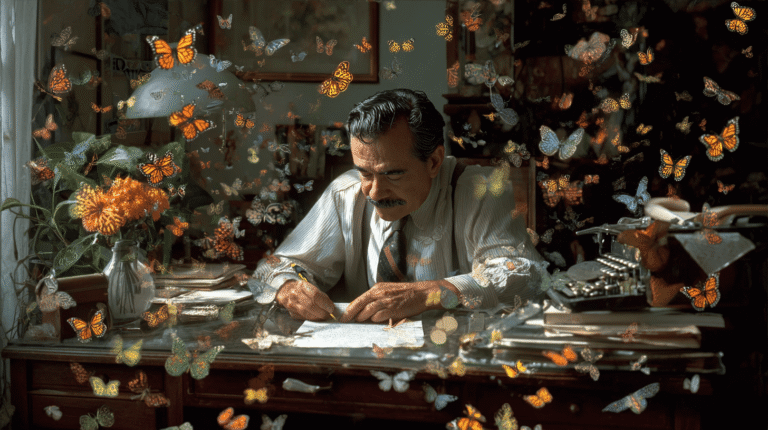
Perhaps the single most influential trick in Don Quixote is its narrator’s unreliability. The book claims to be a translation of a manuscript by a fictional Arab historian named Cide Hamete Benengeli — a figure Cervantes invents specifically so that the “true” account of Don Quixote’s adventures can be full of gaps, contradictions, and disputed details. At one point, the narrator openly wonders whether Cide Hamete is lying, since he was “a lying historian” by nature, being an Arab. The novel constantly reminds readers that they are reading a secondhand, possibly distorted account of events that may not have happened at all.
This device did something no earlier long fiction had done so thoroughly: it made the reader responsible for judging the story’s credibility. Medieval romances asked readers to believe. Don Quixote asked readers to interpret. That shift — from a text that delivers truth to a text that stages the problem of truth — is one of the qualities scholars point to when they call the book distinctly modern.
Cervantes goes even further in Part Two, published a decade after Part One. By 1615, an unauthorized sequel to Don Quixote had already been published by an unknown writer using the pseudonym Alonso Fernández de Avellaneda. Rather than ignore this, Cervantes wrote it directly into his own sequel: his characters have read Part One, know they are famous, and encounter people who have read the fake continuation and expect them to behave like its version of themselves. Don Quixote and Sancho Panza spend part of the novel correcting people’s mistaken impressions of who they are — a level of self-reference that most fiction wouldn’t attempt again for centuries.
Two Minds Talking to Each Other
The second major innovation is the relationship between Don Quixote and his squire, Sancho Panza. Earlier fiction tended to organize itself around a single hero’s actions. Don Quixote organizes itself around a conversation between two incompatible ways of seeing the world.
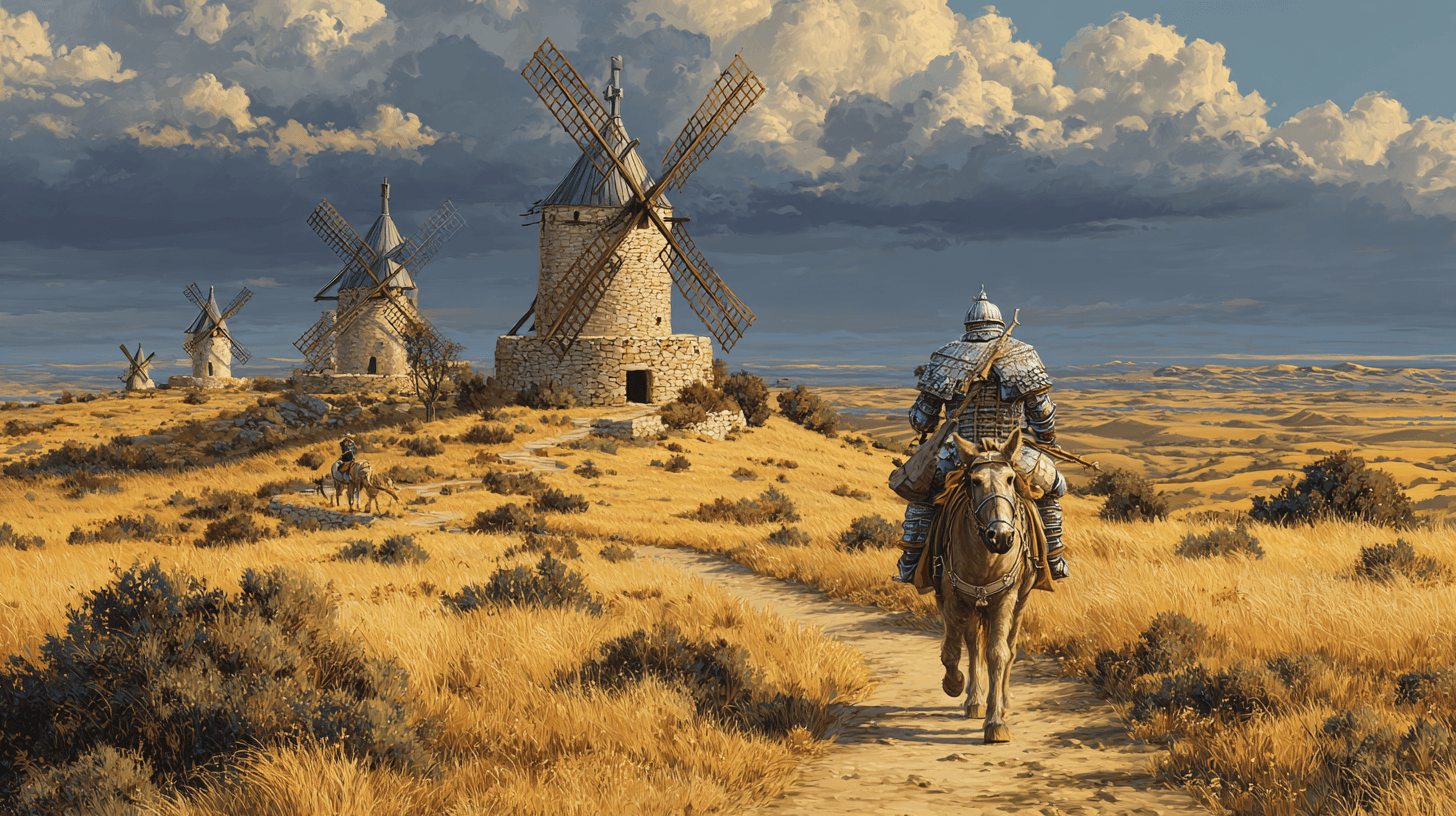
Don Quixote sees giants where there are windmills, armies where there are flocks of sheep, and a peasant girl where there is supposedly an enchanted princess named Dulcinea. Sancho, practical and food-motivated, usually sees the literal truth — yet he is gradually pulled into his master’s imaginative universe, at times half-believing it, at times exploiting it for his own gain, at times defending it against outsiders who mock Don Quixote too cruelly.
This isn’t just comic contrast. It’s an extended argument, conducted through dialogue and incident, about the value and danger of idealism. Don Quixote’s delusions cause real harm — he attacks innocent people, destroys property, and gets both of them beaten repeatedly. But his commitment to a nobler, more meaningful vision of the world also draws out generosity and courage that the “sane” characters around him often lack. Cervantes refuses to resolve this tension. He doesn’t declare Don Quixote simply a fool or simply a visionary.
That refusal to moralize cleanly is another hallmark of what came to be called the novel. Where romance delivered clear verdicts, Don Quixote left readers holding a contradiction.
Why Ambiguity Was the Point
Readers over the centuries have swung between two broad readings of the book, and the disagreement itself reveals why it mattered so much to later writers.
For much of the 17th and 18th centuries, Don Quixote was read mainly as a comedy — a satire of an old fool whose bookish fantasies made him ridiculous. This was the version that made Cervantes famous in his lifetime and shaped how the book was translated and performed across Europe.
By the Romantic era, particularly in Germany and later across Europe, critics began reading the same book as a tragedy about the crushing of idealism by a petty, materialistic world. In this reading, Don Quixote’s madness is not merely foolish; it’s a form of moral courage in a society that has forgotten how to dream. Neither interpretation is simply wrong. The text supports both, sometimes in the same scene, and literary historians generally agree that this openness to conflicting readings was intentional rather than accidental. Cervantes built a character complex enough to sustain contradictory interpretations for four hundred years, which is a different kind of achievement than writing a character who reliably makes one moral point.
This ambiguity is part of why the book resists the simpler categories that governed fiction before it. A romance tells you what to think of its hero. Don Quixote leaves the question open, which is precisely what realistic human beings tend to do to the people who observe them.
What “the Novel” Actually Inherited From It
It’s worth being precise about what later writers took from Cervantes, since “influence” can otherwise sound vague.
The realist novel of the 18th and 19th centuries — from Henry Fielding to Gustave Flaubert to Fyodor Dostoevsky — inherited several specific things from Don Quixote: the idea that a character’s interior delusions and self-image are legitimate subjects for extended fiction; the use of an ordinary, often absurd protagonist rather than an aristocratic hero; the technique of undermining the narrator’s authority to create irony and ambiguity; and the willingness to mix comedy with genuine emotional and moral weight in the same scene.
Fielding, whose Tom Jones helped establish the English novel, explicitly modeled his work on Cervantes and called his own book “a comic epic-poem in prose,” borrowing the mixed tone directly. Flaubert’s Madame Bovary, published more than two centuries later, follows a character whose imagination has been shaped by the wrong kind of books — this time romantic novels rather than chivalric ones — with consequences that are tragic rather than comic. Dostoevsky, who reread Don Quixote throughout his life, drew on its structure of an idealistic figure navigating a cynical world for characters like Prince Myshkin in The Idiot.
None of these later authors copied Cervantes’ plot. What they took was his method: build a character whose relationship to reality is genuinely uncertain, and let the uncertainty do the narrative work instead of resolving it for the reader.
What Popular Memory Gets Wrong
Don Quixote is often remembered today mainly as the man who tilted at windmills — a byword for harmless, comic delusion. That image isn’t false, but it flattens a book that is considerably darker and more self-aware than the phrase suggests.
The novel includes genuine cruelty, both suffered and inflicted. Don Quixote and Sancho are beaten, mocked, and humiliated throughout, often by other characters who stage elaborate pranks purely to laugh at the old man’s madness — a form of entertainment the text does not always endorse. By Part Two, Cervantes seems increasingly uncomfortable with readers who treat Don Quixote’s suffering as pure comedy, and the book’s ending, in which the hero regains his sanity only to die shortly afterward, is genuinely somber rather than simply farcical.
It’s also a mistake to treat Don Quixote as a simple morality tale about the dangers of reading too much fiction, though that was its origin point. By the second half of the book, Cervantes has turned the same critique on his own text — questioning who gets to tell a story, whether any narrator can be trusted, and what happens when a fictional character becomes more real to the public than the man who invented him. That is a considerably more ambitious project than a joke about an old man and his books.
Why the Distinction Still Matters
Calling Don Quixote the first modern novel isn’t an antiquarian label reserved for literature courses. It marks a specific and lasting shift in what long fiction is allowed to do: question its own truth, hold two incompatible views of its hero at once, and treat imagination itself as a serious subject rather than mere decoration on a plot.
Cervantes set out to mock an outdated genre and ended up inventing the tools that every subsequent novelist would use to explore the gap between how people see themselves and how the world actually treats them. Four centuries later, that gap is still where most serious fiction chooses to live.