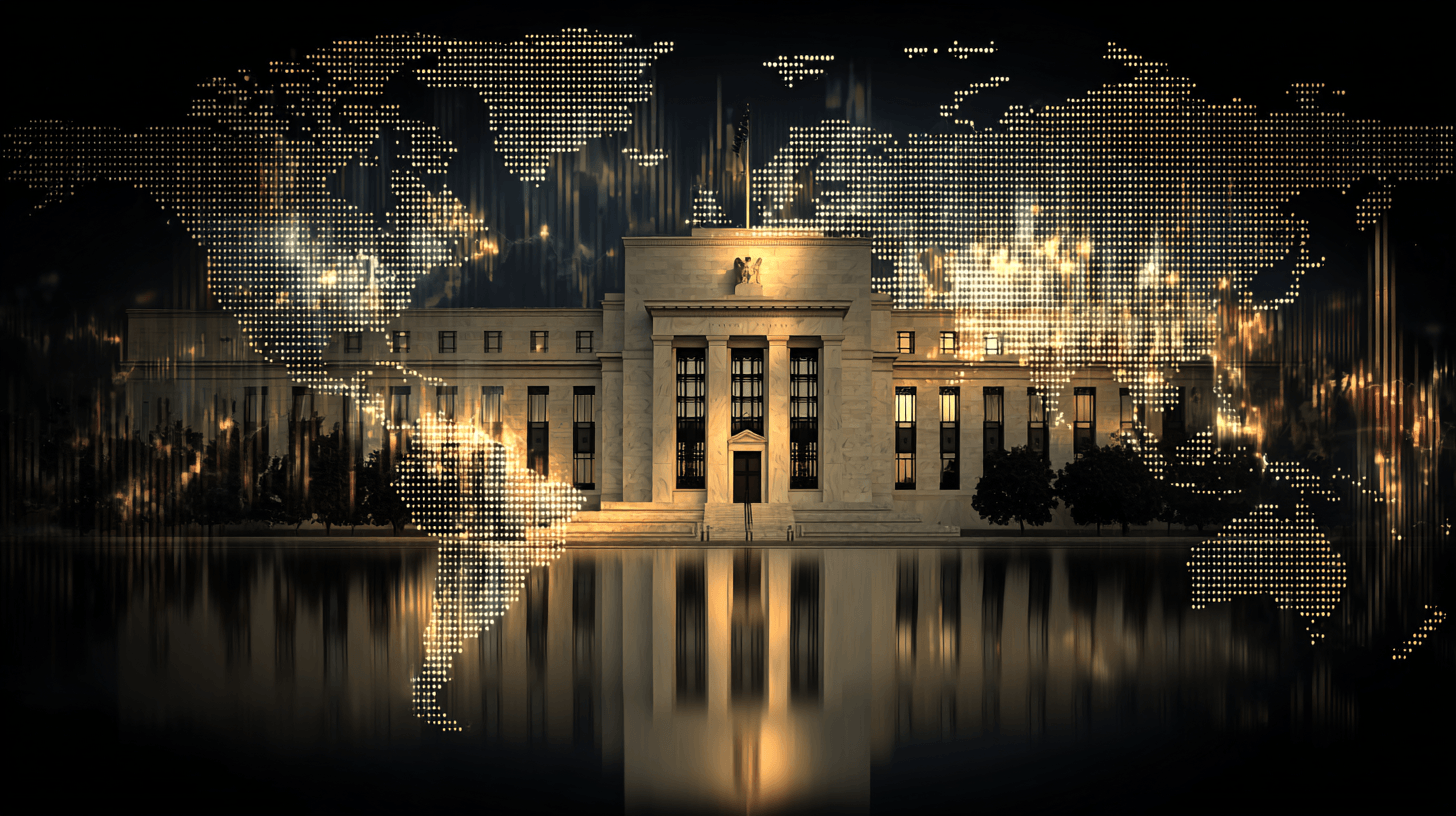
Why the Federal Reserve Moves the Global Economy
The Meeting Nobody Voted For
Twelve people sit around a table in Washington, D.C., roughly eight times a year. None of them were elected. Most of the world has never heard their names. Yet when they decide to raise or lower a single number — the federal funds rate — currencies fall in Jakarta, mortgage costs shift in London, and governments in Buenos Aires start recalculating how they will pay their debts.
This is the strange reality of the U.S. Federal Reserve. It is, on paper, the central bank of one country. In practice, it behaves like the central bank of the world economy, whether the rest of the world consented to that role or not.
The question worth asking is not simply “what does the Fed do?” Almost every financial article can answer that. The harder and more interesting question is why a domestic institution, built to manage inflation and employment inside American borders, ends up setting the financial weather for countries that have no seat at its table. The answer lies less in the Fed’s intentions than in a set of historical accidents and structural dependencies that made the dollar, and by extension American monetary policy, the operating system of global finance.
How the Dollar Became the World’s Currency
The story begins not with the Fed but with the dollar itself. After World War II, the Bretton Woods conference in 1944 established a system in which most currencies were pegged to the U.S. dollar, and the dollar itself was pegged to gold. The United States emerged from the war as the only major industrial power with its factories, gold reserves, and financial system intact, which made the dollar the obvious anchor.
The gold peg collapsed in 1971, when President Richard Nixon suspended dollar-to-gold convertibility. What did not collapse was the habit the rest of the world had already formed: pricing trade in dollars, holding dollar reserves, and borrowing in dollars. Oil exporters continued to sell in dollars through arrangements with the United States in the 1970s, reinforcing what is often called the petrodollar system. Central banks kept building dollar reserves as a safety cushion against financial crises. None of this required a treaty. It became the path of least resistance, and paths of least resistance are notoriously hard to leave once everyone else is already on them.
This is the foundation of what French officials once called America’s “exorbitant privilege”: the ability to borrow in its own currency while much of the world borrows in a currency it does not control. That asymmetry is the root of the Fed’s global reach.
The Mechanism: How One Interest Rate Reaches Everywhere
To understand why Fed decisions travel so far, it helps to separate three distinct channels through which they operate.
The first is the risk-free rate channel. U.S. Treasury securities are treated globally as the closest thing to a riskless investment. When the Fed raises rates, Treasury yields tend to rise with them, and because global investors constantly compare returns across countries, every other asset on earth — stocks, bonds, real estate, emerging-market debt — gets priced relative to that new, higher benchmark. A rate hike in Washington effectively raises the bar that investments everywhere else must clear to look attractive.
The second is the debt channel. Trillions of dollars in debt sit outside the United States but are denominated in dollars — issued by emerging-market governments, corporations, and banks that need dollars to do business internationally. When the Fed raises rates, it becomes more expensive to borrow dollars and more expensive to refinance existing dollar debt. A government in Ghana or a company in Turkey does not need to buy anything from the United States to feel this; it only needs to owe dollars.
The third is the capital flow channel. Higher U.S. rates make dollar-denominated assets more attractive relative to riskier markets. Money that had flowed into emerging economies in search of higher returns during periods of low U.S. rates can reverse and flow back toward the United States when the Fed tightens. This kind of capital flight can weaken currencies, drain foreign reserves, and force other central banks to raise their own rates defensively — not because their domestic economies need higher rates, but because the alternative is a collapsing currency.
These three channels rarely act alone. They interact, amplifying each other in ways that can turn a modest policy change in Washington into a serious shock somewhere else.
The Volcker Shock: A Case Study in Consequences
No episode illustrates this interaction better than the early 1980s. Facing double-digit inflation, Fed Chair Paul Volcker pushed the federal funds rate to levels above 19 percent between 1980 and 1981. The policy did eventually break U.S. inflation, but it also triggered a global debt crisis.
Throughout the 1970s, Latin American governments had borrowed heavily in dollars, often at variable interest rates, to finance development projects. When U.S. rates spiked, the cost of servicing that debt exploded overnight. Mexico announced in 1982 that it could not meet its debt payments, setting off a chain reaction across the region that became known as Latin America’s “lost decade.” The countries involved had not caused U.S. inflation. They simply owed money in a currency whose price had just been reset by a decision made in Washington.
This is the pattern that recurs, in smaller or larger forms, whenever the Fed moves decisively: the policy is calibrated for American conditions, but the consequences are exported globally through dollar debt and capital flows.
The Taper Tantrum and the Limits of Warning
Sometimes it is not even a rate change that causes disruption — it is the expectation of one. In 2013, then-Fed Chair Ben Bernanke suggested that the Fed might begin slowing its bond-buying program, a policy known as quantitative easing that had kept long-term rates low since the 2008 financial crisis. The mere suggestion, without any immediate rate increase, triggered what became known as the “Taper Tantrum”: a rapid sell-off in emerging-market currencies and bonds, particularly in countries such as India, Indonesia, Brazil, Turkey, and South Africa, later grouped by analysts under the label the “Fragile Five.”
The episode revealed something important: markets do not only react to what the Fed does. They react to what investors believe the Fed is about to do. This anticipatory sensitivity means that Fed communication itself — a phrase in a press conference, a shift in tone in a policy statement — can move capital across borders before any actual rate change takes effect.
What Popular Discussion Often Gets Wrong
A common misconception is that Fed policy mainly matters for Americans — mortgage rates, credit card costs, stock portfolios — and that its global effects are a secondary side note. The historical record suggests the opposite emphasis may be more accurate. Because so much of the developing world’s debt and trade is dollar-denominated, the Fed’s decisions can matter more, in proportional terms, to a country like Argentina or Sri Lanka than to the median American household adjusting a mortgage payment.
A second misconception treats the Fed as though it deliberately sets policy to control other countries. It does not. By law, the Fed’s mandate covers U.S. price stability and maximum employment, full stop. Its global influence is a side effect of the dollar’s structural position, not a stated objective. This distinction matters: it explains why the Fed does not adjust policy to protect emerging markets, even when the fallout there is severe. Its legal mandate simply does not include them.
The Fed as Reluctant Lender of Last Resort
Curiously, the same institution that can destabilize foreign economies through rate changes has also become their emergency lender in moments of crisis. During the 2008 financial crisis and again during the 2020 pandemic shock, the Fed extended dollar swap lines to a number of foreign central banks, allowing them to borrow dollars directly from the Fed to stabilize their own banking systems. This function is rarely discussed alongside the Fed’s disruptive power, but it completes the picture: global finance has become so dependent on dollar liquidity that even the institution capable of causing a dollar shortage is often the only one capable of resolving it.
Is This Arrangement Permanent?
Economists have debated the durability of dollar dominance for decades, and the debate has intensified as China, Russia, and several other countries have explored alternatives — bilateral trade agreements in local currencies, expanded use of the Chinese renminbi in some transactions, and increased gold purchases by several central banks. Some analysts argue this represents the early stages of a genuine shift away from dollar reliance. Others point out that no other currency currently offers the combination of deep, liquid, legally secure financial markets that the dollar provides, and that similar predictions of dollar decline have circulated since at least the 1970s without materializing. The honest answer is that the dollar’s dominance is not guaranteed to be permanent, but no clear successor currently exists, and structural shifts of this kind tend to unfold over decades rather than years.
Why It Matters Beyond Economics
The Fed’s global reach is not merely a technical detail of financial plumbing. It shapes political relationships between nations, influences how much room developing countries have to pursue independent economic policy, and periodically forces difficult choices between domestic priorities and financial stability. When a country’s central bank must raise rates purely to defend its currency against Fed-driven capital outflows, it is, in effect, importing American monetary policy regardless of its own domestic conditions. That loss of autonomy is one of the quieter costs of a dollar-centered financial system, borne disproportionately by countries that had no role in designing it.
Understanding the Fed, then, requires looking past its formal mandate. It is a national institution operating with global consequences, shaped by a currency system built from decisions made generations ago and never fully redesigned since. Every time it changes a single interest rate, it is not just adjusting American financial conditions. It is resetting a benchmark that much of the rest of the world, often without much choice in the matter, has agreed to live by.