How Did George Orwell Predict the Future?
George Orwell never owned a smartphone, never saw a closed-circuit camera on a city street, and never lived to see a single satellite orbit the earth. He died in January 1950, just months after publishing the novel that would make his name a permanent fixture in political vocabulary. Yet readers today still reach for his sentences to describe surveillance cameras, government spin, and algorithms that track their every click.
That habit raises an obvious question. Was Orwell some kind of oracle, able to see seventy years into the future? Or did he simply understand something about power that most people miss until it is too late?
The honest answer is the second one, and it is more interesting than the first. Orwell was not guessing about drones or data centers. He was describing, with unusual precision, the methods governments and institutions use to control what people believe. Those methods do not depend on any particular technology. They depend on human behavior, and human behavior changes far more slowly than machines do. Understanding how Orwell arrived at that insight explains why Nineteen Eighty-Four keeps resurfacing every time a new surveillance scandal breaks.
A Writer Who Collected Warning Signs in Person
Orwell’s foresight did not come from imagination alone. It came from a life spent inside the machinery he later wrote about.
Born Eric Arthur Blair in 1903, he spent his early adulthood as a colonial police officer in Burma, enforcing British rule over a population that had no say in its own government. The experience left him with a lasting suspicion of any system that asked ordinary people to obey without question. He later fought in the Spanish Civil War, where he watched a political faction on his own side get rewritten in the press as traitors and fascist agents, simply because a rival faction controlled the newspapers. Orwell was initially pleased with what he considered the realization of socialism in Barcelona, but he quickly saw that dream collapse.
That betrayal by language stayed with him. During the Second World War, Orwell worked for the BBC’s Eastern Service, producing broadcasts intended to shape opinion in India. His distrust of government efforts to control thought was sharpened by his own work as a wartime radio propagandist. He was censored by the Ministry of Information, and colleagues were sometimes ordered to keep dissenting voices off the air entirely. He came away from that job convinced that even a well-intentioned government could quietly slide into managing truth rather than reporting it.
By the time he sat down to write his final novel, Orwell had personally witnessed three of the twentieth century’s darkest experiments in controlling human belief: British colonialism, Stalinist purges disguised as loyalty, and state-run wartime messaging. He did not need to invent a totalitarian society. He had already lived inside pieces of one.
The Machinery Orwell Actually Described
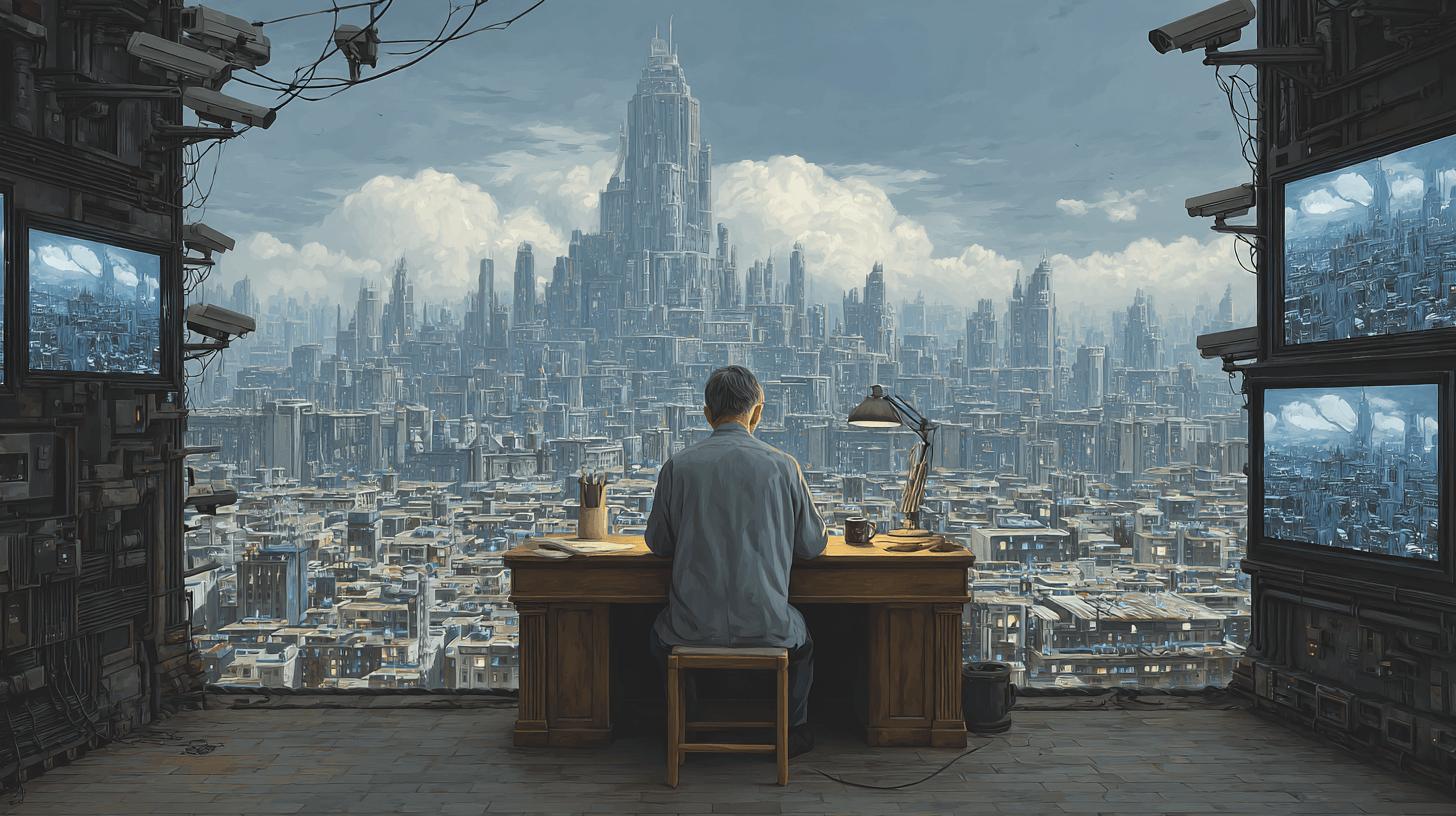
Nineteen Eighty-Four, published in 1949, imagines Britain absorbed into a superstate called Oceania, ruled by a party whose leader, Big Brother, is never seen but always watched for. Oceania is one of three perpetually warring totalitarian states, governed by an all-controlling Party that has brainwashed the population into unthinking obedience. The novel is often remembered for its gadgets, especially the telescreen that watches citizens in their own homes. But the telescreen was never the point. It was a stand-in for something Orwell considered far more dangerous: the deliberate corruption of language and memory.
Consider Newspeak, the Party’s official language, designed to shrink over time until certain thoughts become literally impossible to express. Consider doublethink, the ability to hold two contradictory beliefs and accept both. Consider the Ministry of Truth, whose actual job is to rewrite yesterday’s newspapers so that the Party is never seen to have been wrong.
These are not predictions about future technology. They are descriptions of techniques Orwell had already watched governments use with typewriters, printing presses, and radio. His genius was recognizing that the technique matters more than the tool. Whether a regime alters the past with a pair of scissors and a darkroom or with a database entry, the underlying goal is identical: making it impossible for citizens to trust their own recollection of events.
This is the real reason people keep returning to Orwell during moments of political controversy over misinformation or leaked surveillance programs. He did not foresee any specific device. He identified the enduring logic behind controlling a population, and that logic keeps reappearing in new packaging.
Why the Surveillance Comparisons Keep Recurring
The clearest modern echo of Orwell’s warning arrived in 2013, when the former intelligence contractor Edward Snowden revealed that American intelligence agencies were collecting enormous volumes of phone and internet data on ordinary citizens. In the days after the story broke, sales of Nineteen Eighty-Four on Amazon reportedly jumped by roughly 7,000 percent, and journalists across the world reached for the same word: Orwellian.
The comparison was not simply a marketing coincidence. Orwell’s Oceania depended on the assumption that a letter sent through the mail would be opened as a matter of routine, with citizens expected to behave as though every communication was being read. Snowden’s revelations described intelligence programs built on a similar premise at a civilizational scale: that it was safest to assume communications were being collected as a matter of course, whether or not any individual had done anything wrong.
The parallel is genuinely striking, but it is worth being precise about what it does and does not show. Orwell did not predict data centers, encryption, or cell-tower triangulation. What he predicted was a psychological condition: a society in which people begin to censor their own thoughts because they can never be certain they are unobserved. That condition can be produced by a telescreen in every room or by a smartphone that people carry voluntarily. The technology changed. The underlying dynamic that Orwell identified — the erosion of a private inner life — did not.
It is also worth resisting the temptation to overstate the match. Modern democracies with surveillance programs still maintain independent courts, a free press capable of exposing those programs, and elections that can remove the officials who authorized them. None of those institutions survive in Oceania. The comparison illuminates a real danger. It is not a claim that any contemporary government has become Big Brother’s regime in full.
Animal Farm and the Pattern Behind Every Revolution
Orwell’s other landmark warning, the 1945 fable Animal Farm, works through a different mechanism but arrives at a related insight. In the story, farm animals overthrow their exploitative human owner only to watch the pigs who led the revolution gradually adopt the very privileges they once condemned, until the famous final image shows the animals unable to tell the pigs apart from the humans they replaced.
Orwell was not writing a general warning about ambition. He was responding to a specific, documented pattern: how the Soviet Union’s early revolutionary ideals hardened into a bureaucratic dictatorship under Stalin, complete with purges of former allies and constant revision of official history to erase inconvenient figures. The fable succeeds because it strips away the specific personalities of Soviet politics and exposes the underlying structure — a structure that has repeated in revolutionary movements before and after Stalin, whenever a group that seizes power in the name of equality finds it convenient to reserve certain freedoms for itself.
This is why both books have outlived the twentieth-century crises that inspired them. Orwell was writing about Stalin and Hitler with the tools available to him, but he was describing a mechanism, not a single set of events. Mechanisms repeat. Names change.
What People Commonly Get Wrong About Orwell’s Warning
It is common to hear Nineteen Eighty-Four described as a prophecy of “the surveillance state” as though Orwell were primarily concerned with cameras and wiretaps. That framing undersells the book. Orwell was far more worried about the destruction of objective truth than about surveillance technology itself. Winston Smith’s job at the Ministry of Truth is not to spy on people. It is to alter historical records so that the Party’s past statements always turn out to have been correct. Surveillance in the novel exists mainly to catch anyone who might notice the difference between the falsified record and their own memory.
That distinction matters because it reframes what people should actually watch for. A society can install every camera imaginable and still remain free, provided its citizens retain reliable access to an accurate historical and factual record along with institutions that can check power. A society with far less visible surveillance can drift toward Orwell’s nightmare if it loses the ability to agree on basic facts, or if official narratives can be rewritten faster than the public can verify them. Orwell’s real warning was about epistemic control — control over what counts as true — not merely about being watched.
It is also worth noting that Orwell was a democratic socialist who believed strongly in economic fairness and considered himself politically on the left. He wrote Nineteen Eighty-Four and Animal Farm specifically to warn fellow socialists that totalitarianism was not confined to fascism, and that a revolution carried out in the name of equality could curdle into the same abuses of power it claimed to oppose. Treating him as a partisan mascot for any single side of the modern political spectrum flattens an argument he built to apply across ideologies.
Why the Warning Still Matters
Orwell’s lasting relevance does not rest on any single accurate guess about the future. It rests on the discipline with which he separated the tools of control from the goal of control. Tools change constantly. Typewriters give way to databases, radio gives way to social media, informants give way to algorithms. The goal Orwell identified — making a population unable to trust its own memory and unwilling to think forbidden thoughts — has proven remarkably stable across very different political systems and very different centuries.
That is the real answer to the puzzle this article opened with. Orwell did not predict the future the way a fortune-teller might. He diagnosed a recurring disease in political power, one that had already infected the century he lived through, and he described its symptoms precisely enough that later generations kept recognizing them under new names. Every time his novels resurface during a fresh scandal, it is not because Orwell foresaw that particular scandal. It is because he correctly identified what to look for, regardless of which government, which technology, or which century eventually produced it.
Frequently Asked Questions
Did Orwell actually predict modern technology like smartphones or the internet?
No. Nineteen Eighty-Four imagines a telescreen that watches citizens, but Orwell was extrapolating from radios and television sets already in development during the 1940s, not describing digital networks. His accuracy lies in the social dynamics he identified, not in any specific device.
Was 1984 based on the Soviet Union specifically?
Largely, yes, along with Nazi Germany and Orwell’s own experience of factional propaganda during the Spanish Civil War. Other dictators of the period, including Francisco Franco in Spain and Benito Mussolini in Italy, also shaped the atmosphere behind the novel. Orwell drew on multiple totalitarian systems rather than portraying any single country.
Why did sales of 1984 spike in 2013?
Sales rose sharply after The Guardian published documents from Edward Snowden revealing the scale of NSA surveillance of ordinary communications. Readers turned to the novel because its depiction of pervasive government monitoring felt newly relevant.
Is it fair to call every surveillance program “Orwellian”?
Not always. The term is often applied loosely to any monitoring technology. Orwell’s specific concern was the destruction of an agreed-upon factual record and the psychological effect of assumed constant observation, not surveillance cameras or data collection in isolation.
Was Orwell politically conservative or progressive?
Neither in the modern sense. Orwell identified as a democratic socialist and wrote his major novels partly to warn the political left that totalitarianism could emerge from revolutionary movements as easily as from fascist ones.