Why King Lear Is Shakespeare’s Harshest Verdict on Human Folly
A king asks his three daughters a simple question: how much do you love me? The two who flatter him inherit a kingdom. The one who tells the truth is disinherited on the spot. Within five acts, that single decision will strip an aristocratic father of his crown, his sanity, and everyone he loves.
Shakespeare wrote plenty of tragedies about ambition, jealousy, and indecision. Macbeth wants power too badly. Othello trusts the wrong man too easily. Hamlet cannot bring himself to act. But King Lear is built on something different and, in a way, more ordinary: a father’s vanity, his inability to tell sincerity from performance, and his fury when the truth doesn’t flatter him.
That ordinariness is exactly what makes the play so hard to sit with. Lear’s mistake isn’t a heroic overreach or a tragic passion. It’s a mistake almost anyone could make, and Shakespeare refuses to let the consequences stay proportional to the crime. The central question of King Lear isn’t really “why do bad things happen to a foolish old man.” It’s why Shakespeare chose to make foolishness, rather than villainy, the engine of the worst suffering in his entire body of work.
A Kingdom Divided by a Question
The play opens with an act of political theater disguised as a family ceremony. Lear plans to divide his kingdom among his three daughters before he dies, and he asks each of them to publicly declare how much she loves him. Goneril and Regan, the elder daughters, offer extravagant speeches. Cordelia, the youngest, refuses to compete in a contest of professed affection and says only that she loves him according to her duty, no more and no less.
Lear reacts as though she has betrayed him. He disinherits her immediately, banishes the loyal courtier Kent for defending her, and splits the kingdom between Goneril and Regan instead.
The scene works as tragedy because Lear’s test is designed to reward exactly the wrong quality. Sincerity, by its nature, resists performance. Flattery, by its nature, performs beautifully. A test that measures loudness of declaration will always favor the daughters who don’t mean it over the one who does. Lear built a filter that could only select for exactly the people who would eventually destroy him.
The World That Shaped the Play
Shakespeare did not invent the story. He drew on the legend of Leir, a pre-Roman British king recorded in Raphael Holinshed’s Chronicles, and likely knew an earlier stage version simply called King Leir. In those older tellings, the story ends happily: Cordelia’s side wins, and the wronged king is restored to his throne.
For the Gloucester subplot, in which the Earl of Gloucester is deceived by his illegitimate son Edmund into disinheriting his legitimate son Edgar, Shakespeare adapted an episode from Sir Philip Sidney’s prose romance Arcadia. Scholars generally date the play to around 1605 or 1606; it was recorded as performed at the royal court on December 26, 1606, and first printed in 1608.
What makes Shakespeare’s version distinctive is not the plot but the ending. He took a story that traditionally rewarded virtue and rewrote it so that virtue offers no protection at all.
Two Fathers, One Mistake
The Gloucester subplot exists to make sure the audience cannot mistake Lear’s error for a personal quirk. Gloucester makes almost exactly the same mistake as Lear, and he makes it for almost exactly the same reason.
Edmund, embittered by his status as an illegitimate son with no legal claim to his father’s title, forges a letter suggesting that his legitimate half-brother Edgar is plotting against Gloucester’s life. Gloucester believes it instantly, without asking Edgar for an explanation, and turns against the son who has never given him reason for suspicion.
Both fathers, in other words, choose a fabricated version of loyalty over an inconvenient real one. Both are undone not by an external enemy but by their own inability to distinguish a convincing performance from the truth. Shakespeare doubles the plot because a single instance might read as one man’s personal failing. Two instances read as something closer to a diagnosis of how power listens.
Gloucester’s punishment is the play’s most literal statement of its theme: he is blinded on stage by Regan’s husband, Cornwall, after his loyalty to Lear is discovered. A man who could not see the truth when he had his eyes is stripped of his eyes entirely, and only then, wandering blind, begins to understand what actually happened.
The Storm That Strips Everything Away
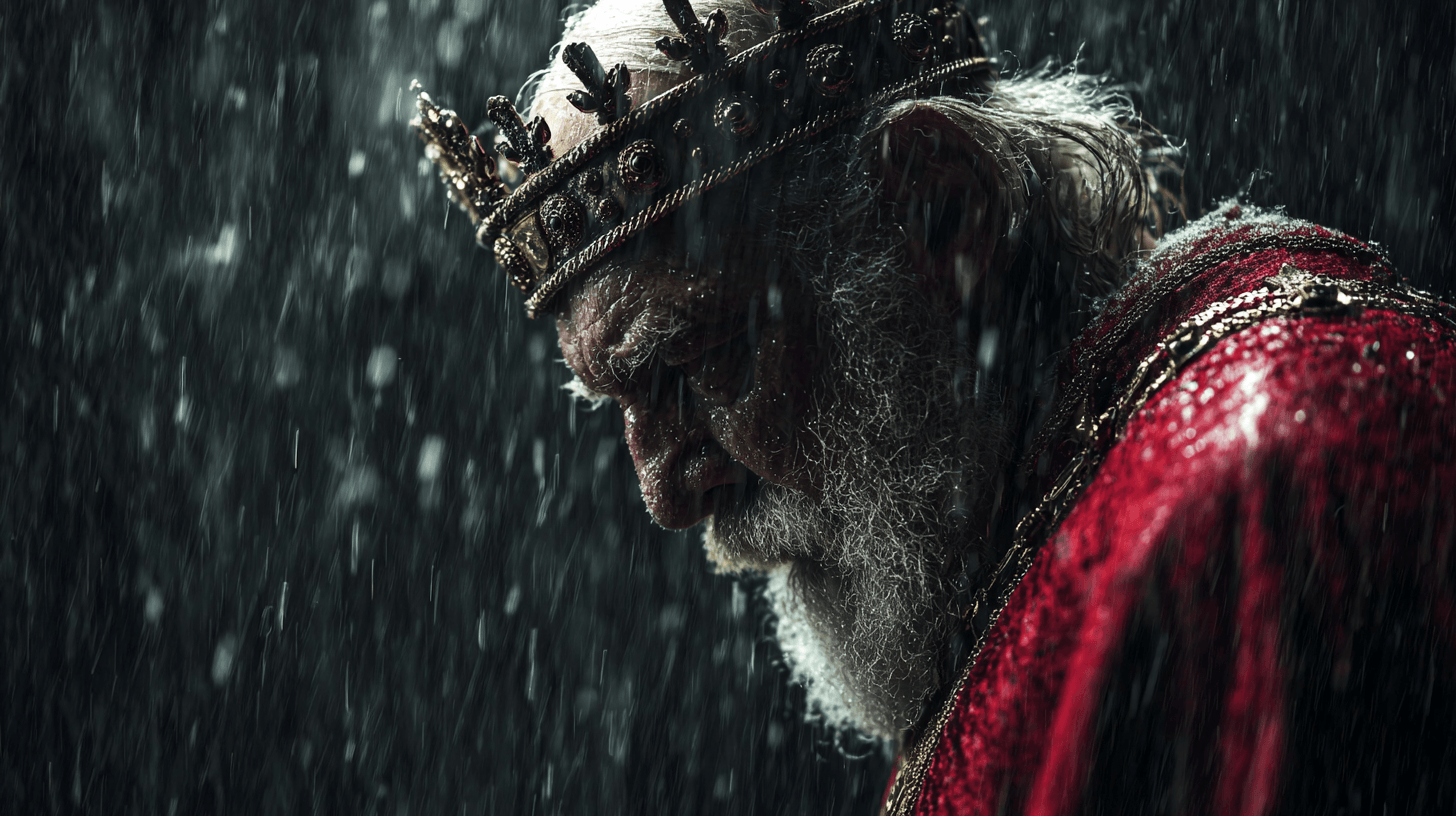
Once Goneril and Regan turn on their father, stripping away his remaining knights and his ceremonial authority, Lear walks out into a violent storm rather than submit. It is one of the most famous scenes in English drama, and it is not primarily about weather.
On the heath, Lear meets Edgar, who is disguised as a mad beggar named Poor Tom to escape his father’s men. Confronted with what looks like a human being reduced to nothing, Lear has a realization that unravels his understanding of his own identity: without titles, land, servants, and flattery, a king is only “unaccommodated man,” a “poor, bare, forked animal” like anyone else.
This is the moment the play’s central idea becomes explicit. Lear’s earlier catastrophe was mistaking performance for truth. Now, having lost every external marker of who he is supposed to be, he begins to see what remains once performance is impossible. The storm does not create his insight. It removes the layers that had been hiding it.
Lear did not lose his mind because he lost his kingdom. He lost his mind because he could no longer keep pretending that the kingdom had ever told him who he was.
Wisdom Wearing a Fool’s Coat
Shakespeare surrounds Lear with characters whose job is to say true things in ways that don’t sound like advice. His court Fool, who accompanies him after the disinheritance, mocks Lear’s decision relentlessly, comparing him to an egg that has given away its shell. Kent, banished for speaking honestly, disguises himself as a servant so he can keep protecting the king who exiled him.
Both figures occupy a familiar Shakespearean role: characters licensed to tell the truth precisely because no one takes them seriously. A court Fool can call a king an idiot in ways a nobleman never could, because his words are filed under entertainment rather than counsel.
The irony sharpens as the play continues. Lear, once he begins to lose his grip on sanity, starts speaking with a clarity he never had while sane. His mad ramblings about justice, authority, and the corruption of judges cut closer to the truth than anything he said while fully in command of his kingdom. Shakespeare seems to be arguing that social position doesn’t just fail to guarantee wisdom. It can actively prevent it, by insulating the powerful from anyone willing to contradict them.
Why Shakespeare Refused a Happy Ending
The final act is where King Lear separates itself most sharply from Shakespeare’s other tragedies. Cordelia returns from France with an army to rescue her father, and for a moment it looks as though the story might correct itself: father and daughter are reconciled, and the play’s clearest instance of undeserved suffering seems ready to end.
Instead, Cordelia’s forces lose. She is captured and, on Edmund’s secret order, executed by hanging. Lear enters carrying her body and dies of grief moments later, having briefly believed she might still be breathing.
There is no equivalent moment of this kind anywhere else in Shakespeare’s major tragedies. Hamlet dies having exposed Claudius’s crime. Othello dies having recognized his own catastrophic error. Even Macbeth’s death restores order to Scotland. King Lear denies its audience that consolation entirely: the one character who never lied, never flattered, and never schemed is killed almost as an afterthought, after the plot’s main villains have already been defeated.
The response to this ending has never been simple. Samuel Johnson, the 18th-century critic and lexicographer, wrote that he found Cordelia’s death so distressing that he could hardly bear to reread the closing scenes when preparing his edition of the play. For roughly a century and a half, English audiences agreed with him strongly enough that theaters staged Nahum Tate’s 1681 adaptation instead, in which Cordelia survives and marries Edgar. Shakespeare’s original ending was not fully restored to the English stage until the 19th century.
Modern criticism has generally read that refusal to soften the ending as the play’s central achievement rather than a flaw. The 20th-century Polish critic Jan Kott famously compared King Lear to the bleak, meaning-starved theater of Samuel Beckett, arguing that Shakespeare had written a vision of the universe in which suffering carries no guarantee of moral order. Cordelia’s death isn’t a plot failure. It’s the play’s argument, delivered in the bluntest possible terms: goodness does not protect you from a world run by people who cannot recognize it.
What Popular Memory Gets Wrong
King Lear is often remembered as a simple story about ungrateful children, with Goneril and Regan cast as villains and their father as an innocent victim of their cruelty. The play doesn’t actually support that reading.
Lear’s opening decision is not a minor misjudgment corrected by fate. It is the initiating cause of everything that follows, and the play repeatedly forces its characters, and its audience, to reckon with that fact. Kent tells Lear directly, in the very first scene, that he is making a catastrophic error. Lear’s response is to banish him. The tragedy does not begin when Goneril and Regan turn cruel. It begins the moment Lear rewards flattery and punishes honesty, creating exactly the conditions that made their cruelty possible.
It’s also worth separating the play from a common modern assumption: that King Lear is essentially a study of aging or cognitive decline. Lear’s mental unraveling is a major thread of the play, but Shakespeare frames it as a consequence of humiliation, betrayal, and loss rather than a portrait of old age itself. The play is less interested in what happens to an aging mind than in what happens to a mind that built its entire sense of self on titles and obedience, and then watched both disappear.
Why the Play Still Unsettles Audiences
King Lear has remained one of Shakespeare’s most frequently reinterpreted plays partly because its central problem hasn’t gone away. Every institution that relies on people telling their leaders what they want to hear is vulnerable to some version of Lear’s mistake: rewarding the confident performance of loyalty over its substance, and punishing the people willing to say something inconvenient.
The play is also unusually direct about a fact most tragedies prefer to soften: virtue is not rewarded by the universe, and the people who behave honorably are not protected from the people who don’t. Shakespeare’s other tragic heroes tend to die having learned something that restores a sense of order to their world. Lear dies having learned the truth about his daughters only after it can no longer help either of them.
That refusal to comfort the audience is precisely why the play has outlasted easier, gentler versions of its own story. Shakespeare had a happy ending sitting in the legend he was adapting, and he took it out. What he left in its place is harder to watch, harder to forget, and, three centuries of critics have concluded, considerably closer to how power actually tends to behave.
Frequently Asked Questions
Is King Lear based on a true story?
No. Lear is a legendary figure recorded in medieval British chronicles, not a historical king with independent documentary evidence. Shakespeare adapted the legend from Holinshed’s Chronicles and likely an earlier play on the same subject.
Why does Cordelia die at the end?
Shakespeare departed from earlier, happier versions of the Lear legend by having Cordelia executed just before she could be rescued. Most modern critics read this as a deliberate refusal to offer moral consolation, reinforcing the play’s argument that goodness offers no guaranteed protection.
What is the significance of the storm scene?
The storm strips Lear of the last comforts of his royal status and forces him to confront his own vulnerability as “unaccommodated man.” It marks the turning point where his suffering begins to produce genuine insight rather than simple despair.
Why is Gloucester blinded in the play?
Gloucester’s blinding literalizes the play’s recurring theme of failing to see the truth. He is punished physically for the same error Lear makes politically: trusting a convincing lie over an unwelcome truth.
Did audiences always accept the tragic ending?
No. From 1681 until the early 19th century, English theaters largely staged Nahum Tate’s adaptation, which gave the play a happy ending with Cordelia surviving. Shakespeare’s original tragic conclusion was gradually restored to the stage over the course of the 1800s.