How the Mona Lisa Became the World’s Most Mysterious Painting
On the morning of August 22, 1911, a Louvre employee named Louis Béroud arrived to sketch the Mona Lisa and found only four iron pegs on the wall. The painting was gone. It took police a full day to confirm what seemed unthinkable: the most famous portrait in the world had been stolen in broad daylight, from one of the most visited museums on Earth.
What is stranger still is that the Mona Lisa was not, at that point, universally considered Leonardo da Vinci’s greatest work. It was admired, certainly, but so were several other Renaissance portraits. The theft changed that. Newspapers across Europe and the United States ran the story for weeks, and a small oil panel that had spent nearly four centuries as one respected painting among many became something closer to a global icon.
That transformation raises a real question, one that goes beyond art history: why this painting? Why did a portrait of a Florentine merchant’s wife, painted by an artist who never delivered it to its original patron, end up defining what people mean when they say a work of art is mysterious?
The answer is not a single secret hidden in the paint. It is a layered history in which Leonardo’s own technical choices, a nineteenth-century shift in taste, a sensational crime, and a century of imitation and parody all reinforced one another. Understanding how those pieces fit together explains far more about the painting’s fame than any single theory about hidden codes or secret meanings ever could.
The Portrait Before the Myth
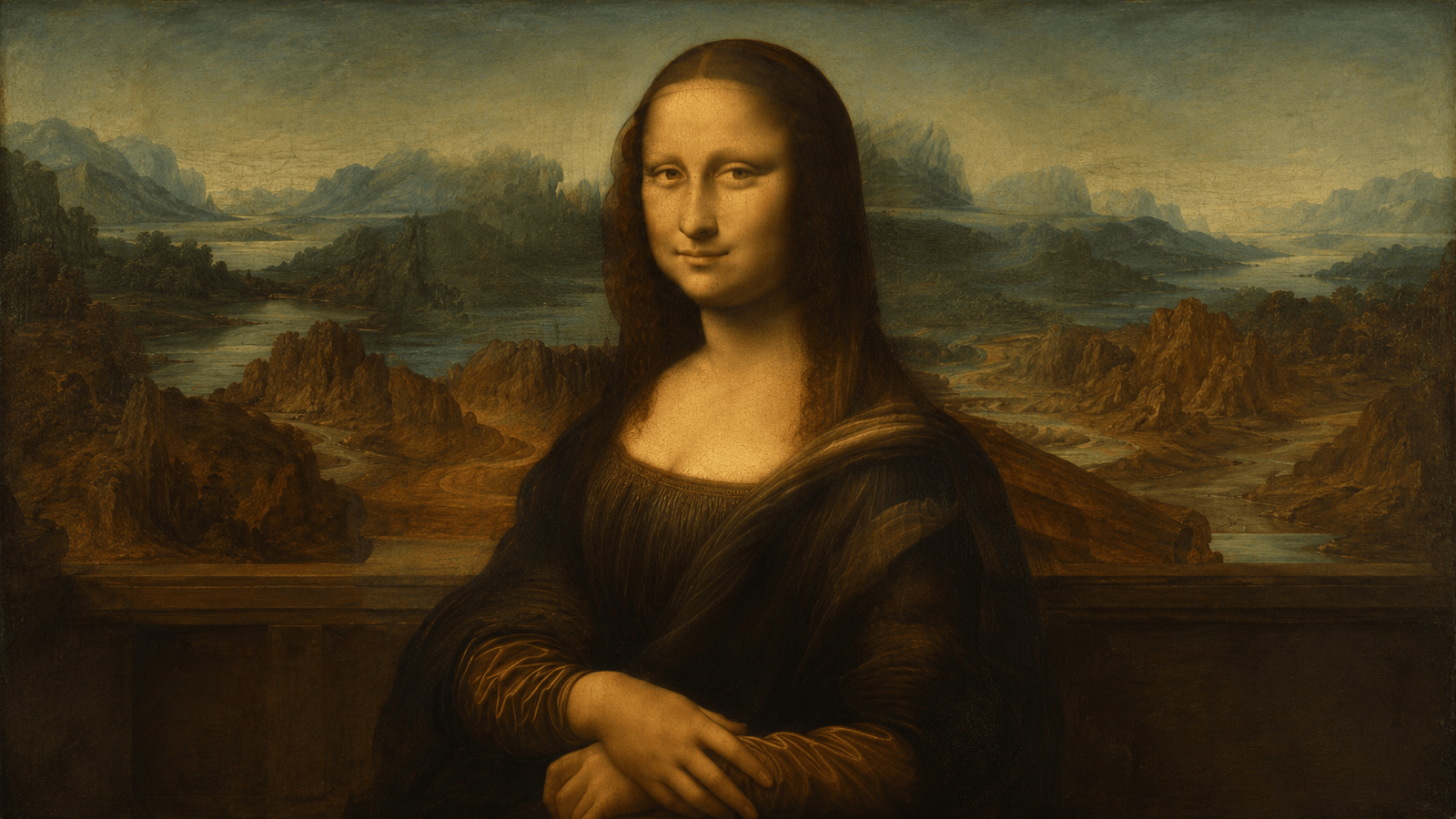
Leonardo began the painting around 1503, most likely in Florence, and continued adjusting it for years, possibly until shortly before his death in 1519. The sitter is widely identified as Lisa Gherardini, the wife of a Florentine silk merchant named Francesco del Giocondo. This is why Italians call the painting La Gioconda and the French call it La Joconde — both puns on the family name and on the Italian word for “cheerful.”
That identification was not fully confirmed until 2005, when a German researcher discovered a marginal note written in 1503 by a Florentine official named Agostino Vespucci, describing Leonardo’s work on a portrait of Lisa del Giocondo. Before that discovery, some historians had proposed other candidates, including Isabella of Aragon and even Leonardo’s own mother. Most specialists now treat the Gherardini identification as strongly supported, though a handful of alternative theories persist in popular writing.
What matters more than the sitter’s identity is what Leonardo did with an otherwise conventional commission. Florentine merchant portraits followed a predictable formula: a woman shown in profile or near-profile, dressed to display her family’s wealth, her expression composed and unremarkable. Leonardo abandoned nearly all of it. He turned the sitter almost fully toward the viewer, set her against an imagined, atmospheric landscape rather than a wall or curtain, and gave her an expression that refuses to resolve into a single, readable emotion.
A Technique Built on Ambiguity
Leonardo’s central innovation was technical, not symbolic. He developed a method called sfumato — from the Italian word for “smoky” — in which he blended color and tone so gradually that no hard line marks the transition from light to shadow, or from one feature to another. Applied to a face, this technique removes the sharp contours that normally tell a viewer exactly what an expression is doing.
The effect is most visible at the corners of the mouth and eyes, the very places human vision relies on most to read emotion. Because Leonardo softened those edges into shadow rather than defining them with a clear line, the mouth appears to shift slightly depending on where the viewer looks. Focus directly on the lips, and the smile can seem to fade. Let your eyes drift slightly upward or to the sides, and it can seem to return. This is a known property of peripheral vision, which processes shadow and contrast differently than direct focus does. Leonardo, who studied optics and anatomy closely enough to fill notebooks with diagrams of the eye, appears to have understood this effect and used it deliberately.
The result is a face that behaves less like a fixed image and more like an expression caught mid-change. That quality — not any concealed message in the brushwork — is the real technical source of the painting’s famous ambiguity.
The Smile Debated for Centuries
Long before the painting became a global celebrity, its expression was already unsettling viewers. Giorgio Vasari, writing about Leonardo in 1550, described the portrait’s smile as so lifelike that it seemed more divine than human — though Vasari almost certainly never saw the actual painting and was likely repeating secondhand accounts, a reminder that even early descriptions of the work were shaped by reputation as much as observation.
By the nineteenth century, writers had turned that ambiguity into something closer to a psychological puzzle. The English critic Walter Pater, in an influential 1873 essay, described the sitter as a figure who seemed to carry the accumulated experience of centuries within her expression. Pater’s writing had little to do with Leonardo’s actual intentions, but it helped establish a new way of looking at the painting — not as a well-executed portrait, but as a woman who appeared to know something the viewer did not.
This is worth pausing on, because it marks a real turning point. The painting’s reputation for mystery was substantially built by nineteenth-century critics and poets responding to Leonardo’s technique, centuries after it was painted. The Mona Lisa did not arrive in the world already mysterious. It became mysterious partly because later writers decided to read it that way.
The Theft That Made It Famous Worldwide
The 1911 theft did more to build the painting’s global fame than any critical essay could. The thief was Vincenzo Peruggia, an Italian handyman who had briefly worked at the Louvre building protective glass cases for its most valuable paintings. He hid inside the museum overnight, removed the panel from its frame the next morning, and walked out with it concealed under his coat.
For over two years, the painting’s whereabouts were unknown. Pablo Picasso and the poet Guillaume Apollinaire were both briefly questioned by French police, an episode that only added to the sensational coverage. Newspapers speculated wildly, reproducing the image again and again so that readers who had never visited the Louvre came to recognize the Mona Lisa on sight. Peruggia was eventually caught in Florence in 1913, after he attempted to sell the painting to a gallery director, apparently believing he was returning Renaissance art to its rightful home in Italy.
The recovery was celebrated across Italy and covered heavily in France, and the painting toured briefly before returning to the Louvre. By the time it was back on the wall, it had become something it had not quite been before: a painting whose absence had made international news, and whose face was now familiar to millions of people who had never studied art history at all.
A Painting Attacked, Copied, and Argued Over
Fame of that scale invites both reverence and provocation, and the Mona Lisa has drawn plenty of the second kind. In 1919, the Dadaist artist Marcel Duchamp added a mustache and goatee to a cheap reproduction, along with a title that reads as a crude pun when spoken aloud in French. The gesture mocked the reverence surrounding the painting, but it also confirmed how deeply recognizable the image had already become — the joke only worked because everyone already knew the face being altered.
The painting has also survived physical attacks, including a 1956 acid assault that damaged the lower section and a separate incident the same year in which a visitor threw a rock at it, chipping paint near the sitter’s elbow. These events led the Louvre to place the painting behind reinforced, climate-controlled glass, which is why visitors today view it from behind a barrier and a thick pane rather than at close range.
Each of these episodes — the parody, the vandalism, the protective glass — reinforced the same pattern. The more precious and famous the painting became, the more it attracted attention, and the more that attention confirmed its status. Fame, in this case, fed itself.
What Popular Memory Gets Wrong
Modern popular culture has added a layer of mystery that has little to do with the actual painting. Books and films have proposed hidden codes, secret self-portraits, and concealed symbols embedded in the brushwork. These claims make for entertaining fiction, but art historians and conservators who have studied the panel closely, including through infrared and X-ray imaging, have found no evidence supporting them. The painting’s genuine ambiguity comes from Leonardo’s optical technique and centuries of accumulated interpretation, not from a puzzle waiting to be decoded.
It is also a common misconception that the Mona Lisa was always considered Leonardo’s masterpiece. For much of its history, works such as The Last Supper were more widely discussed by critics and more frequently copied by other artists. The Mona Lisa‘s current status as the single most famous painting in the world is a relatively recent development, shaped as much by nineteenth-century criticism and twentieth-century media events as by its original reception in Renaissance Florence.
Why the Mystery Persists
None of this diminishes Leonardo’s achievement. If anything, it clarifies what that achievement actually was. He built a genuine technical ambiguity into the human face, one that later viewers were free to fill with their own interpretations. A theft turned that ambiguous face into an international sensation. Critics, artists, and provocateurs each added another layer of meaning on top of it, until the painting carried far more cultural weight than its paint and wood panel could ever hold on their own.
The Mona Lisa endures not because it hides an answer, but because it was built, quite literally, never to give one. Every viewer who leans in to catch the smile is repeating an experiment in perception that Leonardo appears to have designed five hundred years ago, and that a Parisian crime, a Dadaist joke, and a century of retelling have made impossible to ignore.
That, more than any hidden code, is the real mystery worth understanding: not what the painting is hiding, but how much of its meaning the world built onto it after Leonardo had already put down his brush.