Why American Gothic Isn’t the Satire Most People Think It Is
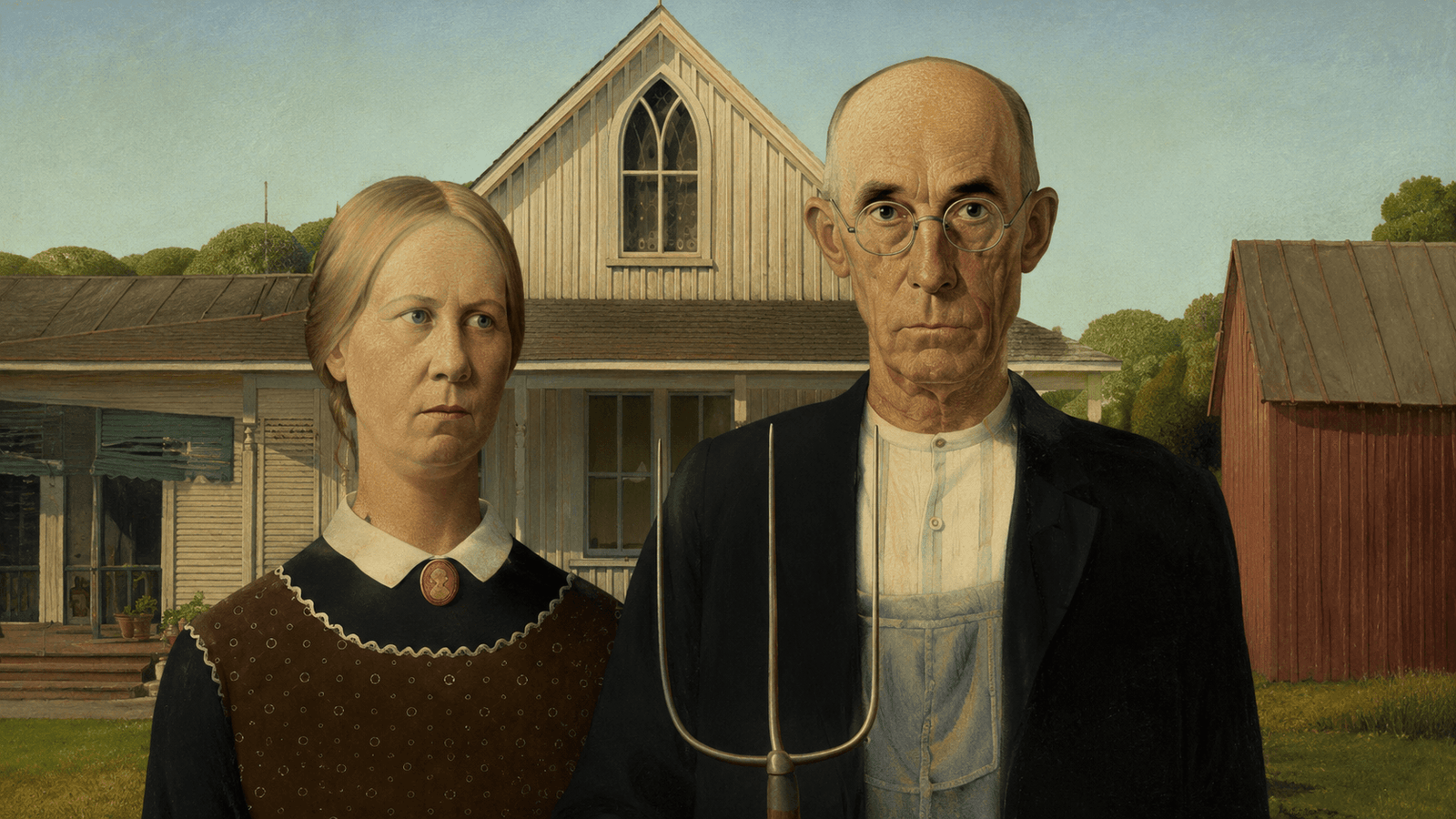
For nearly a century, one painting has stood as the visual shorthand for small-town American life: a stern farmer, pitchfork in hand, standing beside a woman in a high-collared apron, both frozen in front of a plain white farmhouse. It has been reproduced on magnets, greeting cards, and magazine covers. It has been parodied with politicians, cartoon characters, and celebrities standing in for the original pair. Almost everyone assumes they know what Grant Wood’s American Gothic is making fun of.
The trouble is that Wood spent much of his life insisting they were wrong.
The painting that most viewers read as a sly dig at rigid, humorless Midwesterners was, according to its own creator, meant as something closer to a compliment. That gap between what people see and what the artist claimed he intended is not a footnote to the painting’s history. It is the real subject of this article, because understanding that gap explains why American Gothic has remained impossible to pin down for almost one hundred years.
The House That Started Everything
In August 1930, Grant Wood, a painter and teacher from Cedar Rapids, Iowa, drove through the small town of Eldon while visiting a friend. There he spotted a modest white farmhouse built in a style known as Carpenter Gothic, a rural American adaptation of the ornate Gothic Revival architecture popular in wealthier homes. Its distinguishing feature was a narrow, pointed window set into the upper gable, an echo of the arched windows found in Gothic cathedrals, scaled down to fit a simple wood-frame house.
Wood was struck by the house’s peculiar combination of high-minded architectural ambition and small-town plainness. He later said he imagined the kind of people who might live inside it: figures shaped by hard work, thrift, and old-fashioned religious rectitude. He made a quick sketch of the house, then returned home to build a painting around it, using the models available to him rather than professional actors or paid strangers.
The Two People Behind the Painting
The woman in the painting was Wood’s own sister, Nan Wood Graham. The man was Wood’s dentist, Dr. Byron McKeeby. Neither posed alongside the house itself; Wood painted them separately in his studio, dressed in clothing chosen to evoke an earlier generation.
Wood described the effect he wanted as resembling old family photographs, or as he put it, tintypes pulled from a family album. That detail matters, because it suggests Wood was not attempting documentary realism. He was constructing a composite image of an imagined American past, using real people to stand in for a type rather than individuals he intended to mock.
He was also careful, later in his career, to clarify the relationship between the two figures. Many early viewers assumed they were husband and wife. Wood maintained they were meant to be father and daughter, a distinction that changes the painting’s emotional register considerably. A stern husband glaring beside a rigid wife reads as marital tension or patriarchal control. A father standing protectively beside an unmarried daughter reads as something closer to guardianship.
A Movement Built on Rejecting Europe
To understand why Wood chose this subject at all, it helps to know what he was reacting against. In the 1920s, ambitious American painters were expected to study in Paris and absorb European modernism: Cubism, Surrealism, abstraction. Wood did exactly that early in his career, spending time in Europe and experimenting with Impressionist techniques.
By the end of the decade, he had reversed course. Alongside painters like Thomas Hart Benton and John Steuart Curry, Wood became a leading figure in a movement historians call Regionalism, which rejected European abstraction in favor of clearly rendered scenes of American rural and small-town life. Regionalists believed that authentic American art should come from American subjects: farmland, Main Street, the people who worked the land rather than the salons of Paris.
American Gothic was, in this sense, a statement of artistic identity as much as a portrait. Wood was not simply painting two Iowans. He was arguing that Iowa itself was worth painting seriously, at a moment when serious painting was assumed to require a European education and a European subject.
Why Iowans Felt Insulted
When Wood submitted the painting to a competition at the Art Institute of Chicago in 1930, it won an honorable mention and a $300 prize, a meaningful sum during the early years of the Great Depression. The museum purchased the work, and newspapers across the country quickly reprinted it. Within weeks, American Gothic had gone from an unknown regional entry to a genuine national sensation.
That sudden fame produced an immediate backlash, and it came from the very people Wood claimed to be honoring. Many Iowans were offended. They saw in the painting a caricature: two grim, joyless figures who seemed to confirm every coastal stereotype about a backward, puritanical Midwest cut off from modern life. Some accused Wood of mocking his own neighbors for a wider audience’s amusement, trading his community’s dignity for national attention.
This reaction reveals something important about how satire works. A satirical image does not need its creator’s confirmation to function as satire in the eyes of its audience. If enough viewers read cruelty into a picture, that reading becomes part of the picture’s life regardless of what the artist intended. Wood now faced a public relations problem entirely of his own unintentional making.
What Wood Actually Said He Meant
Wood pushed back against the satire label for the rest of his career, though not always consistently. He described his subjects as good, solid people, the kind of resilient Midwesterners he believed had been unfairly dismissed by East Coast critics and European-trained artists. In 1935, he published an essay titled “Revolt Against the City,” which argued that American culture had wrongly concluded that only urban, cosmopolitan life deserved artistic attention, and that the rural Midwest held its own kind of value worth celebrating.
Read against that essay, American Gothic looks less like mockery and more like a corrective: an attempt to give unglamorous, hardworking rural Americans the same formal seriousness that European portraiture had always reserved for aristocrats and clergy. The painting’s severe, upright composition, some art historians argue, was meant to dignify its subjects rather than ridicule them.
Wood, however, never fully closed the door on the other reading. Late in his life, he offered a more complicated answer when pressed on the question, allowing that there is satire in it, but only as there is satire in any realistic statement. That single sentence captures the painting’s real difficulty. Wood wanted credit for sincerity while conceding that unflinching realism can look like mockery even when none was intended.
The Great Depression Changed How People Saw It
Timing shaped the painting’s reputation almost as much as its content did. American Gothic was completed in the same year the Great Depression began tightening its grip on American life. As banks failed and unemployment climbed through the early 1930s, the qualities that had initially struck viewers as grim and repressive, thrift, endurance, unglamorous labor, began to look like virtues rather than flaws.
The same stiff, unsmiling couple that had seemed like a caricature in 1930 could be reread, a few years later, as a picture of quiet resilience. Farmers who had weathered hard times before were exactly the kind of people the country now needed to admire. The painting did not change. The country around it did, and that shift in circumstance did more to soften the painting’s reputation than any explanation Wood ever gave.
What Popular Memory Gets Wrong
The common assumption today is that American Gothic is settled history: a straightforward satire of narrow-minded rural conservatism, the visual equivalent of a joke about hayseeds and Sunday-best rigidity. That assumption is too tidy. Serious art historians remain genuinely divided, and prominent contemporaries were divided from the very beginning. The writer Gertrude Stein, upon seeing the painting, reportedly called it a work of devastating satire, so effective that she believed every artist should fear Wood’s talent for it. Wood’s own defenders, by contrast, point to his essays and interviews as evidence of sincere regional pride.
Part of what keeps the debate alive is the painting’s formal construction. Wood deliberately elongated and thinned both figures’ faces to echo the sharp vertical lines of the gothic window behind them, a technique that creates a subtle sense of visual tension. That choice can be read two ways. It could be an aesthetic device meant to unify the composition, tying human figures to their architectural setting through pure formal harmony. It could also be read as a way of making the figures look slightly inhuman, stretched and severe in a manner that quietly undercuts any claim to warmth. Wood likely intended the former. Many viewers have always felt the latter.
Why the Ambiguity Is the Point
This is ultimately why the question “what does American Gothic satirize” may be less useful than it first appears. The painting endures not because it delivers a clear verdict on rural America, but because it refuses to. It sits at the exact midpoint between admiration and unease, and different generations of viewers have leaned toward whichever side matched their own feelings about small-town life at the time.
That flexibility explains the painting’s enormous afterlife in parody. An image that clearly mocked its subjects would eventually feel dated, tied to a specific joke about a specific decade. An image that holds two contradictory meanings at once, sincerity and suspicion, dignity and rigidity, stays available for reinterpretation indefinitely. Every parody that swaps in new faces is really asking the same original question again: are we looking at people worth respecting, or people worth laughing at? The painting has never told us which, and that may be exactly why it has never stopped being useful.
American Gothic did not simply capture a couple standing in front of a farmhouse. It captured America’s unresolved argument with itself about what rural life actually meant, an argument that was already underway in 1930 and, in different forms, has never really ended.