The Night Boston Lost Half a Billion Dollars in Art
It was 1:24 a.m. on March 18, 1990, and Boston was still recovering from a night of St. Patrick’s Day parties when two men in police uniforms rang the side entrance of the Isabella Stewart Gardner Museum. They told the night guard they were responding to a disturbance call. The guard, breaking protocol, buzzed them in.
Eighty-one minutes later, the men walked out with thirteen works of art, cut some of them straight out of their frames, and vanished into the Boston night. Among the missing pieces were a Vermeer, three Rembrandts, and five Degas drawings. More than three decades later, not one has resurfaced, no one has ever been charged, and the case remains the largest unsolved art theft in world history, with the stolen works now valued at roughly $500 million.
The mystery isn’t just what happened to the paintings. It’s how a museum built by one of America’s most exacting collectors, a woman who insisted every object in her house-turned-museum stay exactly where she placed it, became the site of the art world’s greatest unsolved crime. Understanding why requires looking at the museum itself, the two strange hours of the robbery, and the decades of investigation that followed without ever reaching an ending.
A Museum Built to Never Change
Isabella Stewart Gardner was not a typical Gilded Age philanthropist. Rather than donating her art collection to an existing institution, she built her own museum inside a Venetian-style palazzo in Boston’s Fenway neighborhood, arranging paintings, sculptures, and tapestries in room-by-room compositions she designed herself. When the museum opened in 1903, she stipulated in her will that the collection remain permanently arranged exactly as she left it. Move a single object, and by the terms of her bequest, the museum could be forced to auction the entire collection and give the proceeds to Harvard.
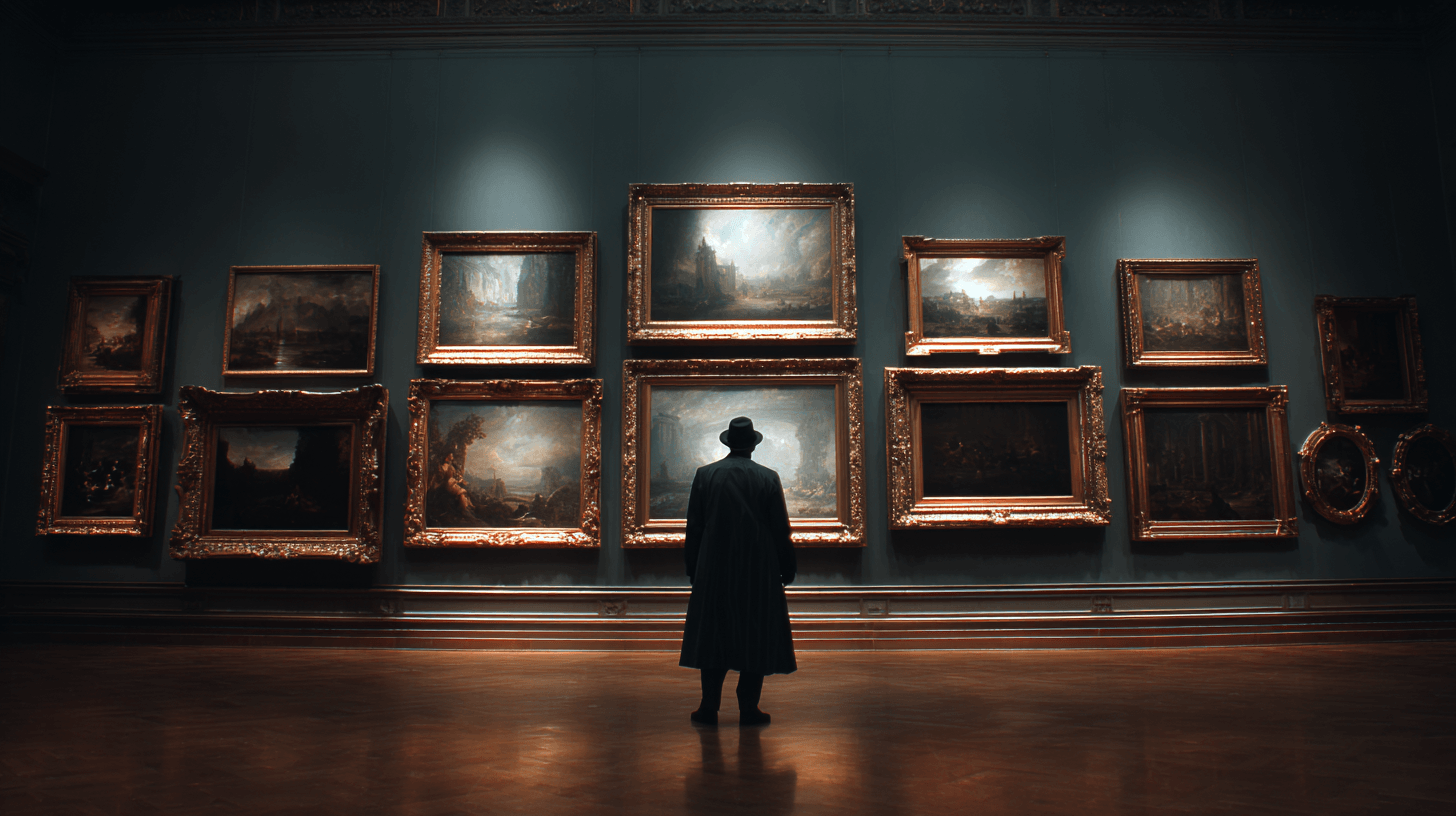
That obsession with permanence is precisely why empty frames still hang on the Gardner’s walls today. The museum cannot rearrange its galleries to disguise the gaps left by the theft, so the absence of the stolen works has become part of the museum’s identity, a daily reminder of what vanished.
By 1990, though, the institution guarding Gardner’s legacy had grown financially threadbare. Security director requests for better-paid, more qualified guards had been turned down by the board. The guards on duty earned barely above minimum wage, and among Boston’s criminal underworld, the museum’s lax security was reportedly something of an open secret.
Eighty-One Minutes
The two thieves knew what they were doing, at least at first. Claiming to investigate a disturbance, they persuaded the guard to let them through a side door, then lured him away from the only alarm button in the building. Once both guards were separated from any way of calling for help, the thieves handcuffed them and duct-taped them to a pipe and a workbench in the basement, informing them, “Gentlemen, this is a robbery.” The men then bound their victims and left them there for the rest of the night. Smithsonian Magazine
What happened over the next eighty-one minutes is where the professionalism of the crime starts to look uneven. The thieves moved through the museum’s Dutch Room and took Vermeer’s The Concert, one of only three dozen surviving Vermeer paintings in the world, along with Rembrandt’s only known seascape, The Storm on the Sea of Galilee, and his small self-portrait etching. They also removed five Degas drawings, a Manet, and a handful of decorative objects, including a Chinese bronze beaker and the finial from a Napoleonic flag.
Yet rather than carefully unhooking the paintings, the thieves sliced several of them out of their frames with a blade, damaging the canvases in the process. They ignored other works nearby that were, by most estimates, considerably more valuable, including a Titian widely regarded as one of the collection’s masterpieces. They also stole the museum’s security videotape but somehow left behind the motion-detector log, which recorded their exact movements through the building, room by room, for investigators to study later.
That contradiction, part meticulous plan and part clumsy improvisation, is one of the central puzzles that has shaped nearly every theory about who committed the crime.
Why the Case Went Cold So Fast
Art theft investigations rely heavily on one basic economic fact: stolen masterpieces are almost impossible to sell. A Vermeer or a Rembrandt is too recognizable to move through any legitimate auction house, and most reputable buyers won’t touch a piece with a well-documented, headline-making theft attached to it. This is precisely why the vast majority of high-value art thefts are eventually solved, either the paintings surface in a ransom negotiation, or the thieves are caught trying to sell them to undercover agents posing as buyers.
The Gardner case broke that pattern almost immediately. No ransom note ever arrived. No credible offer to sell the paintings ever materialized on the black market in a way investigators could act on. Whoever took the works either understood from the start that they were essentially unsellable and never intended to profit directly, or they lost control of the paintings soon after the theft, passing them to people who had no idea what to do with something so valuable and so radioactive.
Investigators have spent decades chasing the second possibility. FBI agent Geoff Kelly and Gardner security chief Anthony Amore, who has led the museum’s side of the investigation since 2005, have pursued leads connecting the theft to organized crime networks in Boston, Connecticut, and Philadelphia. In 2013, the FBI announced it had identified the likely thieves, tying the crime to a criminal organization with New England connections, but declined to name them publicly, citing the ongoing investigation and the statute of limitations complications that come with a case this old.
The Suspects Who Can Never Talk
Nearly every theory about the Gardner heist eventually runs into the same wall: the people investigators consider most likely to have known what happened are dead. Several men connected to organized crime figures in Boston and Connecticut, men with documented histories of art and antiques theft, have died over the years without ever being charged. Whatever knowledge they carried about the paintings’ fate died with them.
One of the stranger threads in the investigation involves Robert Gentile, an elderly Connecticut mobster who, according to court filings, was recorded discussing the paintings’ value with an informant and reportedly offered to sell some of the stolen works to an undercover agent. Gentile denied any knowledge of the theft’s specifics and was never charged in connection with the case; he served time on unrelated firearms charges and died in 2021, maintaining he had no information about where the art had gone.
Other theories have connected the crime to Irish organized crime networks, to a getaway car reportedly seen near the museum, and even, more speculatively, to funding schemes for paramilitary groups. None of these threads has ever produced a painting.
What Popular Memory Gets Wrong
A common assumption about the Gardner heist is that it must have been an inside job orchestrated by professional art thieves working for a wealthy private collector who wanted the paintings for personal enjoyment. It’s a compelling image, a criminal mastermind admiring a stolen Vermeer in a hidden room. But investigators who have spent decades on the case describe this scenario as one of the least likely explanations.
The physical evidence, paintings crudely sliced from frames, expensive works ignored in favor of less valuable ones, points instead toward thieves with more ambition than expertise, men who may have expected to ransom the paintings back to the museum or an insurer and never anticipated how radioactive the works would become. The five-hundred-million-dollar valuation attached to the case today reflects the paintings’ market worth, not evidence that anyone involved ever had the connections to realize anything close to that sum.
It’s also worth correcting a common misconception about the reward. The $10 million offered by the Gardner Museum, one of the largest private rewards ever posted for recovered art, is not a bounty for turning in the thieves. It is specifically for information leading to the safe recovery of the artwork itself, no questions asked about who has been holding it or how it got there. The museum has made clear it cares more about getting the paintings back than about prosecuting anyone involved.
A Crime That Outlived Its Trail
The practical obstacle facing investigators today isn’t a lack of interest. Books, documentaries, a Netflix docuseries, and a popular investigative podcast produced by the Boston Globe and public radio station WBUR have kept the case in public view for years, generating a steady stream of tips. The obstacle is time itself. Physical evidence degrades. Memories fade or get reshaped by decades of retelling. And the people closest to the crime, the ones most likely to have handled the paintings in the chaotic weeks after the theft, have largely died without talking.
Even so, art theft experts point out that major stolen artworks have a habit of resurfacing generations after they vanish, sometimes when an estate is settled, sometimes when a low-level criminal tries to use a painting as collateral without understanding what it actually is. The Gardner Museum and the FBI continue to treat the case as active rather than closed, following new tips as they arrive.
Why the Empty Frames Still Matter
The Gardner heist endures in public imagination not simply because of its scale, though half a billion dollars in stolen art is a staggering figure by any measure. It endures because it represents an almost perfect failure of the assumptions institutions make about security, memory, and permanence. Isabella Stewart Gardner built a museum designed never to change, and for nearly ninety years it didn’t. Then, in eighty-one minutes, two men with duct tape and a box cutter proved that even the most carefully preserved collection is only as secure as the guard standing at the door.
The empty frames that still hang in the Dutch Room aren’t decorative. They are the museum keeping its founder’s terms, and a case file, open at the same time. Somewhere, presumably, thirteen works of art still exist. Whether anyone now living knows where is, after more than three decades, the only mystery left to solve.