How the Renaissance Rewired the Rules of Art
In the 1420s, worshippers stepped into the church of Santa Maria Novella in Florence and encountered something that made many of them stop in place. On a flat wall, the painter Masaccio had created a chapel that appeared to open backward into the building, complete with a coffered ceiling receding into the distance and figures standing inside a space that felt physically real. According to accounts written decades later, viewers described the illusion as a hole punched through solid stone. Nothing in the church had moved. The wall was still a wall. But the way it had been painted had changed.
That single fresco, known as the Trinity, captures the central puzzle of the Renaissance in art: how did a relatively small number of painters, sculptors, and architects, working in a handful of Italian cities over roughly two centuries, manage to overturn a thousand years of artistic convention? The answer is not simply that talented people appeared at the same time. It involves mathematics, money, rediscovered ancient texts, professional rivalry, and a changing idea of what a human being actually is.
Understanding why the Renaissance became a genuine revolution, rather than a gradual improvement in style, means looking at what made it possible.
The World Before the Revolution
Medieval European art was not primitive. It was purposeful. Painters and sculptors worked within a visual language built to communicate religious meaning clearly and consistently, not to reproduce the physical world as the eye actually sees it. Figures were often arranged by spiritual importance rather than physical position: a saint might appear larger than a king simply because holiness outranked royalty in the picture’s logic.
Space in medieval painting tended to be flat and symbolic rather than measured. Gold backgrounds signaled the eternal rather than a specific place. Most artists worked anonymously within guild workshops, trained through apprenticeship, and were classified alongside other skilled tradespeople rather than as independent creative thinkers. A painter’s job was to execute a commission according to established conventions, not to express a personal vision.
This system was not broken. It served its purpose well for centuries. But by the early 1400s in central Italy, several forces were converging that would make this older visual language feel, to an influential group of artists and patrons, insufficient.
Florence, Money, and the Hunger for Prestige
Renaissance art did not emerge from artistic inspiration alone. It emerged from a specific economic and political environment: independent city-states, particularly Florence, that had grown wealthy through banking, textiles, and international trade, and that lacked a single unifying monarchy to define cultural authority.
In a monarchy, artistic patronage often flowed from one royal court. In Florence, wealth and political influence were distributed among competing families, guilds, and merchant elites. The Medici family, who built their fortune through banking, used art and architecture as a direct instrument of political legitimacy and civic reputation. Commissioning an impressive chapel, a public sculpture, or a family palace was a way of demonstrating power without a crown.
This created something the medieval system had not: competitive demand for visible artistic innovation. Wealthy families and civic institutions were not merely paying for religious devotion. They were competing with rival families and rival cities for prestige. A guild that funded a strikingly lifelike statue for a public niche was making a public statement about its own importance. Artistic novelty became valuable in a way it had rarely been before, because it now carried social and political weight.
At the same time, the rediscovery and translation of ancient Greek and Roman texts was reshaping how educated Italians understood human achievement. Scholars known as humanists argued that classical antiquity represented a high point of human reason, civic life, and artistic skill that had been buried, not surpassed, by the intervening centuries. Ancient statues and ruins, still visible across Italy, offered direct physical evidence of what that lost civilization had been able to create. Artists were not inventing an idealized human body from nothing. They were looking, often quite literally, at surviving classical sculpture and asking how it had been made.
The Invention of Depth: How Perspective Rewrote the Rules
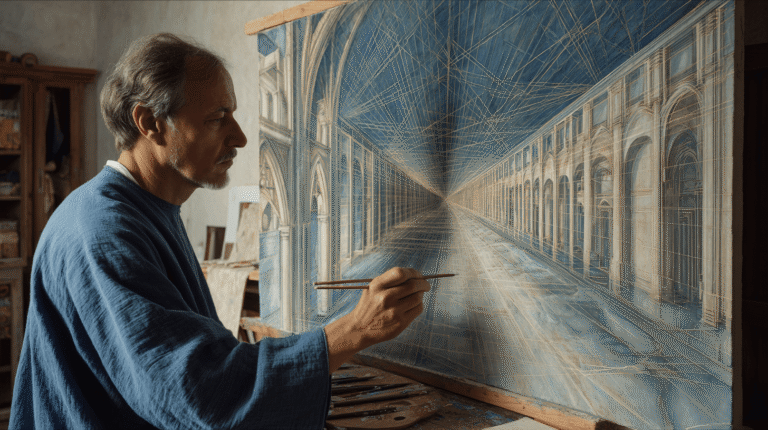
The single technical innovation most responsible for the Renaissance’s visual break from the past was linear perspective: a mathematical system for representing three-dimensional space on a flat surface so that it corresponds to how the human eye actually perceives depth.
The architect Filippo Brunelleschi is generally credited with formally demonstrating this system in Florence in the early 1400s, reportedly using a small painted panel and a mirror to show that a scene of the Florence Baptistery could be rendered with mathematically consistent recession. The theorist and architect Leon Battista Alberti then codified the technique in writing, giving painters a repeatable method rather than an intuitive trick.
Before this, painters could suggest depth through overlapping figures or diminishing size, but there was no consistent underlying geometry. Perspective changed that. A single vanishing point, combined with converging orthogonal lines, allowed an artist to calculate exactly how large a distant object should appear relative to a near one. Masaccio’s Trinity was one of the first major works to apply this system with full mathematical rigor, which is why its illusion of a real, physical space struck contemporary viewers so forcefully.
Perspective did more than make paintings look more realistic. It reframed the picture itself as a kind of window rather than a symbolic surface. The viewer was now positioned as a specific observer standing at a specific point in space, looking at a scene governed by the same physical rules as the world outside the frame. This was a fundamentally different relationship between viewer and image than medieval art had offered.
The Human Body Returns to the Center
Alongside the mathematics of space came a renewed intensity of interest in the human body itself. Renaissance artists increasingly studied anatomy directly, in some cases through the dissection of cadavers, in order to understand how muscle, bone, and weight actually behave. Leonardo da Vinci filled notebooks with detailed anatomical studies that were far more precise than anything produced in the preceding centuries. Michelangelo’s sculptures, most famously his David, demonstrate a command of musculature and weight distribution that reflects sustained, direct anatomical study rather than inherited convention.
This mattered because it connected to the humanist idea that the individual human being, not only the divine order above them, deserved serious artistic attention. Bodies in Renaissance art are not flattened symbols of virtue or sin. They are rendered as physical, weighted, specific things, capable of standing, twisting, and bearing their own mass convincingly. Even religious subjects, still the dominant category of commissioned art, were increasingly painted with attention to believable human emotion and physical presence rather than purely symbolic gesture.
This shift did not mean Renaissance art became secular. Most major commissions remained religious throughout the period. What changed was the manner of religious representation: sacred figures were now given bodies and faces that behaved according to observed human reality, which made the religious scenes feel immediate rather than distant and iconic.
Painters Become Thinkers
One of the most significant, and least visually obvious, changes of the Renaissance was the transformation of the artist’s professional and social identity. Medieval painters and sculptors were classified as craftsmen, members of trade guilds alongside masons or metalworkers. Their work was valued for skilled execution, not personal vision.
Alberti’s writings, along with the broader humanist argument that painting required geometry, anatomy, and intellectual judgment, helped reposition painting and sculpture as liberal arts requiring education, not just manual dexterity. By the sixteenth century, the painter and writer Giorgio Vasari was compiling biographies of individual artists, treating figures like Michelangelo and Raphael as historically significant creative personalities in their own right, comparable to poets or philosophers.
This change had lasting consequences well beyond the Renaissance itself. It helped establish the enduring Western idea of the artist as an individual genius with a personal style, rather than an anonymous craftsman fulfilling a set of established conventions. That idea shaped how art would be discussed, taught, and valued for centuries afterward.
What Popular Memory Gets Wrong
Popular accounts sometimes describe the Renaissance as a sudden rebirth after a uniformly dark and artistically stagnant medieval period. Historians have long pushed back on this framing. Medieval art was not primitive or unsophisticated within its own aims, and the transition into Renaissance style was gradual, uneven, and built on techniques and ideas that had been developing for generations before Brunelleschi’s demonstrations became widely known.
It is also worth noting that the Renaissance was never a single unified movement. Florence, Venice, and Rome each developed distinct artistic priorities, and the Northern European Renaissance, centered in cities like Bruges and Antwerp, developed its own approach to realism, particularly in oil painting technique, somewhat independently of Italian perspective theory. What made the period revolutionary was not that one city or one genius invented everything at once, but that several converging forces, economic competition, humanist scholarship, mathematical technique, and a new professional status for artists, reinforced one another closely enough, and rapidly enough, to produce a visibly different way of making and understanding art within a few generations.
Why the Revolution Still Shapes How We See
The Renaissance did not simply produce a collection of admired paintings and sculptures. It established a framework for representing reality, and for understanding the human figure within it, that continued to dominate Western art for roughly four centuries, until artists in the late 1800s and early 1900s began deliberately breaking from perspective-based realism.
It also helped cement an idea that still shapes how societies think about creativity: that an artwork can express an individual mind, and that the person who makes it deserves recognition as an intellectual figure rather than an anonymous laborer. Museums built around named artists, art history built around personal biography, and the modern art market’s emphasis on an individual creator’s identity all trace back, in part, to this shift.
The Renaissance mattered because it changed the terms on which art operates: not only what a painting or statue depicts, but what kind of claim it makes about space, about the human body, and about the mind behind it. That is the real revolution, and it is why a fresco in a Florentine church, painted six centuries ago, can still make a modern viewer stop and look twice.