How Liberty Leading the People Became the Face of Revolution
The Painting Nobody Could Ignore
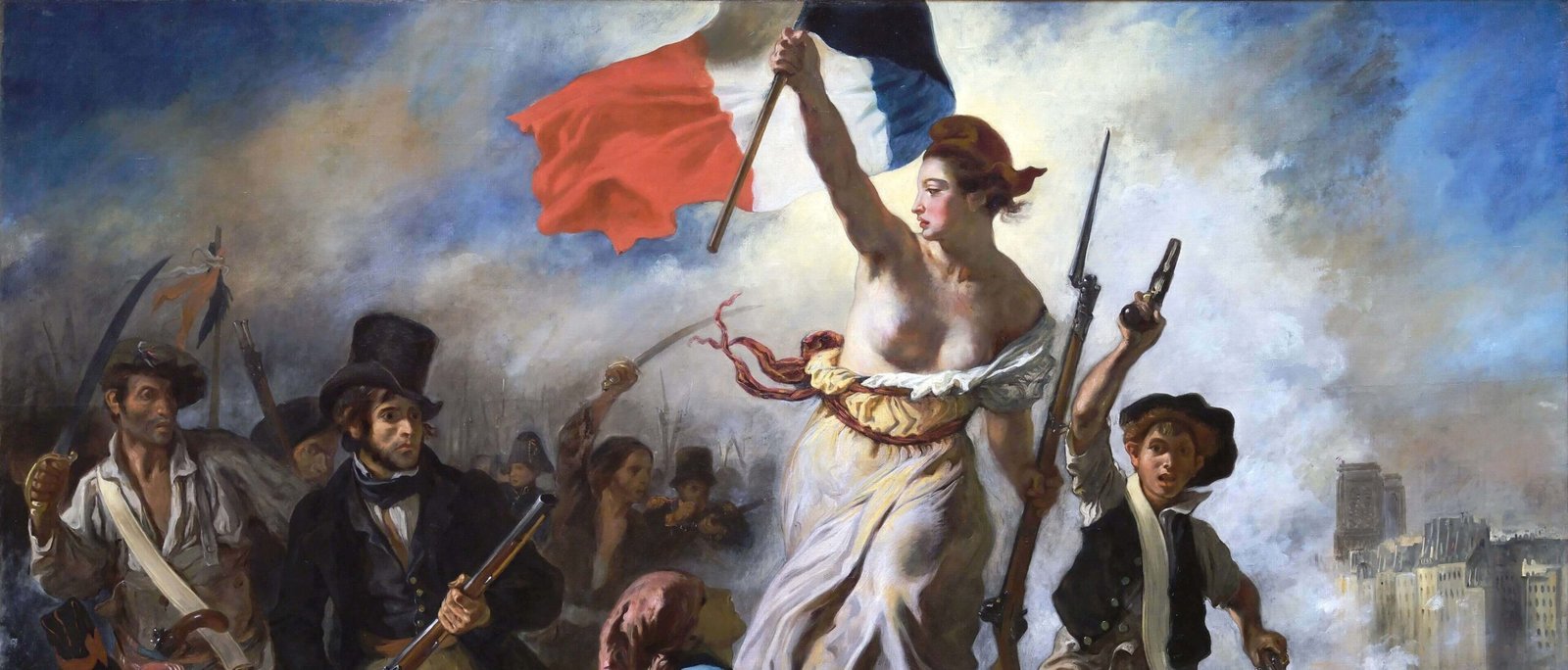
At the Paris Salon of 1831, visitors walking past rows of portraits and pastoral landscapes stopped short in front of one enormous canvas. A bare-chested woman strode over a barricade of broken furniture and paving stones, a musket in one hand and the French tricolor raised in the other. Around her, a street boy waved pistols, a wounded man in ragged clothes reached toward her, and a bourgeois figure in a top hat advanced with a rifle at his shoulder.
The painting was Eugène Delacroix’s Liberty Leading the People, and nothing quite like it had appeared in French art before. It mixed the language of classical allegory with the grit of contemporary street violence, placing an imagined goddess of liberty inside a real Parisian uprising that had ended just months earlier.
Today the image is instantly recognizable, reproduced on currency, textbooks, protest banners, and museum posters around the world. Yet the uprising it depicts is barely remembered outside France. The central puzzle of this painting is not why it looks striking. It is how a picture of a small, half-forgotten revolt became the visual shorthand for revolution itself.
A Revolution the World Forgot
Liberty Leading the People does not depict the storming of the Bastille in 1789, though the two are frequently confused. It commemorates the July Revolution of 1830, a much shorter and less famous uprising that Parisians at the time called the Trois Glorieuses, or Three Glorious Days.
King Charles X, who had ruled France since 1824, tried to tighten his grip on power by suspending press freedom, dissolving the newly elected legislature, and restricting who could vote. He issued these measures by royal ordinance rather than through the legislature, a move that many Parisians read as an open attempt to reverse the constitutional limits placed on the monarchy after Napoleon’s fall.
Printers, journalists, students, and workers responded within days. Barricades went up across the city, fighting broke out between the crowds and royal troops, and by the third day Charles X had abdicated and fled to England. The result was not a republic but a compromise: Louis-Philippe, a cousin from a rival branch of the royal family, took the throne as a constitutional monarch under the new label of the July Monarchy.
It was a revolution with a modest outcome. One king had replaced another, and France remained a monarchy for another eighteen years. Delacroix chose to paint this event, not the more mythologized Revolution of 1789, and that choice shaped everything about how the image would later be read and misread.
An Artist Who Almost Didn’t Fight
Delacroix was thirty-two in 1830, already known for dramatic, emotionally charged paintings inspired by literature and current events. He was not a street fighter or a political radical. By his own later account, he watched the July uprising largely from a distance, more curious observer than combatant.
What he decided to do instead was paint it. In letters to his brother, a career army officer, Delacroix described feeling that if he had not personally fought for his country, he could at least make something for it with his brush. The remark reflects a common tension for artists of his generation: a genuine sympathy for the uprising’s ideals, combined with the practical distance of a professional painter rather than a participant.
This distance mattered. Because Delacroix was not simply illustrating his own memory of combat, he had room to invent. He could combine an allegorical figure that existed only in imagination with the very real rubble of a Parisian street, and blend them into a single, coherent scene.
A Painting That Broke Its Own Rules
Before 1830, allegorical figures like Liberty typically appeared in their own separate visual world: draped in flowing robes, standing in idealized settings, disconnected from ordinary people. Genre painting, which showed everyday life and current events, followed the opposite convention, staying grounded in realistic detail without symbolic figures wandering through it.
Delacroix broke this boundary. His Liberty is bare-breasted and physically active, closer to a Greek goddess than a modern Frenchwoman, yet she strides through an unmistakably real Paris, with the towers of Notre-Dame visible through the smoke in the background. The effect places myth and street violence in the same frame, so each idea reinforces the other. The uprising gains the weight of a timeless cause, and the abstract idea of liberty gains the urgency of a specific, bloody afternoon.
Delacroix organized the composition as a rising pyramid, with Liberty at its peak and the fighters spreading out and downward on either side. This structure pulls the eye upward through the smoke toward the flag, giving the chaotic scene a clear visual direction rather than a random tangle of bodies.
A Crowd That Erases Class Lines
The fighters around Liberty come from different parts of society, and Delacroix made this diversity visible rather than implied. A man in a top hat and cravat, dressed like a member of the professional or student class, stands beside a laborer in a work shirt and a boy in ragged clothing waving pistols.
This was a deliberate political statement. The July Revolution had, in reality, drawn fighters from across French society, including students, artisans, and shopkeepers rather than one single class. By placing these figures shoulder to shoulder beneath the same flag, Delacroix visually argued that liberty belonged to no single class, but to the nation as a whole.
The painting’s use of red, white, and blue reinforces this unity. The colors of the tricolor flag reappear throughout the composition, in the boy’s cap, in scattered clothing, and in the wisps of gunsmoke lit by the same warm light. Liberty does more than lead the people forward. She visually stitches them together into a single body.
Too Dangerous to Display
The French state purchased the painting shortly after the 1831 Salon, intending to display it prominently as a celebration of the new government’s origins. That plan did not last long.
Louis-Philippe’s government soon grew uneasy about a painting that glorified street insurrection, even one that had installed his own reign. A canvas celebrating the overthrow of one king carried an obvious, uncomfortable implication for the king who now sat on the throne. Within a few years, the painting was removed from public view and placed in storage, where it remained largely hidden for roughly two decades.
It reemerged briefly during the revolutionary upheavals of 1848, when France again experienced political turmoil and a new republic was declared, before returning to storage under the following regime. Only in 1874, well after Delacroix’s death, did the painting finally enter the Louvre, where it has remained on permanent public display ever since.
This decades-long hesitation is itself revealing. A government that owed its existence to the July Revolution was still unwilling to let its own citizens look too closely at an image glorifying insurrection. The painting was not dangerous because it was inaccurate. It was dangerous because it captured something true about how quickly ordinary people could rise up against a ruler who overstepped his authority.
What Popular Memory Gets Wrong
Two persistent misunderstandings surround this painting, and both are worth correcting.
The first is the confusion with the French Revolution of 1789. Because the painting has become the default visual symbol of “the French Revolution” in textbooks and popular culture, many viewers assume it depicts the storming of the Bastille or the fall of the monarchy under Louis XVI. It depicts neither. The uprising shown took place forty-one years later, against an entirely different king, under different political conditions.
The second concerns the street boy waving pistols near Liberty’s side. Some later commentators have suggested that this figure directly inspired the character of Gavroche, the street urchin in Victor Hugo’s 1862 novel Les Misérables. The claim is popular and frequently repeated, but it rests on resemblance and timing rather than confirmed documentary evidence connecting Hugo directly to this specific painting. It remains a plausible cultural echo rather than an established fact.
The Image That Outgrew Its Moment
Once installed permanently in the Louvre, the painting gradually detached itself from the specific events of 1830 and became something closer to a universal emblem. French governments reproduced it on postage stamps and, for a period, on the 100-franc banknote. Political movements across the ideological spectrum, some far removed from Delacroix’s own moderate sympathies, borrowed its imagery to lend their causes an air of popular legitimacy.
The painting is sometimes linked to the Statue of Liberty in New York Harbor, given the shared theme and name. The connection is mostly a coincidence of subject rather than a direct artistic debt. Frédéric Auguste Bartholdi, the sculptor of the American statue, chose a calm, robed, classically restrained figure, closer to the ancient Roman goddess Libertas than to Delacroix’s bare-chested revolutionary striding over corpses. If anything, the American statue appears to have deliberately distanced itself from the insurrectionary energy of the French painting, offering a gift meant to symbolize enlightenment and welcome rather than armed uprising.
What both images share is not visual inheritance but function. Each turned an abstract political idea into a single memorable human figure, because abstract principles are difficult to feel and a striding woman with a flag is not.
Why the Painting Still Works
Liberty Leading the People endures because it solved a genuinely difficult artistic problem: how to make a political idea feel as immediate as a lived event, without draining that event of its symbolic weight.
By fusing allegory with reportage, Delacroix created an image flexible enough to represent almost any uprising against unjust authority, while still remaining anchored in one specific, dated afternoon in Paris. A painting locked entirely into historical accuracy might have faded into a specialist curiosity. A painting entirely abstract might never have felt urgent. Delacroix’s decision to combine both is what let the image travel so far beyond its original occasion.
Liberty herself does more than lead a fictional crowd across a canvas. She turns a forgotten three-day uprising into a lasting argument about collective will, one that later generations kept borrowing precisely because the argument never went out of date.
Frequently Asked Questions
Does the painting show the French Revolution of 1789?
No. It depicts the July Revolution of 1830, a separate and later uprising against King Charles X. The confusion is common because the painting has become a general symbol of French revolutionary history.
Was the woman in the painting a real historical figure?
No. She is an allegorical personification of Liberty, not a portrait of an actual participant in the 1830 uprising, though her pose and setting were inspired by real events Delacroix had witnessed or heard described.
Why was the painting hidden for so long after it was purchased?
The government of Louis-Philippe, who came to power through the very uprising the painting celebrates, grew uneasy about publicly displaying an image glorifying insurrection against a monarch. It remained largely out of public view for roughly two decades before eventually entering the Louvre in 1874.