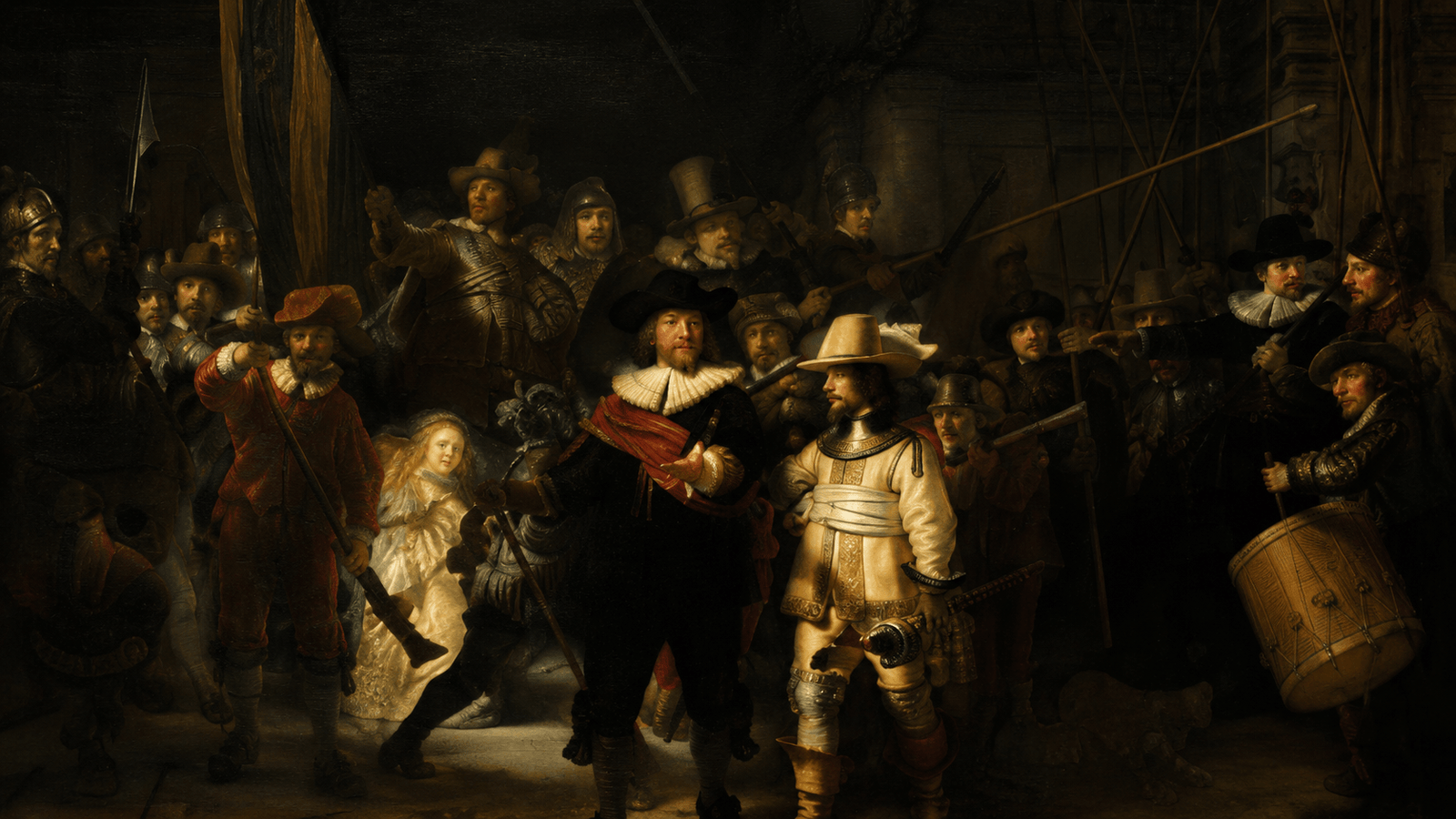
Why “The Night Watch” Is Considered Rembrandt’s Greatest Masterpiece
In 1715, someone in Amsterdam’s city hall needed Rembrandt van Rijn’s enormous militia portrait to fit between two doors. The solution was simple and brutal: workers sliced off more than half a meter from the left side of the canvas, along with strips from the other three edges. Two figures disappeared entirely. No one recorded who gave the order, and no one seems to have thought it worth objecting to.
That casual act of vandalism says something important about how differently this painting was once regarded compared to how it is seen today. The work now called The Night Watch hangs in the Rijksmuseum behind reinforced glass, guarded around the clock, and studied by more scientists over a longer period than almost any other painting in the world. It draws crowds who have often traveled specifically to stand in front of it. Yet for much of its early life, it was simply a large, useful piece of decoration that could be trimmed to fit a wall.
So what changed? Why does this particular painting, out of Rembrandt’s roughly 300 surviving works, occupy such a singular place in the history of art? The answer lies not in one dramatic quality but in a convergence of technical innovation, psychological insight, and sheer audacity that Rembrandt brought to a genre that had, until then, produced competent but largely forgettable group portraits.
A Commission That Almost Guaranteed Mediocrity
To understand what Rembrandt did, it helps to understand what he was supposed to do.
In the 1630s, Amsterdam’s civic guard companies were a peculiar institution. Originally organized for the city’s military defense, by Rembrandt’s time they functioned more like social clubs for wealthy merchants and prominent citizens. Membership offered status, camaraderie, and the right to parade through the streets in elaborate dress on ceremonial occasions. It also came with an expectation: each company would periodically commission a large group portrait to hang in its meeting hall.
These portraits followed a rigid formula. Members paid according to their rank and prominence, and in return expected to appear clearly, evenly lit, and identifiably placed within the composition. The genre had produced dozens of paintings that functioned essentially as expensive class photographs. Rows of men in ruffs and sashes stood shoulder to shoulder, each face given equal visual weight, each figure a paying customer who expected value for money.
In 1642, Captain Frans Banninck Cocq commissioned exactly this kind of painting from Rembrandt for the Kloveniersdoelen, the headquarters of Amsterdam’s musketeer militia. Eighteen guardsmen paid for the privilege of appearing in it, along with Cocq and his lieutenant, Willem van Ruytenburch. The painting’s full original title identifies its subject precisely: Militia Company of District II under the Command of Captain Frans Banninck Cocq.
Rembrandt was contractually bound to include specific individuals in recognizable form. He was not bound to make them all equally visible, equally prominent, or equally interesting. That distinction turned out to matter enormously.
The Decision That Broke the Formula
Rather than lining his subjects up in tidy rows, Rembrandt staged the painting as a moment of sudden, chaotic motion. The company appears to be mobilizing, stepping out from beneath an archway into daylight. Captain Cocq strides forward mid-command, his hand gesturing outward as if issuing an order we can almost hear. Van Ruytenburch beside him is caught in brilliant, buttery light, his costume rendered so precisely that later scientific analysis would identify the exact pigments Rembrandt used to make the gold threads glow.
Behind and around them, the scene dissolves into overlapping figures, raised weapons, a barking dog, and a small girl in a luminous yellow dress who seems to have wandered into the frame from nowhere. Some faces are lit brilliantly. Others are half in shadow or nearly obscured behind a companion’s shoulder. A few guardsmen who paid for the privilege of appearing in the painting are barely visible at all.
This was a genuine risk. Group-portrait patrons in the Dutch Golden Age were consumers as much as subjects, and Rembrandt’s approach meant some of them got considerably less for their money than others. Yet the painting was accepted, hung, and admired. It suggests that Rembrandt understood something his patrons may not have consciously articulated: a painting that captured a living, breathing moment of collective action would be more compelling, and ultimately more prestigious to be part of, than one that simply catalogued everyone’s face with equal care.
Weak version of this point: Rembrandt made the painting more dramatic than other group portraits.
Better version: Rembrandt replaced a lineup of individuals with the illusion of a single unfolding event, and in doing so, he made each guardsman part of something larger than his own portrait — a trade-off that cost some sitters visibility but gave the whole company a painting unlike any other militia group had ever owned.
Light as an Argument, Not Just an Effect
Rembrandt’s use of light and shadow, the technique known as chiaroscuro, is often described in art history as simply dramatic or atmospheric. In The Night Watch, it functions more precisely than that. Light in this painting is an argument about attention itself.
Van Ruytenburch’s golden costume and Cocq’s illuminated hand and face pull the eye first. Recent research conducted by the Rijksmuseum’s Operation Night Watch project, using eye-tracking technology, confirmed what many viewers had long sensed intuitively: viewers’ attention is drawn disproportionately to Van Ruytenburch’s brightly lit attire, exactly where Rembrandt directed his most careful and innovative paint handling.
That same research revealed just how deliberately Rembrandt achieved these effects. Using non-invasive imaging techniques including X-ray fluorescence and reflectance spectroscopy, scientists mapped Rembrandt’s full pigment palette across the painting, including lead white, lead-tin yellow, ochres, vermilion, arsenic sulfide compounds, red lake pigments, smalt, and azurite. Crucially, they found that Rembrandt applied these materials in a consistent, systematic way, grouping pigments together to achieve visual unity across the canvas rather than mixing techniques haphazardly.
The choice of arsenic-based pigment for the gold embroidery on Van Ruytenburch’s costume turns out to have been especially unusual. Rembrandt used pigments containing arsenic that had, until then, primarily been reserved for still-life paintings of fruit and flowers, making him an innovator in applying arsenous pigments to portraiture. He was, in effect, importing a technical trick from one genre to solve a problem in another: how to make gold thread appear to catch real light on canvas.
This was not decoration for its own sake. It was Rembrandt using material science, whether he understood it in those terms or not, to make the eye behave exactly as he wanted.
A Painting That Kept Changing Its Mind
One of the more striking discoveries from decades of technical study is that The Night Watch was not a fixed idea Rembrandt executed mechanically. It was a composition he revised as he worked, sometimes substantially.
Imaging techniques revealed a hidden preparatory sketch beneath the paint layers, showing that Rembrandt worked out his composition directly on the canvas rather than transferring it from a separate design. Comparing that underlying sketch to the finished painting shows Rembrandt adjusting his own plan as he went: he added and later removed a central sword and several spears, altered the leg position of one soldier, and inserted a sword between Captain Cocq and Lieutenant Van Ruytenburch that had not appeared in his original layout.
Perhaps the most evocative of these discoveries involves a background figure’s helmet. Modern element-mapping technology uncovered something invisible to the naked eye and even to earlier generations of X-ray equipment: Rembrandt had originally painted feathers onto that helmet, then painted over them and removed them entirely, a change that offers a rare glimpse into his evolving judgment about the composition.
None of these changes were required by the patrons. They represent an artist continuously testing and refining his own choices, unwilling to settle for his first solution simply because it satisfied the terms of the commission.
The Painting That Wasn’t Meant to Be Called “Night”
One of the most persistent misconceptions about this painting is baked into its own name. For centuries, viewers assumed Rembrandt had depicted a nighttime scene, and the title stuck. It is, in fact, wrong.
The painting almost certainly depicts daylight, not night. Over roughly two centuries, accumulated layers of varnish and grime darkened the surface so dramatically that later viewers came to believe the scene itself was nocturnal. The name “Night Watch” only became attached to the painting in the eighteenth century, in part because of its heavy varnish coating and the passage of time, not because Rembrandt had painted a company of guards patrolling after dark.
When conservators cleaned the painting in the 1940s, removing the accumulated layers of varnish lifted much of the apparent darkness and revealed a scene far closer to Rembrandt’s original intention: a group stepping into daylight, not shadow. By then, however, the title was too firmly established to change, and the painting has carried a slightly misleading name into the present.
This is worth pausing on, because it illustrates something larger about the painting’s history: much of what people believe about The Night Watch has been shaped as much by four centuries of accident, damage, and intervention as by what Rembrandt actually painted.
Survival Through Violence
Few major paintings in the Western canon have endured as much physical trauma as this one, and its survival is itself part of why it commands such reverence today.
Beyond the 1715 trimming that permanently altered its composition, the painting has been the target of direct attacks. In 1975, a man slashed the canvas repeatedly with a knife, requiring an extensive and delicate restoration. In 1991, it was attacked again, this time by a visitor who sprayed it with acid. Combined with normal aging processes, these episodes left the painting with what conservation scientists describe as a complex history of numerous treatments and localized damage, including crusts, hazes, and abrasions across various paint layers.
That accumulated damage is precisely why the Rijksmuseum launched Operation Night Watch in July 2019, described as an effort to give the painting, now nearly four centuries old, the best possible scientific care so it can continue to be enjoyed by future generations. The project’s ambitions were unprecedented for a single artwork: given the painting’s scale of 3.78 by 4.53 meters and the range of technical investigations undertaken, it became the largest research project ever conducted at the Rijksmuseum.
The research has yielded discoveries that continue into the present. In 2023, scientists analyzing a paint sample identified a previously unknown lead-containing layer within the painting, discovered through combined X-ray fluorescence and powder diffraction analysis, revealing that Rembrandt had been willing to experiment with unconventional materials, likely because he knew the painting would ultimately hang in a humid environment and wanted to safeguard it against that condition. Then, in November 2025, researchers announced the discovery of lead formate within the paint layers, a compound described as a chemical never before identified in any historic painting, offering new clues about both Rembrandt’s original process and the effects of centuries of conservation attempts.
Each of these findings reinforces the same point from a different angle: this painting has survived enough intentional and accidental damage that its continued existence, in a form still recognizable as Rembrandt’s original vision, is itself remarkable.
What Made the Difference
None of this fully explains why The Night Watch, rather than any of Rembrandt’s other outstanding paintings, became the singular icon it is today. Part of the answer is scale: at nearly 4.5 meters wide, it remains Rembrandt’s largest surviving work, physically impossible to ignore in a way smaller portraits are not. Part of it is subject matter that resonated with Dutch national identity, a scene of ordinary citizens armed and ready to defend their city during a period when the Dutch Republic’s independence still felt recent and hard-won.
But the deeper reason is that Rembrandt used a formulaic, commercially constrained assignment to test the outer limits of what a group portrait could be. He gave up predictable visibility for a handful of paying patrons in exchange for a painting that felt alive in a way the genre never had before. He treated light not as decoration but as a tool for directing human attention. And he kept revising his own choices even after the composition was already underway, refusing to treat the first solution as the final one.
The painting survived a trim, two separate attacks, centuries of grime, and a name that describes a time of day it does not actually depict. What remains, after all of that, is still recognizably the work Rembrandt intended: a moment of ordinary men transformed, through light and motion, into something that still commands a room four hundred years later.
Frequently Asked Questions
Why is it called “The Night Watch” if the scene takes place during the day?
The nickname developed over roughly two centuries as layers of varnish and dirt darkened the canvas, leading viewers to mistakenly believe the scene depicted night. The title became attached to the painting in the eighteenth century largely because of this darkened varnish, and it stuck even after 1940s cleaning revealed a daylight scene underneath.
How large is the painting, and has it always been this size?
The current dimensions are 3.78 by 4.53 meters, but the original was larger. In 1715, more than half a meter was cut from the left side and smaller strips from the other edges so the painting would fit between two doors at Amsterdam’s city hall, permanently removing two figures from the composition.
What is Operation Night Watch?
It is an ongoing Rijksmuseum research and conservation initiative launched in July 2019, described as the largest research project ever undertaken at the museum, using advanced imaging and chemical analysis to understand Rembrandt’s materials and techniques and to guide future conservation decisions.
Did Rembrandt paint from a fixed plan, or did the composition change during painting?
Research shows he revised the composition as he worked. A hidden underlying sketch revealed changes including an added and later removed central sword and spears, an adjusted leg position for one soldier, and a sword inserted between the two central commanders, along with feathers on a helmet that were painted out entirely.
Why did some militia members appear more prominently than others despite paying equally?
Rembrandt broke from the standard convention of giving every paying member equal visual prominence, instead using light, positioning, and composition to create a sense of a single dramatic moment. This meant some guardsmen received less individual visibility than they might have expected, a trade-off that ultimately distinguished the painting from conventional militia portraits.