Why The Little Prince Means More to Adults Than to Children
A child finishes The Little Prince and closes the book the way children close most stories: satisfied, a little sad that the fox and the rose are gone, ready for the next adventure. An adult finishes the same book, on the same afternoon, and sits still for a moment before doing anything else. Something has landed that wasn’t there in the plot alone.
Booksellers and teachers have noticed this gap for decades. Antoine de Saint-Exupéry’s 1943 story is shelved in the children’s section, illustrated with the author’s own gentle watercolors, and sold to millions of families as a bedtime book. Yet surveys of readers consistently find that adults reread it more often than children do, buy it for other adults, and quote it at funerals, weddings, and moments of loss. A story about a boy who visits a handful of tiny planets has become one of the most reread books by grown people in the world.
The puzzle is not that children dislike the book. It’s that the book seems to know something about being an adult that only adults are positioned to recognize.
A Pilot Writes a Fairy Tale in Exile
Saint-Exupéry did not write The Little Prince as a children’s author settling in for a cozy project. He wrote it in New York City in 1942, exiled from a France that had just fallen to Nazi occupation, uncertain whether his country would survive as a nation. He was a professional aviator, not a novelist by trade, and his earlier books—Night Flight, Wind, Sand and Stars—were adult memoirs about the danger and solitude of early commercial flying.
The desert crash that opens The Little Prince was not invented for effect. In 1935, Saint-Exupéry had actually crashed his plane in the Sahara during a long-distance flying race, surviving several days in the desert before Bedouin travelers found him near death from dehydration. When the narrator of the book—an adult pilot stranded beside a broken engine—meets a strange boy who asks him to draw a sheep, Saint-Exupéry was writing from a memory he knew intimately, not staging a fantasy backdrop.
He wrote the book, illustrated it himself, and sent it to be published in New York in 1943, in both French and English editions, before returning to fly reconnaissance missions for the Free French forces. In July 1944, less than a year after the book appeared, his plane disappeared over the Mediterranean. The wreckage was not confirmed until 2000, when a fisherman’s net brought up part of the fuselage off the coast of Marseille.
The Story Beneath the Story
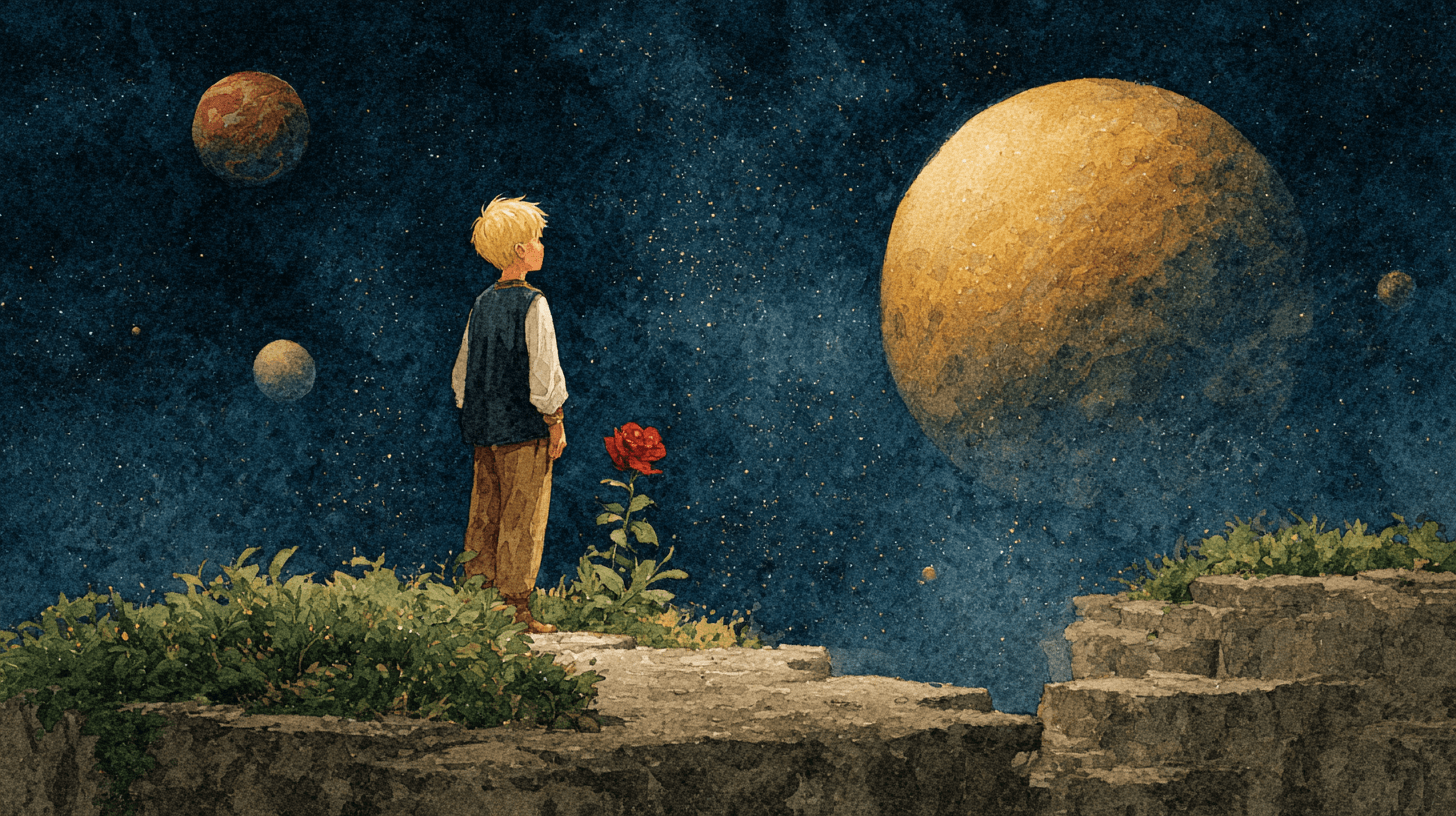
On its surface, the plot is simple. A boy from a distant, barely-there asteroid—Asteroid B-612—has left his tiny planet after a falling-out with a proud, demanding rose he loves. He travels from world to world, meeting a series of adults, before arriving on Earth, where he meets the stranded pilot and, eventually, a fox who teaches him what it means to form a bond with another living thing.
The book’s most quoted line comes from that fox: the idea that one sees clearly only with the heart, and that what truly matters often cannot be seen at all. Children can follow this as a nice sentiment about friendship. Adults tend to hear it as something closer to a diagnosis—of their own habit of mistaking visible things, like income and status, for what actually holds a life together.
The Grown-Ups the Prince Meets
Before reaching Earth, the prince visits six small planets, each occupied by exactly one adult. A king rules an empire with no subjects, insisting his authority is absolute because he only ever gives orders he knows will be obeyed. A vain man asks every visitor to admire him, unable to hear anything but praise. A drunkard drinks to forget the shame of drinking. A businessman spends his life counting the stars so that he can, in his mind, own them, without ever looking up to actually see one. A lamplighter obeys an order to light and extinguish his lamp every minute, on a planet that spins so fast the order has become absurd, but he never questions it. A geographer records the location of oceans and mountains he has never visited, because he considers travel beneath his professional dignity.
None of these figures is cruel. That is precisely the point. Each has simply organized an entire life around one hollow habit—control, admiration, forgetting, ownership, obedience, abstraction—and stopped noticing that the habit has replaced any real contact with the world. Children tend to find these characters amusingly odd. Adults tend to recognize, with some discomfort, a piece of their own week in at least one of them.
What Children See, and What Adults See
This is the real difference in how the book lands. A child experiences The Little Prince as a gentle, sometimes melancholy adventure story: strange planets, a fox, a snake, a boy who wants a sheep. An adult experiences it as a mirror held up to the exact compromises adulthood tends to require—the slow trade of wonder for efficiency, curiosity for status, and attention for busyness.
Saint-Exupéry makes this trade explicit rather than leaving it to inference. The narrator opens the book by explaining that as a child, he once drew a picture of a boa constrictor that had swallowed an elephant, and every adult who saw it mistook it for a hat. Discouraged, he gave up drawing and became a serious professional instead, one who talks to adults about “bridge, and golf, and neckties,” because that is the only language they seem willing to hear. The meeting with the prince, years later, is framed as the first time in his adult life that someone has actually understood his drawing.
A child reading this doesn’t yet have a stockpile of abandoned drawings, ambitions, or ways of seeing to mourn. An adult usually does. The book isn’t only describing lost childhood wonder in the abstract—it is naming a specific, familiar mechanism by which that wonder gets talked out of a person, one reasonable adult conversation at a time.
The Rose, the Fox, and the Weight of Responsibility
The prince’s central relationship is not with any of the planet-dwellers he meets on his travels, but with the single rose he left behind, and later, with the fox on Earth who asks the prince to tame him. Taming, the fox explains, means to create ties—to make one being unique and irreplaceable to another through the ordinary, unglamorous work of time and attention. Once tamed, the fox says, each is responsible for what he has tamed.
This idea reframes the prince’s earlier frustration with his rose. He had left his planet partly because the rose was vain and demanding, and he mistook her difficult behavior for a lack of love. Only after meeting the fox does he understand that her thorns and pride were not evidence against her, and that love is demonstrated less through declarations than through the patient, sometimes tedious labor of care—watering, sheltering from wind, listening past the surface complaint.
Many biographers connect this thread to Saint-Exupéry’s own marriage to Consuelo Suncín, a relationship marked by long absences, jealousy, and reconciliation, though the author never confirmed the rose as a direct portrait of his wife. What is clear from the text itself is that the book treats commitment as an active, ongoing responsibility rather than a feeling one simply has. That is a distinctly adult problem. Children generally have not yet had the experience of loving someone whose difficulty they had to learn to see past.
An Ending Children Forgive and Adults Mourn
The book’s ending is where the difference in reader experience becomes sharpest. To return to his rose, the prince allows a venomous snake to bite him, letting his body fall away so that something essential in him can travel back to his asteroid. The narrator is left on Earth, uncertain whether the prince’s body was ever found, aware only that a small mound of sand looked slightly different the morning after.
Children often accept this as a kind of magic departure, sad but survivable, the way stories about talking foxes and tiny planets are allowed to end strangely. Adult readers, who understand what it means to lose someone permanently and to be left with only the ambiguous evidence of absence, tend to read the same scene as something closer to a death, softened just enough by fantasy to be bearable. Saint-Exupéry’s own disappearance a year after publication, his body unrecovered for decades, has only deepened this reading for later generations of readers, even though the parallel was not one he could have intended as a marketing point.
A Book Written for a Child Who Grew Up
The dedication at the front of the book makes the intended reader more explicit than most people remember. Saint-Exupéry dedicates it to his real-life friend Léon Werth, then apologizes to the children who might be reading, explaining that Werth is in fact a grown man who lives in France, is cold and hungry, and needs cheering up. He revises the dedication a final time: to Léon Werth, when he was a little boy.
That single line does most of the interpretive work the rest of the book only implies. Saint-Exupéry is not writing to children as a separate category of person. He is writing to the adult that every child eventually becomes, on the theory that the child does not vanish but simply gets buried under obligations, neckties, and the business of counting stars. The book’s real audience was never children exclusively; it was adults who had once been children and had, in his view, mostly forgotten it.
Why the Book Still Matters
The Little Prince has sold in excess of 200 million copies and has been translated into more than 300 languages and dialects, making it one of the most translated works in publishing history. That reach is often credited to its simple vocabulary and gentle illustrations, which make it accessible to language learners and young readers worldwide. But simplicity of language is not the same as simplicity of content, and the book’s endurance among adult readers suggests its real appeal lies elsewhere: in its refusal to let grown-up seriousness pass as automatically wiser than a child’s attention.
The book does not ask adults to abandon responsibility and become children again. It asks them to notice what responsibility has quietly cost them, and to decide whether the trade was worth it. That is not a question most children are yet in a position to ask themselves. It is, however, a question most adults have already been living inside for years, whether or not anyone had put it into words for them.
That may be the simplest explanation for why a book about a boy and his rose keeps finding its way back into adult hands: it does not tell grown-ups something new. It reminds them of something they already knew and had simply stopped saying out loud.