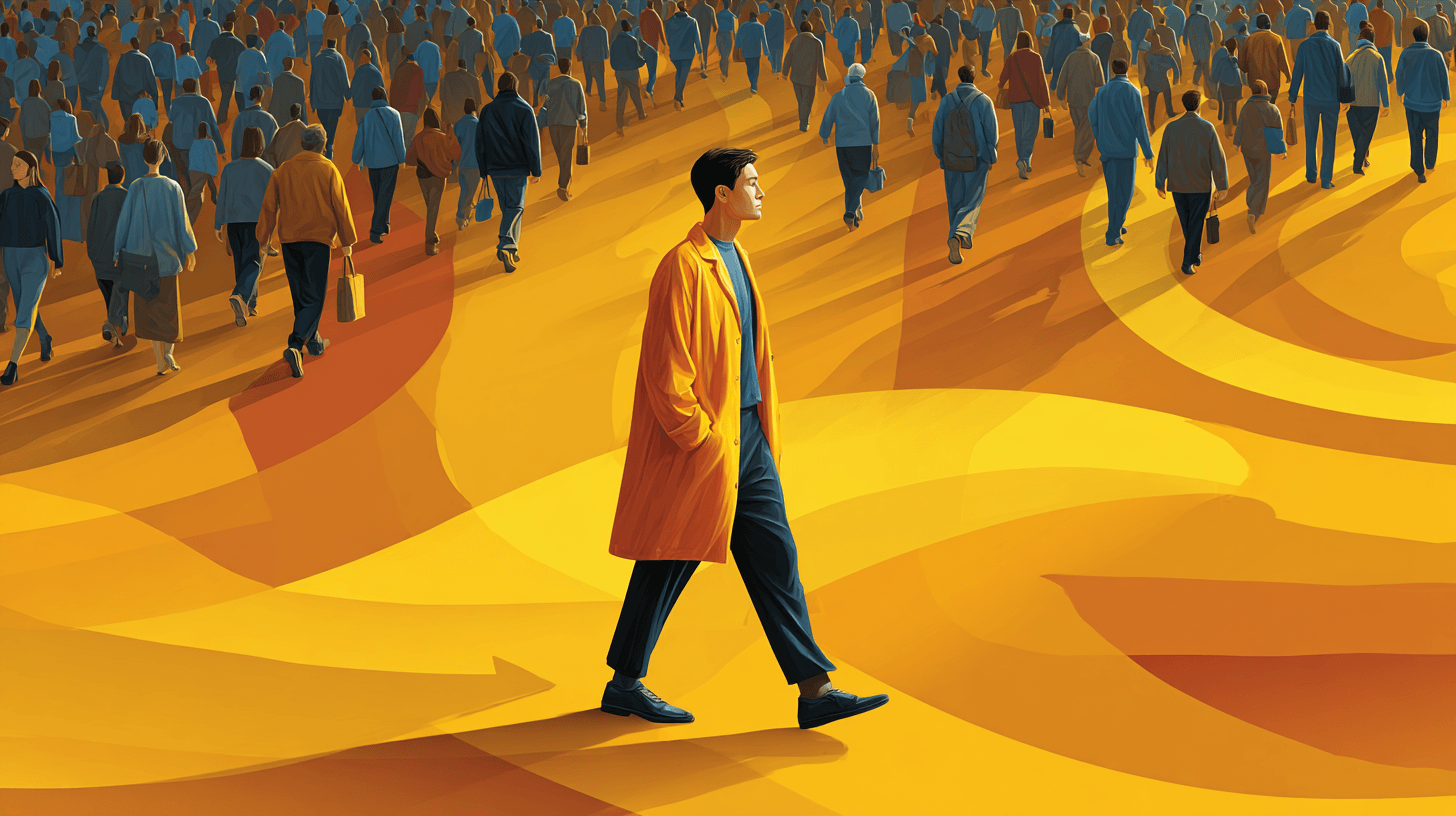
Why We Follow the Crowd, Even When We Know Better
In the early 1950s, the psychologist Solomon Asch invited a group of college students into a lab and asked them to complete what looked like a simple vision test. Each person had to say which of three lines matched a reference line in length. The answer was obvious. Yet in about a third of the trials, ordinary participants gave a wrong answer that matched everyone else in the room.
The catch was that everyone else was in on the experiment. They had been instructed to give an incorrect answer on purpose, and the one real subject sat at the end of the row, listening to person after person confidently name the wrong line. Many people caved. Some didn’t even realize they had.
Asch’s line experiment became one of the most famous studies in psychology because it exposed something uncomfortable: people will override the evidence in front of their own eyes to avoid standing apart from a group. The puzzle this article tries to answer is not whether people conform — that much is well established — but why. What is actually happening when someone abandons a correct, independent judgment simply because others disagree with it?
A Pressure Everyone Recognizes
Most people can recall a moment when they went along with a group decision they privately doubted. Maybe it was staying quiet in a meeting when a plan seemed flawed, or agreeing that a restaurant was “great” when the food was mediocre, because three other people had already said so.
This isn’t a personality flaw limited to the insecure or the weak-willed. Asch’s original participants were not unusually submissive people. They were ordinary students, tested under mild, low-stakes conditions, with no punishment for disagreeing. If conformity emerges even there, it suggests something built into how humans process social information, not just a quirk of certain individuals.
Understanding why requires separating two different things that often get blurred together: believing something because others believe it, and saying something because others are saying it.
Two Different Reasons People Conform
Psychologists studying this behavior, beginning with Muzafer Sherif’s research in the 1930s and extended by Asch two decades later, generally distinguish between two separate mechanisms.
The first is informational influence. When a situation is ambiguous and a person is genuinely unsure what the right answer is, other people’s opinions become a source of evidence. If you’re new to a city and don’t know which restaurant is trustworthy, a crowded dining room is useful information. Sherif demonstrated this using an optical illusion called the autokinetic effect, in which a stationary point of light in a dark room appears to move. Because there was no objective answer, participants’ estimates drifted toward a shared group norm and stayed there even when tested alone later. They weren’t performing agreement. They had genuinely updated their belief.
The second is normative influence. This is what dominated Asch’s line experiment. The task wasn’t ambiguous at all — the correct line was easy to identify. Participants who conformed usually knew, privately, that the group was wrong. They conformed anyway, because disagreeing publicly carried a social cost: looking strange, appearing difficult, risking exclusion from the group’s approval.
The distinction matters because it changes what conformity actually reveals about a person. Informational conformity is often a reasonable strategy for handling uncertainty. Normative conformity is closer to a trade-off: the discomfort of public disagreement weighed against the cost of being factually right but socially isolated.
Why the Group’s Approval Feels So Important
The intensity of Asch’s results becomes easier to understand once conformity is framed as a signal detection problem the brain treats as high-stakes. Humans evolved in small groups where social standing affected access to food, protection, and mates. Being excluded from a group was not merely uncomfortable; for most of human history, it could be dangerous. A nervous system that treats social disapproval as a serious threat, even over something as trivial as line length in a lab, may simply be applying an old survival calculation to a new and low-risk situation.
Neuroscience research has offered a more specific version of this idea. In a study led by Gregory Berns in the mid-2000s, participants performed a mental rotation task while seated with a group of confederates who sometimes gave deliberately wrong answers. Brain imaging showed that when participants conformed to an incorrect group answer, activity increased in regions associated with visual and spatial perception, not in regions associated with conscious decision-making or conflict monitoring. Berns and his colleagues interpreted this as evidence that, in some cases, group pressure may actually alter what a person perceives, not merely what they are willing to say aloud.
This finding is influential but should be read carefully. It comes from a single study with a modest sample, using indirect inference from brain activity patterns, and it does not prove that social pressure rewires perception in every conformity situation. It’s better understood as a compelling illustration of how deeply normative pressure can reach, rather than a settled account of the underlying mechanism.
What Changes the Odds of Conforming
Not every group produces the same pull toward agreement. Asch and later researchers identified conditions that reliably increase or decrease conformity.
Group size matters, but only up to a point. Conformity rates rose sharply once a group reached three or four confident, agreeing members, then leveled off — a lone additional voice of dissent had a far bigger effect than adding more agreeing voices did. Unanimity turned out to be the critical ingredient. When even one confederate in Asch’s setup broke ranks and gave the correct answer, conformity among real participants dropped dramatically, even though the dissenter was still outnumbered.
This is one of the most practically important findings to come out of the research. A single ally can undo much of the pressure that a unanimous majority creates. It isn’t the size of the opposition that matters most; it’s whether the group appears to speak with one voice.
Public versus private response also changes the outcome. When participants were allowed to write down their answers privately instead of speaking them aloud, conformity fell substantially. This supports the idea that a large share of Asch-style conformity is about managing appearance in front of others, not about genuinely doubting one’s own senses.
What Popular Retellings Get Wrong
The Asch experiments are often summarized as proof that people are simply “sheep,” inclined to believe whatever the crowd tells them. That reading overstates the case in two ways.
First, most participants did not conform on most trials. Across Asch’s studies, roughly a quarter of participants never gave in to the group at all, and the overall rate of conforming to the incorrect answer was around a third of trials, not a majority. Independent judgment remained the more common response, even under real social pressure.
Second, as the Berns study suggests, conformity is not always simple dishonesty. Some participants appear to genuinely arrive at a different perceived answer, while others report privately disagreeing the entire time but choosing not to say so. Treating all conformity as one uniform behavior collapses an important distinction between changed belief and suppressed disagreement.
The Limits of What the Evidence Shows
Like much classic social psychology research from the mid-twentieth century, the Asch experiments were conducted primarily with American college students, and cross-cultural replications since then have found meaningful variation. Reviews comparing conformity research across dozens of countries have generally found higher average conformity rates in cultures that place greater value on group cohesion and social harmony relative to individual expression, though the underlying mechanisms — informational versus normative pressure — appear to operate in both types of societies. This suggests that the tendency to conform is not fixed, but shaped by the norms a person has been raised in.
Some specific replications of Asch’s original numbers have also produced more mixed results, and psychology as a field has spent the past decade re-examining how reliably several mid-century social psychology findings replicate under stricter modern methods. The core phenomenon — that people can be pushed toward incorrect group answers under unanimous social pressure — has held up reasonably well across replications. The exact conformity rates Asch originally reported should be treated as illustrative rather than a precise, universal figure.
Why It Still Matters
Conformity research reaches well beyond a psychology classroom demonstration. It offers a partial explanation for how juries can reach unanimous verdicts that individual jurors privately doubt, how flawed corporate decisions survive internal review even when several employees privately recognize the risk, and how misinformation can spread through a group faster once a critical mass appears to accept it, regardless of whether any individual actually verified it first.
It also explains why structural safeguards — anonymous voting, written dissent, rotating who speaks first in a meeting — tend to produce better group decisions than open, sequential discussion, where early confident voices can quietly set a direction that later speakers feel reluctant to challenge. Groups don’t fail because their members are unintelligent. They often fail because unanimity, real or apparent, is one of the most persuasive forces a social species can encounter.
None of this means group agreement is inherently suspect. Informational conformity, drawing on the accumulated judgment of others facing genuine uncertainty, is often a rational and useful shortcut. The risk lies specifically in normative conformity: agreeing not because the group has better information, but because disagreement feels costlier than being wrong.
The most useful lesson from seven decades of this research may be the simplest one. A single dissenting voice, even one voice against a unanimous room, changes the social math enough to make honest disagreement easier for everyone else. The line was never really about which one was longer. It was about who was willing to say so first.