How Einstein’s Relativity Rewrote the Rules of Space and Time
In 1887, two American physicists tried to measure something that should have been easy to detect: the wind. Not an ordinary wind, but the motion of Earth through a substance called the luminiferous ether, the invisible medium that 19th-century scientists believed carried light waves the way air carries sound. Albert Michelson and Edward Morley built an instrument sensitive enough to catch the faintest trace of this cosmic breeze. They found nothing. Earth seemed to be standing still in the ether, no matter which direction they measured or what time of year they tried.
The result made no sense under the physics of the time. Either the experiment was flawed, or something fundamental about space and time needed to change. It took nearly two decades and a young patent clerk in Switzerland to show it was the second possibility. In 1905, Albert Einstein proposed that light itself, not some invisible medium, sets the rule: its speed in a vacuum is the same for every observer, regardless of how fast they are moving. That single idea, followed to its logical conclusion, forced a complete rebuilding of what space and time actually are.
This is the story of how that happened, and why a hundred years later, satellites orbiting the Earth still have to correct for it every single day.
A Universe Built on Absolute Time
Isaac Newton’s physics, which had governed scientific thought for over two centuries, rested on an assumption that felt too obvious to question. Time, Newton wrote, flows “equably without relation to anything external.” A clock in London and a clock on a ship crossing the Atlantic tick at the same rate. Space, likewise, was a fixed stage on which events occurred, the same for every observer everywhere.
This picture matched everyday experience perfectly. If a train moves at 60 miles per hour and someone throws a ball forward inside it at 10 miles per hour, an observer standing outside sees the ball moving at 70 miles per hour. Velocities simply add. This is called Galilean relativity, and it works flawlessly for trains, ships, and cannonballs.
The trouble came from light. In the 1860s, James Clerk Maxwell’s equations describing electricity and magnetism predicted a fixed speed for electromagnetic waves, roughly 186,000 miles per second, with no reference to who was measuring it or how fast they were moving. If light behaved like the ball on the train, its measured speed should change depending on the observer’s motion. Maxwell’s equations said it shouldn’t. Physicists assumed there had to be a medium, the ether, that light waves traveled through, and that Earth’s motion through it should show up as a detectable effect. The Michelson-Morley experiment was designed to catch exactly that effect. It found none.
The Insight That Changed Everything
Einstein did not run a laboratory experiment to solve this puzzle. He thought his way through it, using two starting assumptions rather than new data. The first was that the laws of physics look the same to any observer moving at a constant velocity. The second, more radical, was that the speed of light in a vacuum is constant for every observer, no matter how fast they themselves are moving.
That second postulate seems to violate common sense. If you are moving toward a light source, shouldn’t the light appear to approach you faster? Einstein’s answer was that something else has to give, and what gives is our assumption that time and distance are fixed and absolute. If the speed of light must stay constant while different observers are moving relative to each other, then those observers must disagree about how much time has passed and how much distance has been covered. Speed, after all, is just distance divided by time. If speed is fixed, time and distance become the flexible quantities.
This is the core mechanism of special relativity, and it produces three interlocking effects.
Time Dilation
A clock moving relative to an observer ticks more slowly, from that observer’s point of view, than an identical clock at rest beside them. This is not an illusion or a measurement error. It is a real difference in the passage of time itself. The effect is negligible at everyday speeds but becomes dramatic as an object approaches the speed of light.
Length Contraction
An object moving relative to an observer appears shortened along its direction of motion, again from that observer’s perspective. A spaceship traveling near light speed would appear compressed to someone watching it pass, while the crew inside would notice nothing unusual about their own ship.
The Relativity of Simultaneity
Perhaps the strangest consequence is that two events happening at the same moment for one observer may not happen at the same moment for another observer moving at a different velocity. There is no single, universal “now” shared by everyone in the universe. Simultaneity depends on your frame of reference.
None of these effects meant that “everything is relative,” a phrase often misapplied to Einstein’s work. Quite the opposite: the speed of light is absolute and unchanging, and it is precisely because that one thing stays fixed that time and space must bend around it. Einstein also showed that a related quantity, the spacetime interval between two events, remains the same for all observers even when time and distance individually do not. Relativity replaced one set of absolutes with a different, more precise one.
From Special to General: Bringing Gravity Into the Picture
Special relativity, published in 1905, applied only to objects moving at constant velocity. It said nothing about acceleration or gravity, and Einstein was uneasy about that gap for years afterward. The breakthrough came in 1907, while he was still working at the Swiss patent office, in what he later called “the happiest thought of my life.”
Einstein imagined a person in a windowless box falling freely toward the ground. Inside that box, the person would feel weightless, exactly as an astronaut does in orbit. From this thought experiment, Einstein proposed the equivalence principle: the effects of gravity and the effects of acceleration are indistinguishable from the inside. A person standing in a rocket accelerating through empty space would feel a force pressing on their feet identical to gravity on Earth’s surface.
Working out the full mathematical consequences of this idea took Einstein nearly a decade, with crucial help from mathematician Marcel Grossmann, who introduced him to the geometric tools needed to describe curved, four-dimensional space. The result, published in 1915, was general relativity. Its central claim reshaped the meaning of gravity itself: massive objects do not pull on each other across empty space, as Newton had described. Instead, mass and energy curve the fabric of spacetime around them, and objects moving through that curved spacetime follow paths that look, to us, like the effect of gravity.
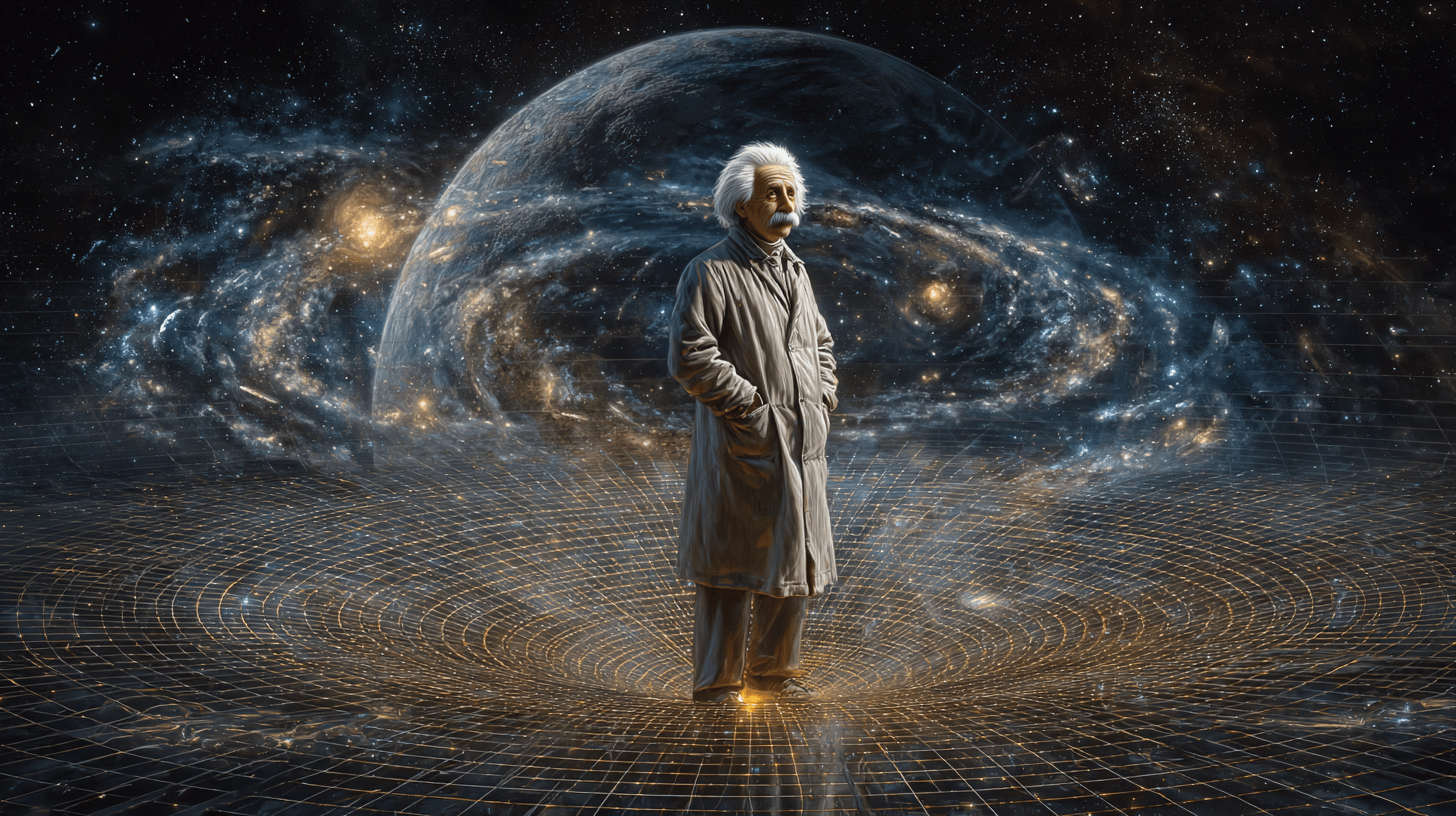
A useful, if imperfect, image is a heavy ball placed on a stretched rubber sheet. The ball creates a dip, and a smaller ball rolling nearby will curve toward it, not because it is being pulled by some invisible force, but because it is following the shape of the surface. Spacetime works similarly, though in four dimensions rather than two.
Putting the Theory to the Test
A theory this strange demanded direct evidence, and general relativity provided a testable prediction almost immediately: light passing near a massive object, such as the sun, should bend by a specific, calculable amount, roughly twice what Newtonian physics alone would predict.
The test came in 1919, during a total solar eclipse that briefly blocked the sun’s glare, allowing stars near its edge to become visible. British astronomer Arthur Eddington led an expedition to the island of Príncipe off the coast of West Africa to photograph the star positions during the eclipse and compare them to their normal positions in the night sky. The measurements matched Einstein’s prediction. The story made front-page news around the world, and Einstein, virtually unknown to the public before that point, became an international celebrity almost overnight.
Since then, general relativity has passed test after test with remarkable precision. Mercury’s orbit shows a slight, gradual shift that Newtonian gravity could not explain but that general relativity predicts exactly. Gravitational waves, ripples in spacetime caused by colliding black holes, were finally detected directly in 2015, a century after Einstein first predicted their existence. Even black holes themselves, regions where spacetime curves so extremely that nothing can escape, follow from the equations of general relativity.
An Everyday Consequence Most People Never Notice
Relativity is often treated as a subject relevant only to physicists studying black holes or the early universe. In fact, millions of people rely on it every day without realizing it. GPS satellites orbit roughly 12,500 miles above Earth, moving fast enough that special relativity causes their onboard clocks to run slightly slower than clocks on the ground, while being far enough from Earth’s gravity that general relativity causes those same clocks to run slightly faster. The two effects don’t cancel out. Left uncorrected, the discrepancy would accumulate into a navigation error of several miles within a single day. GPS systems apply relativistic corrections continuously, built directly into their calculations, so that the technology in a smartphone works only because engineers took Einstein’s equations seriously.
What Popular Memory Gets Wrong
Relativity is frequently summarized as “everything is relative,” suggesting a kind of universal subjectivity where no fact holds up across different viewpoints. This inverts what the theory actually says. Einstein’s work identifies what remains constant, the speed of light and the structure of spacetime intervals, precisely so that we can understand why other quantities, like time and distance, change depending on an observer’s motion. The theory is a search for invariants, not a declaration that nothing is fixed.
A related myth holds that Einstein performed poorly in school and struggled with mathematics as a child. School records and Einstein’s own recollections contradict this; he excelled in mathematics from an early age and was working through advanced calculus texts as a teenager. The myth likely persists because it makes his later achievements feel more encouraging and accessible, but it isn’t supported by the historical record.
Why the Theory Still Matters
General relativity remains one of the two pillars of modern physics, alongside quantum mechanics, which describes the behavior of particles at the smallest scales. The two theories are spectacularly successful within their own domains, yet they do not fit together cleanly. Inside a black hole or during the earliest fractions of a second after the Big Bang, physicists need both theories to apply simultaneously, and current mathematics cannot fully reconcile them. Finding a theory of quantum gravity that unifies them remains one of the most difficult open problems in physics.
Relativity’s deeper legacy lies in what it demonstrated about scientific reasoning itself. Einstein did not discover new data that others had missed. He took existing evidence, including a null result that had puzzled physicists for years, and asked what would have to be true about the universe for that evidence to make sense. The answer required abandoning assumptions about space and time that had gone unquestioned since Newton, assumptions that felt like common sense because they matched ordinary human experience at ordinary human speeds.
The universe, it turned out, was never obligated to match our intuitions. Time and space are not the fixed stage Newton imagined, but flexible, interconnected quantities that bend in response to speed and mass. We do not notice this in daily life only because we move too slowly and stay too far from anything massive enough to reveal it. Once you look closely enough, at the scale of satellites, stars, or the edge of a black hole, the universe has been running on Einstein’s rules all along.