How the Internet Was Built to Survive a War That Never Came
The Machine No One Wanted to Lose
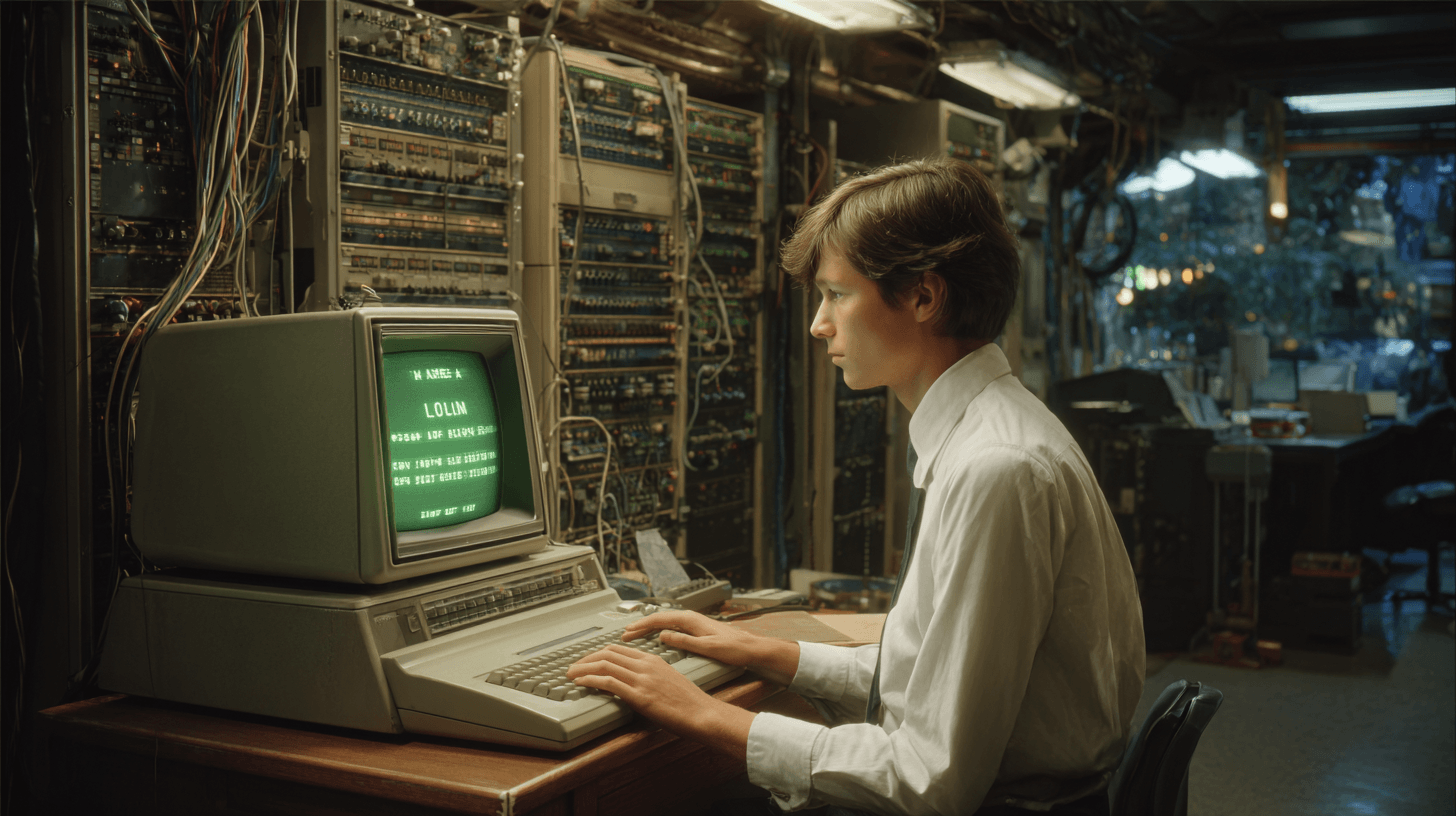
In the summer of 1969, a UCLA graduate student named Charley Kline sat at a computer terminal and tried to send a single word to a computer four hundred miles away in Menlo Park, California. He typed the letters L and O, watched them appear on a screen at Stanford Research Institute, and then the system crashed before he could finish typing “LOGIN.” The two machines had exchanged a total of two letters, and the connection had already broken.
That failed message is now remembered as the first data ever sent across what would become the internet. It is a strange origin story precisely because it wasn’t dramatic. No single person invented the internet, no single company built it, and no single moment marked its arrival. It emerged instead from a decades-long, often uncoordinated effort to solve a much narrower problem: how could computers, built by different institutions on different hardware, talk to each other at all?
Understanding how the internet was built means setting aside the popular image of a lone inventor and looking instead at how military funding, academic ambition, and a series of specific technical puzzles combined to produce something none of the original participants fully anticipated.
The Cold War Problem That Started It
The internet’s earliest ancestor was funded by the U.S. Department of Defense, through an agency called ARPA (the Advanced Research Projects Agency), in a political climate shaped by the Cold War and the shock of the Soviet Union’s Sputnik launch in 1957. ARPA’s mandate was broad: fund research that might give the United States a technological edge, without worrying too much about immediate practical payoff.
One of the problems ARPA researchers cared about was resilience. The United States had built a national telephone network, but that network relied on centralized switching stations. If a handful of those stations were destroyed, large parts of the system could go dead. Researchers including Paul Baran at the RAND Corporation and, separately, Donald Davies in the United Kingdom, began exploring a different way of moving information: instead of establishing a single continuous connection between two points, break messages into small pieces, send each piece independently, and let the network figure out the best path for each one.
This idea became known as packet switching, and it is the single most important technical concept behind the internet. Baran’s original research was explicitly about survivability, though the network ARPA eventually built, called ARPANET, was designed primarily to let expensive, incompatible research computers share resources and data rather than to survive a nuclear strike. The defense funding shaped the project’s priorities, but the researchers who built it were mostly university computer scientists, not soldiers.
How Packet Switching Actually Solved the Problem
Traditional telephone networks used circuit switching: when you made a call, the network reserved a dedicated line for the entire conversation, whether or not anyone was talking. That approach worked reasonably well for voice, but it was wasteful and fragile for computer data, which tends to arrive in short, irregular bursts.
Packet switching solved this by chopping data into small units, each labeled with its destination, and releasing them into a shared network where they could travel independently, sometimes along completely different routes, before being reassembled at the far end. If one path was congested or damaged, packets simply took another route. No single connection had to survive intact for the whole message to arrive.
This is the reason the internet has no dependence on any single central computer. When you send an email or load a webpage today, you are still relying on the same basic principle that Baran and Davies worked out in the 1960s: break the information apart, send the pieces independently, and trust the network to put them back together correctly.
Building the First Network
ARPA awarded the contract to build the physical network to a Massachusetts company called Bolt, Beranek and Newman, whose engineers designed specialized computers called Interface Message Processors to handle the packet-switching work at each site. The first four nodes connected UCLA, Stanford Research Institute, the University of California, Santa Barbara, and the University of Utah in 1969.
Leonard Kleinrock, whose UCLA lab hosted that first, incomplete “LO” message, had done earlier theoretical work on queuing and data networks that helped establish that packet switching could work at scale, not just in principle. Over the next several years, ARPANET grew to connect dozens of university and research computers across the country, allowing researchers to log into distant machines, share files, and, almost as an afterthought, exchange short messages with one another. That last feature, email, turned out to be far more popular than anyone had planned for, and by the mid-1970s it accounted for most of the traffic on the network.
ARPANET worked, but it was still just one network. It could not yet talk to other, separately built networks that used different technical standards. Solving that problem would require a second, less visible breakthrough.
The Problem of Getting Networks to Talk to Each Other
By the early 1970s, several experimental computer networks existed in addition to ARPANET, including radio-based and satellite-based systems built for different purposes. Each used its own internal rules for how data should be packaged and delivered. There was no common language that would let a message originating on one network pass cleanly into another.
Researchers Vint Cerf and Bob Kahn set out to design that common language. Their solution, developed through the mid-1970s and formalized as the Transmission Control Protocol and Internet Protocol, commonly known as TCP/IP, established a shared set of rules that any network could adopt regardless of its internal design. IP handled the addressing and routing of individual packets, while TCP handled reassembling those packets in the correct order and checking that none had been lost or corrupted along the way.
This is the point at which it becomes accurate to talk about “the internet” rather than simply ARPANET, because TCP/IP made it possible to connect a growing collection of independent networks into a single, interoperable system: an internetwork, which is where the modern name actually comes from. On January 1, 1983, a date computer scientists still refer to as flag day, ARPANET formally switched over to TCP/IP, retiring its earlier protocol and adopting the standard that continues to run the internet today.
Why Government Funding Alone Wasn’t Enough
TCP/IP gave computer networks a common language, but the internet still needed infrastructure to reach beyond a small circle of defense-funded research institutions. That expansion came largely through the National Science Foundation, which built a backbone network called NSFNET in the mid-1980s to connect university computing centers around the country. NSFNET’s bandwidth and reach quickly outgrew the original ARPANET, and by 1990 ARPANET itself was formally shut down, its functions fully absorbed into the growing NSFNET-based system.
For most of the 1980s, the internet remained something used almost exclusively by researchers, university staff, and government contractors. It had no graphical interface, no search engines, and no obvious appeal to a general audience. That changed once the National Science Foundation lifted restrictions on commercial use of its network in the early 1990s, opening the door for private companies to build and sell internet access rather than leaving it dependent on federal grants.
The Layer Most People Actually Mean
When most people today say “the internet,” they are usually picturing something that is not, technically, the internet at all: the World Wide Web. The web is a system of linked documents built on top of the internet’s infrastructure, and it was created separately, years after TCP/IP was already running.
In 1989, a British computer scientist named Tim Berners-Lee, working at the CERN particle physics laboratory in Switzerland, proposed a way to organize and link documents across different computers using hypertext, a system in which clicking a piece of text takes the reader directly to related information elsewhere. Berners-Lee built the first web browser, the first web server, and the addressing system that still underlies web links, all running on top of the internet’s existing TCP/IP infrastructure rather than replacing it.
This distinction matters because it explains why the internet and the web are often confused. The internet is the physical and protocol-level network that lets computers exchange data. The web is one particular application built on that network, alongside others such as email and file transfer. The web became so dominant, especially after the release of graphical browsers like Mosaic in 1993 and Netscape Navigator in 1994, that for most users it effectively became synonymous with going online.
From Research Tool to Global Infrastructure
Commercial internet service providers began offering dial-up access to households in the early 1990s, and the combination of an accessible visual web browser with widening public access triggered rapid, largely unplanned growth. Traffic that had once consisted mostly of academic file transfers and email between a few hundred institutions turned into a fast-expanding commercial and social medium used by millions of people within just a few years.
That growth brought real costs alongside its benefits. The late-1990s “dot-com” boom saw enormous investment poured into internet companies based more on speculation than on proven business models, and its 2000 collapse wiped out a large share of that invested capital, though many of the technologies and companies that survived went on to define the following two decades of internet growth. The infrastructure itself also had to be substantially rebuilt and expanded, since a network designed for a few thousand research computers had to scale to support billions of connected devices.
What the Story Reveals About Invention
The common misconception is that the internet was invented, in the way a lightbulb or a telephone was invented, by an identifiable person at an identifiable moment. The more accurate picture is a layered one: a defense-funded packet-switching network built to connect research computers, a protocol designed to let separate networks speak the same language, a publicly funded backbone that extended the network’s reach, and a hypertext application built on top of all of it that made the system usable and appealing to ordinary people.
Each layer solved a specific, narrow problem, and none of the people solving those problems set out to create anything resembling the internet as it exists today. Baran was thinking about network survivability. Cerf and Kahn were thinking about interoperability between existing networks. Berners-Lee was thinking about how physicists at CERN could share research documents more easily. The internet is the accumulated, largely unplanned result of those separate efforts converging.
That layered history also explains something about how large technical systems tend to develop more broadly. They rarely arrive as finished, comprehensive designs. They accumulate, protocol by protocol and institution by institution, until something that began as a modest solution to a specific problem becomes infrastructure the rest of the world depends on without a second thought.