How the Smartphone Reorganized Daily Life
A Decade of Devices Compressed Into One Pocket
In 2006, a traveler heading to the airport might have carried a mobile phone for calls, a digital camera for photos, an iPod for music, a paper map or a separate GPS unit for directions, and possibly a laptop for email. Each device did one job well. None of them talked to each other, and none of them fit in a single pocket.
A decade later, that same traveler carried one object that did all of it — and dozens of things none of those devices could do at all. The central question is not simply what the smartphone does. It is why folding so many separate tools into a single, constantly connected device changed the rhythm of daily life so much more than any single new gadget had before.
The answer has less to do with any one piece of hardware and more to do with what happens when computing, communication, and constant connectivity are combined and placed permanently within reach.
The World Before the Smartphone
By the early 2000s, mobile phones were already common, and some — known as smartphones in a limited sense — could send email or browse simplified web pages. Companies like Palm, BlackBerry, and Nokia had built devices aimed mostly at business users who needed messaging on the go.
These early devices shared a common limitation: they were built around physical keyboards and small, low-resolution screens designed for text, not for rich interaction. Software came preinstalled, and there was no simple way for outside developers to add new capabilities. A phone bought in 2005 could do in 2007 only what it had been able to do the day it left the factory.
Meanwhile, the internet itself was becoming something people expected to use constantly, but that expectation collided with reality the moment they left their desks. Mobile browsing existed, but it was slow, cramped, and widely regarded as a poor substitute for a real computer.
The Interface That Changed the Equation
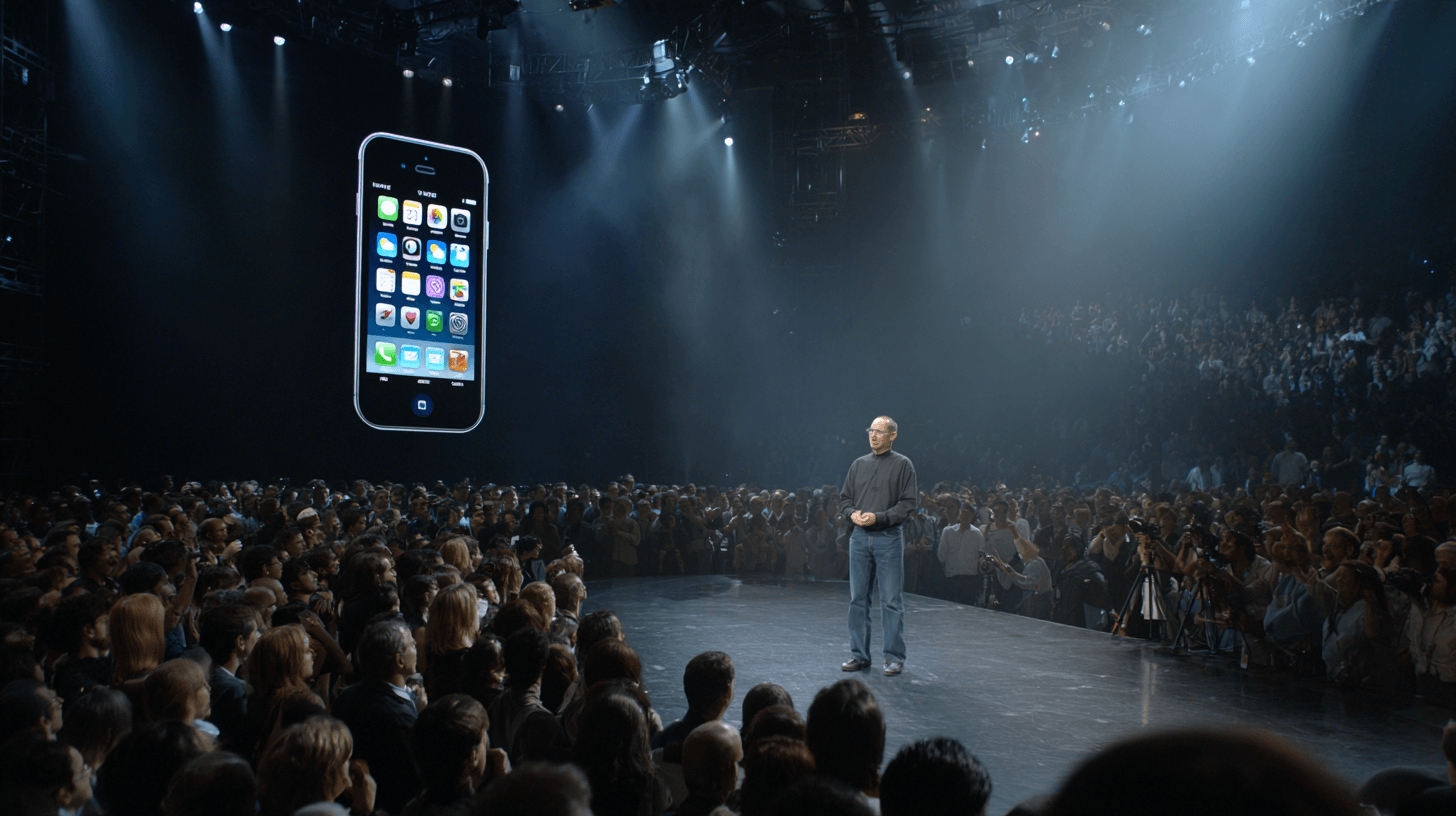
When Apple introduced the iPhone in January 2007, the most consequential design decision was not the touchscreen alone — it was the decision to remove the physical keyboard entirely and let software control the whole surface of the device. That single choice meant the interface itself could be redesigned for any task, instead of being permanently shaped by whatever buttons the manufacturer had installed.
A touchscreen is not just a convenience. It is a general-purpose canvas. The same physical device could become a keyboard, a game controller, a map, or a camera viewfinder, depending only on which software was running. This flexibility is what allowed a single object to absorb the functions of a dozen older ones.
The second decisive step came a year later, in 2008, with the opening of the App Store. Apple did not simply build more features into its own software — it opened the platform to outside developers and let them sell directly to users. This turned the smartphone into what economists call a two-sided market: a platform that becomes more valuable to users as more developers build for it, and more valuable to developers as more users buy the device. Google’s Android, launched around the same time, adopted a similar app-based model and would eventually become the more widely used platform worldwide.
Once that loop started, the smartphone stopped being a fixed product and became an open-ended one. Its capabilities were no longer limited by what a single company could design. They were limited only by what an entire global community of developers could imagine and build.
The smartphone did not succeed by inventing new functions. It succeeded by making every future function installable.
How Constant Connectivity Changed Behavior
Mobile internet access existed before the smartphone, but it was occasional — something people used at a desk or through a slow, awkward mobile browser. The combination of app-based software, faster mobile data networks, and an always-on design changed that pattern into something closer to constant presence.
This shift mattered because many of the most widely used smartphone apps, particularly social media and messaging platforms, generate revenue primarily through advertising. Advertising revenue depends on how much time people spend inside an app and how often they return to it. As a result, much of the software running on smartphones was designed, refined, and tested specifically to maximize engagement — through notifications, infinite scrolling feeds, and features built around social approval, such as likes and shares.
This is a structural incentive, not a conspiracy. Companies competing for advertising revenue had strong business reasons to build software that people would open frequently and use for long stretches of time. The smartphone provided the ideal delivery mechanism: a device most people kept within arm’s reach for nearly all of their waking hours.
The result was a new kind of relationship between people and technology. Earlier computers required a person to sit down and choose to log on. The smartphone reversed that relationship — it was the device, not the person, that increasingly decided when attention should be interrupted.
The Economic and Social Consequences
The smartphone’s effects reached far beyond communication and entertainment. Its built-in GPS, camera, and internet connection made possible entire industries that had not existed in their current form before, including ride-hailing services, food delivery platforms, and mobile payment systems. Companies such as Uber were not simply new ideas — they were only technically possible once a majority of potential customers and drivers carried a GPS-equipped, internet-connected computer in their pocket.
In regions where landline telephone networks and traditional banking infrastructure had never been fully built, the smartphone allowed many people to skip those earlier stages of development entirely. Mobile banking and mobile payment systems expanded rapidly in parts of Africa, South Asia, and Latin America, giving millions of people their first reliable access to financial services without requiring a physical bank branch nearby.
Journalism and media distribution changed as well. Smartphones turned every user into a potential photographer, reporter, and publisher, able to capture and share events in real time. This expanded the range of voices able to reach a wide audience, while also weakening the traditional gatekeeping role that newspapers, broadcasters, and editors had held for most of the twentieth century.
What the Debate Over Smartphones and Well-Being Gets Right — and Wrong
Public conversation about smartphones, and about social media in particular, often treats their effects on mental health as a settled and simple story. The evidence is more complicated than that.
Some researchers, including psychologist Jonathan Haidt, have argued that the rapid rise of smartphone and social media use among adolescents coincided with documented increases in reported anxiety and depression, particularly among teenage girls. Other researchers have pushed back, noting that correlation across broad trends does not establish that smartphones themselves caused the shift, and that survey-based mental health data is also affected by changing diagnostic practices, reporting habits, and broader social conditions during the same period.
The honest summary is that researchers continue to debate how much of the change in adolescent mental health can be attributed specifically to smartphones, as opposed to social media design, changing parenting norms, economic pressure, or other overlapping factors. What is better supported is a narrower claim: notification-driven apps are built to capture attention, and many users — of all ages — report finding it difficult to disengage from their phones even when they want to.
The Limits of a Device That Seems Limitless
The smartphone’s spread has not been even, and its benefits have not reached everyone equally. Billions of people in lower-income regions still rely on older, less capable devices or lack consistent access to affordable mobile data, meaning the digital advantages associated with smartphones remain unevenly distributed even within connected societies.
The device’s design also carries real trade-offs. Small screens and split attention make sustained, deep reading and concentrated work more difficult for many users compared with a dedicated computer. Battery limitations, screen fragility, and planned software obsolescence create ongoing costs, both financial and environmental, tied to a product that a large share of the world’s population now replaces every few years.
Where the technology goes next remains genuinely uncertain. Foldable screens, on-device artificial intelligence, and voice-based interfaces are already reshaping what a “phone” can look like, and it is not yet clear whether the smartphone in its current touchscreen form will still be the dominant personal computing device a decade from now.
Why This Particular Device Mattered So Much
The smartphone did not change daily life because it was the first device to offer internet access, take photographs, or play music. Older devices could already do each of those things separately. It changed daily life because it combined all of them inside one object that people carried constantly, connected to an open software platform that could keep adding new capabilities indefinitely.
That combination collapsed the distance between having a thought and acting on it. A question could be answered, a photo could be shared, a purchase could be made, or a stranger’s car could be summoned, all within seconds, without leaving wherever a person happened to be standing.
The smartphone did not simply give people a more powerful tool. It removed nearly every pause that used to exist between wanting something and getting it — and that change in the texture of daily life, more than any single feature, is what made the device impossible to set aside.