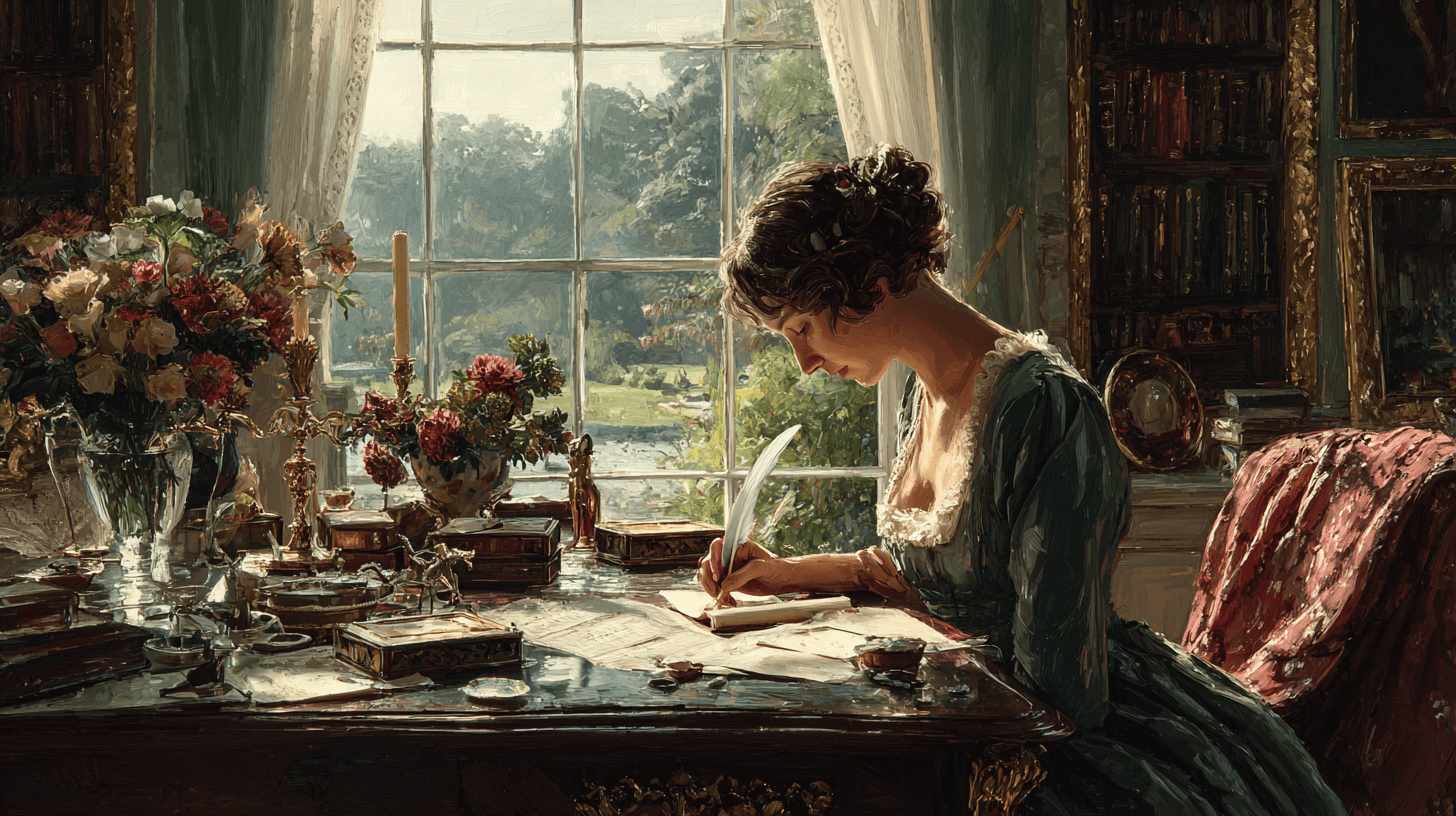
Why Jane Austen Is Still the Author Women Love Two Centuries Later
Jane Austen published her novels without her name on them. The title pages read only “By a Lady.” She never married, rarely traveled beyond a small circle of English villages, and died at forty-one having earned, by some estimates, less in her lifetime than a single year of royalties from one modern film adaptation. And yet her six novels have never gone out of print, and new readers keep finding her, often through channels she could not have imagined: streaming adaptations, fan podcasts, academic conferences, and quiet personal recommendations passed from one reader to another.
The puzzle is not that Austen is well regarded. Many nineteenth-century novelists are well regarded. The puzzle is that she remains genuinely beloved, read by choice rather than obligation, by people who could easily ignore a writer whose world was so narrow. Her novels rarely leave the drawing room. Napoleon barely appears. The great political convulsions of her era pass by almost unmentioned.
So why does a writer this contained keep producing readers this devoted?
A Writer Working Inside a Small World
Austen wrote what she knew, and what she knew was deliberately small. She once described her own material, in a letter to her nephew, as work done on “a little bit (two inches wide) of ivory,” suggesting fine detail rather than broad landscape. Her novels are set almost entirely among the English gentry: families with enough property to worry about but not enough to be secure, navigating a marriage market where a woman’s future depended on decisions she rarely got to make herself.
This was not a limitation Austen stumbled into. It was the world available to her. Women of her class could not typically inherit property on equal terms with male relatives, could not vote, and had few respectable paths to financial independence outside marriage. Austen herself, after her father’s death, depended on the goodwill of male relatives for a home. She understood the marriage plot not as a romantic convention but as an economic reality dressed in the language of courtship.
That understanding gives her fiction its edge. When Charlotte Lucas in Pride and Prejudice accepts a marriage proposal from a man she does not love, Austen does not present this as a failure of the heart. She presents it as a rational response to limited options, narrated without judgment and without sentimentality. The scene is quietly devastating precisely because Austen refuses to soften it.
The Invention That Let Readers Inside a Character’s Head
Part of Austen’s staying power comes from a technical innovation that changed what novels could do. She was among the first English writers to make sustained, skillful use of free indirect discourse: a narrative technique that blends a character’s private thoughts with the narrator’s voice, without quotation marks or the announcement “she thought.”
The effect is subtle but powerful. In Emma, readers experience the heroine’s misjudgments from the inside, sharing her confident, mistaken interpretations of the people around her, before the narrative gradually reveals how wrong she has been. The reader is not told that Emma is being foolish. The reader discovers it alongside her, and often slightly before her, which produces a peculiar intimacy that later novelists would build entire careers on.
This is why Austen reads as strikingly modern despite her Regency setting. The technique she refined would go on to shape the psychological realism of writers from George Eliot to Virginia Woolf, who admired Austen’s control precisely because it created interior depth without heavy-handed narration.
Irony Without Cruelty
Austen’s wit is often the first thing new readers notice, and it remains one of the clearest reasons she is still funny in a way many of her contemporaries are not. Her irony operates at the level of the sentence. The opening line of Pride and Prejudice, declaring it “a truth universally acknowledged” that a wealthy single man must be in want of a wife, immediately signals that the narrator does not fully believe what she is saying, and that the reader is invited to notice the gap between social assumption and actual truth.
This is a difficult tone to sustain. Satire easily curdles into contempt, and contempt is exhausting to read for very long. Austen avoids this by directing her sharpest irony at social behavior rather than at individual human worth. She mocks vanity, hypocrisy, and self-deception with real precision, but she rarely mocks the capacity for growth. Her protagonists are allowed to be wrong and then to become less wrong, which gives her comedy a warmth that keeps it from curdling into cynicism.
The Misconception That She Wrote Only Romance
A common misunderstanding, reinforced by decades of film marketing built around ballrooms and love confessions, is that Austen wrote romantic escapism. Her novels do end in marriages, and the courtships are genuinely engaging. But the marriages that conclude her books are rewards for moral clarity, not simply for romantic longing.
Elizabeth Bennet does not end up with Mr. Darcy because she wanted him from the start. She ends up with him after both characters confront their own pride and prejudice, a process that requires real self-correction on both sides. Anne Elliot in Persuasion is not reunited with Captain Wentworth through fated attraction alone, but through years of quiet constancy and eventual honesty about a mistake she made years earlier. Austen’s marriages function as verdicts on character, not simply as happy endings bolted onto a love story.
This distinction matters because it explains why Austen has held up so well among readers who are otherwise skeptical of traditional romance narratives. Her novels are structured less around whether the couple will get together and more around whether the characters deserve to.
Complicating the Picture: What Austen Leaves Out
Modern readers and scholars have also pushed back against an overly comfortable image of Austen. Her novels are largely silent on the economic systems that supported the leisured world she depicts, including the wealth some of her characters draw from colonial trade and, in Mansfield Park, from a Caribbean plantation whose operations are mentioned only obliquely. Postcolonial critics, most notably Edward Said, have argued that this silence is itself significant, showing how easily a comfortable domestic world could be built on arrangements its inhabitants preferred not to examine closely.
This is a fair and important critique, and it complicates any simple celebration of Austen as a universal moral guide. Her sharp eye for hypocrisy in the drawing room did not extend, at least on the page, to the broader systems that made the drawing room possible. Acknowledging this does not diminish what she accomplished within her chosen frame. It does mean that her fiction is best understood as a brilliant study of a specific social world, rather than a complete account of the era that produced it.
A Reputation Built in Layers
Austen’s current status was not immediate. Her novels sold modestly during her lifetime and earned respectful but limited attention. It was Sir Walter Scott, already the most famous novelist in Britain, who gave her an important early boost, praising in his journal her “exquisite touch” for rendering ordinary life and contrasting it with his own more sweeping historical romances. That endorsement helped establish her reputation among serious readers even as popular taste moved toward grander, more dramatic fiction.
Her standing rose again in the early twentieth century, when critics including Virginia Woolf held her up as a model of formal control and psychological precision, arguing that Austen had mastered a kind of writing that looked simple only because she had made it look that way. Later in the century, television and film adaptations, especially a widely watched 1995 BBC production of Pride and Prejudice, introduced her to audiences who might never have picked up the novels otherwise, and often sent them back to the books afterward. This layered reputation, built by novelists, critics, and adapters across two centuries, is part of why Austen’s popularity feels durable rather than trend-driven. Each generation has found a different reason to keep reading her.
Why the Small Canvas Still Works
The deeper explanation for Austen’s endurance may be the simplest one. She chose to examine, with total precision, a small number of universal problems: how people deceive themselves, how social pressure shapes private choices, how pride and shame distort judgment, and how genuine understanding between two people is difficult to earn and easy to fake. Because she narrowed her setting so deliberately, she had room to examine these problems in extraordinary depth.
A writer working across battlefields and empires has less space to linger on the exact moment someone realizes they have misjudged another person’s character. Austen had nothing but that space. Her novels succeed not despite their narrow world but because of how completely she was able to explore it.
That is why readers two centuries later, living in circumstances Austen never saw, still recognize themselves in her characters’ mistakes. The corsets and carriages have dated. The observations about vanity, self-deception, and the slow work of genuine understanding have not.
Frequently Asked Questions
Did Jane Austen publish her novels under her own name?
No. Her novels were published anonymously during her lifetime, typically credited only to “A Lady” or to “the Author of” her previous work. Her identity as the author became widely known only after her death.
Why do Austen’s novels focus so little on major historical events of her time?
Austen wrote about the domestic and social world she knew directly, largely excluding the Napoleonic Wars and other national events that were unfolding around her. Scholars generally read this as a deliberate narrowing of scope rather than ignorance of the wider world, since two of her brothers served in the Royal Navy during this period.
Is Jane Austen considered a feminist writer?
Historians and literary scholars are divided on this question. Austen did not advocate directly for women’s legal or political rights, but her fiction repeatedly exposes the economic vulnerability women faced under the marriage and inheritance laws of her time, which many scholars read as a form of social critique even without explicit political argument.
Which Jane Austen novel is considered the best starting point for new readers?
There is no single agreed answer, but Pride and Prejudice is most commonly recommended for new readers because of its clear structure, sharp wit, and widely appealing central relationship.