How Romeo and Juliet Became the Blueprint for Every Love Story After It
Every year, thousands of couples name a child Romeo or Juliet without ever having read a line of Shakespeare’s play. Advertisers borrow the phrase “star-crossed lovers” to sell everything from perfume to phone plans. When a modern news story describes two people from rival backgrounds falling in love, journalists reach for the same comparison almost automatically. No other love story in the English language commands that kind of instant recognition.
The strange part is that Shakespeare did not invent the tale. The plot of two young lovers destroyed by their families’ hatred had circulated in Europe for decades before he wrote a single scene. So the real question is not where the story came from, but why this particular version of it became the one the world could not stop retelling.
The answer has less to do with the plot itself than with what Shakespeare did to the material he inherited: how he compressed it, how he wrote it, and how he pushed it, without warning, from comedy into catastrophe.
A Plot Shakespeare Borrowed and Rebuilt
By the time Shakespeare sat down to write his play in the mid-1590s, the story of two lovers from feuding families already had a long paper trail. Italian writers had told versions of it earlier in the sixteenth century, and an English poet named Arthur Brooke had turned it into a long narrative poem in 1562 called The Tragical History of Romeus and Juliet. Shakespeare leaned on Brooke’s poem heavily for names, events, and structure.
What he changed was pacing. In Brooke’s version, the romance unfolds across several months, giving the lovers time to marry, separate, and reunite with something like ordinary patience. Shakespeare tore that timeline apart. In his play, the entire relationship, from first meeting to double death, plays out in four or five days.
That single decision changed the emotional physics of the story. Compressed into less than a week, every choice the characters make feels urgent rather than considered. There is no room for second thoughts, cooling-off periods, or adult intervention. The lovers are not reckless because Shakespeare wanted to moralize about young people. They are reckless because he removed the calendar that would have let them behave otherwise.
A City Built for a Feud to Make Sense
Setting the play in Verona did more than supply colorful scenery. Italian city-states in this period were genuinely organized around powerful family networks, in which loyalty to one’s household could override loyalty to the law itself. Audiences in Shakespeare’s London did not need the feud between the Montagues and Capulets explained at length, because the idea of family honor overriding civic order was culturally legible to them.
This is why the opening street brawl matters more than it first appears to. Before either lover speaks a word, the audience already understands that this is a world where grudges are inherited rather than chosen. Romeo and Juliet are not fighting against an abstract idea of hatred. They are fighting against a social structure that has existed since before they were born, one neither of them had any part in creating.
That detail quietly reframes the whole tragedy. The lovers are not undone by a flaw in their own characters so much as by an argument that predates them and will outlive them if nothing changes.
The Meeting That Turns Into a Poem
When Romeo and Juliet meet at the Capulet feast, Shakespeare does something unusual with the language itself. Their opening exchange forms a complete sonnet, split between the two speakers, with the same rhyme scheme Elizabethan poets used for love poetry addressed to a single beloved.
The effect is subtle but powerful: two strangers, speaking for the first time, instinctively finish each other’s rhymes. Structurally, the poetry suggests a compatibility the plot has not yet earned. Long before either character explains why they feel drawn to the other, the verse itself performs the attraction.
This matters because it solves a problem nearly every love story has to face: how do you make an audience believe in sudden love without it looking cheap? Shakespeare’s answer was not to argue for the lovers’ connection through dialogue, but to build it into the sound of the language. Readers and audiences absorb the compatibility before they consciously analyze it.
Few playwrights before or since have solved the problem of instant attraction this elegantly. It is one reason the balcony scene that follows, with its mixture of wit, hesitation, and vulnerability, still reads as fresh rather than saccharine centuries later.
The Comedy That Turns Into a Tragedy
For roughly its first half, Romeo and Juliet behaves like one of Shakespeare’s romantic comedies. There are secret meetings, comic servants, teasing wordplay, and a friar willing to help arrange a hasty marriage, all standard ingredients of the genre. Then, in the space of a single scene, everything changes.
Tybalt kills Mercutio, Romeo kills Tybalt in return, and the play pivots without warning from comic momentum toward irreversible violence. Mercutio’s dying line, cursing both households, functions almost as the moment the genre itself breaks.
This tonal collision is not an accident of plotting. Shakespeare was experimenting with what happens when a comic structure, built on misunderstandings that usually resolve themselves, collides with real consequences that cannot be undone. Once blood is spilled, jokes cannot fix the situation the way they could earlier in the play. Every scene that follows moves under the shadow of that irreversible act.
Few tragedies build this kind of trap door into their own structure, one that audiences do not see coming until they have already fallen through it.
What Popular Memory Gets Wrong
Modern culture tends to remember Romeo and Juliet as the ultimate celebration of true love. That reading flattens what the play is actually doing.
Read closely, the text repeatedly signals that the lovers’ haste is dangerous, not admirable. Friar Laurence, who agrees to marry them, warns Romeo directly that violent delights carry violent consequences. Juliet’s own family assumes she can be married off within days to a suitor she has never chosen. Nearly every adult in the play, however flawed, tries at some point to slow the young lovers down, and every attempt fails.
The tragedy is not that love is doomed by fate alone. It is that a system of adult feuding, combined with impulsive choices made by teenagers with no safe outlet for those choices, leaves almost no room for a different outcome. Shakespeare gives the audience a play about consequences, not a manual for romantic devotion.
It is worth noting that this distinction has fueled genuine scholarly debate. Some critics emphasize fate and the stars, pointing to the prologue’s own description of the lovers as “star-cross’d.” Others emphasize human error and social failure, arguing that fate is a convenient screen for choices adults could have prevented. The play arguably supports both readings at once, which is part of why it has remained so durable for literary interpretation.
How the Story Escaped the Stage
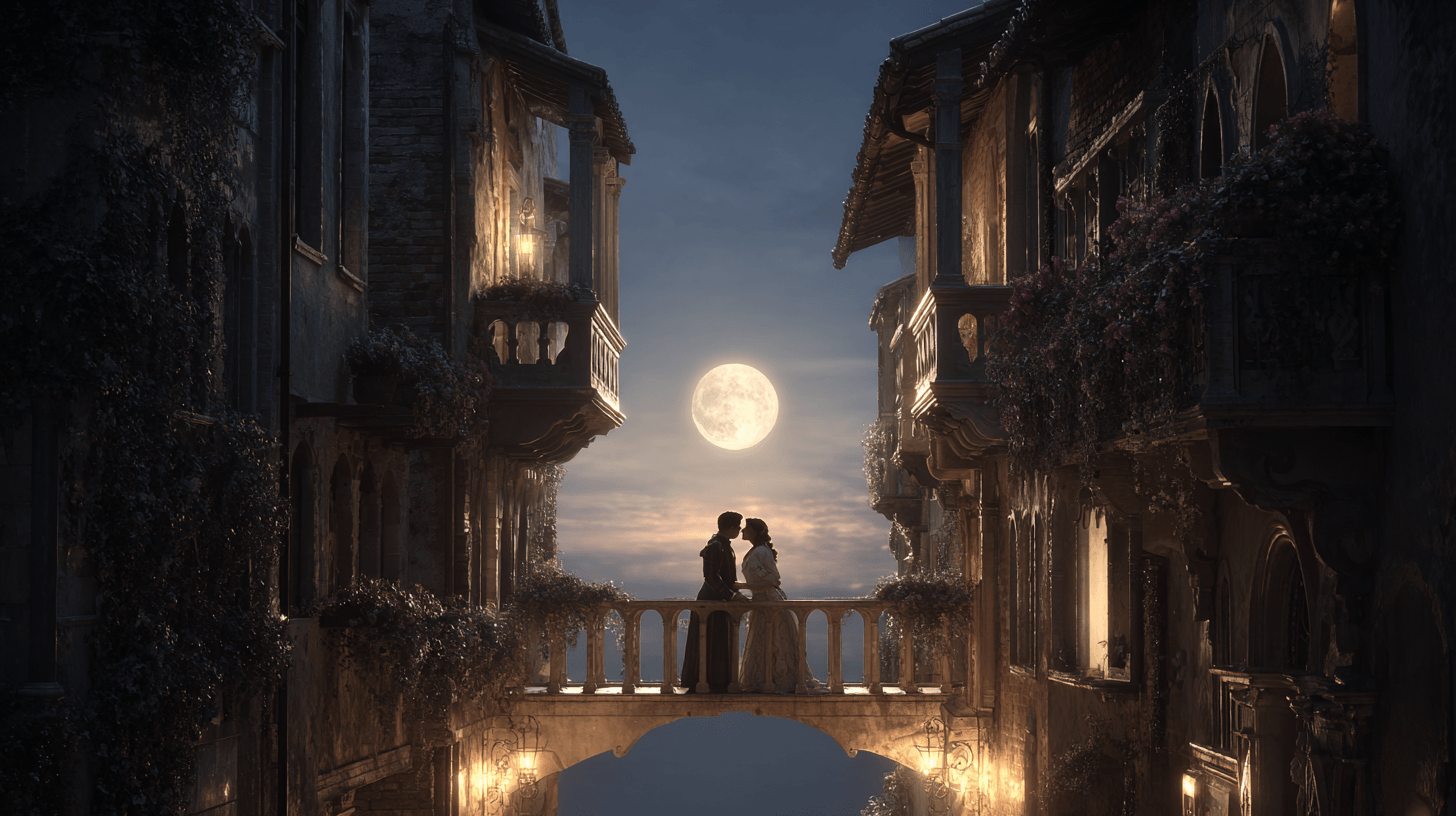
A play this influential rarely stays contained to the theater, and Romeo and Juliet escaped its original form remarkably quickly and completely. Composers turned it into opera and ballet, most famously Sergei Prokofiev’s ballet score, which is still performed by companies worldwide. Painters and illustrators returned to the balcony scene for generations, cementing it as visual shorthand for romantic longing.
In the twentieth century, the story crossed into new genres entirely. West Side Story relocated the feuding families to rival street gangs in New York, replacing the Montagues and Capulets with the Jets and the Sharks, and became one of the most successful stage musicals and films of its era. Decades later, filmmakers continued reinterpreting the material for new audiences, from Franco Zeffirelli’s 1968 film set in Renaissance Italy to Baz Luhrmann’s 1996 adaptation, which transplanted the story into a modern, gun-soaked American city while keeping Shakespeare’s original language largely intact.
What allowed the story to migrate so easily across centuries and mediums is precisely the structure Shakespeare built: a rigid social divide, a compressed and irreversible timeline, and a sudden turn from lightness to catastrophe. Change the setting, the costumes, or the century, and the underlying architecture still works.
Why the Template Still Fits
The reason Romeo and Juliet became the reference point for love stories, rather than any of the many similar tales that came before or after it, is not that Shakespeare invented forbidden love. It is that he built a structure precise enough to be copied endlessly while remaining specific enough to feel new every time.
A rigid barrier between two people. A short, unforgiving timeline that removes the option of patience. A moment of violence that makes retreat impossible. And language sturdy enough to survive translation, adaptation, and four centuries of reinterpretation. Strip away the Italian setting and the Elizabethan verse, and what remains is a mechanism, one that writers have been reassembling under different names ever since.
Shakespeare did not simply write a tragic romance. He wrote the operating instructions for one, and storytellers have been following them, consciously or not, for more than four hundred years.
Frequently Asked Questions
Is Romeo and Juliet based on a true story?
No verified historical couple inspired the play directly. Shakespeare adapted an existing literary tradition of feuding-family romances, most immediately Arthur Brooke’s 1562 narrative poem, which itself drew on earlier Italian tales.
How old are Romeo and Juliet in the play?
The text states that Juliet is not yet fourteen. Romeo’s age is never specified, though he is generally understood to be a young man rather than a boy.
Did Shakespeare invent the balcony scene?
The specific staging and dialogue are Shakespeare’s own creation, though earlier versions of the story included a private meeting between the lovers. The famous physical image of a lover speaking from a balcony above became fixed in popular culture largely because of later stage productions and illustrations rather than the original stage directions, which do not explicitly mention a balcony.
Why do the events of the play happen so quickly?
Shakespeare deliberately compressed a story that unfolded over months in his sources into four or five days. The shortened timeline heightens urgency and removes opportunities for the characters, or the adults around them, to reconsider their choices.