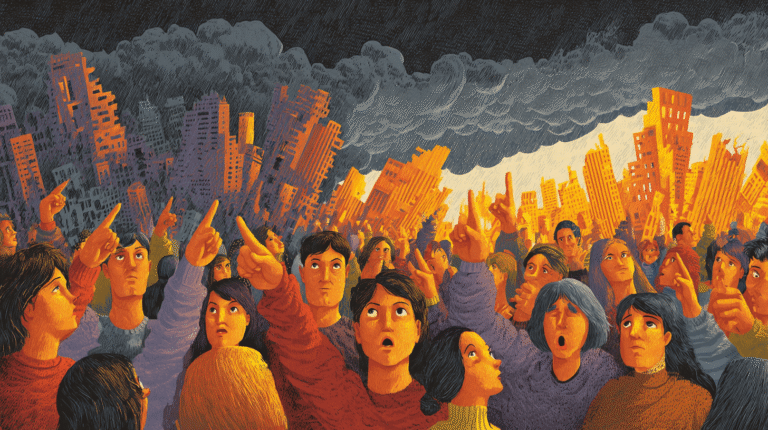
Why Do We Need the State?
In 1991, the government of Somalia collapsed. There was no single dramatic revolution moment that ended it, no new regime that rose to replace it—just a slow disintegration into competing clan militias, each claiming authority over a patch of territory. For the next two decades, most of the country had no functioning central government at all. Warlords collected taxes at checkpoints. Local courts based on religious law filled some of the vacuum. Telecommunications companies built their own private security forces to protect their networks.
Somalia’s experience is often cited as a natural experiment: what actually happens when a state disappears. The answer was not a return to peaceful self-governance. It was violence, instability, and a scramble by armed groups to seize the functions a government normally performs—taxation, dispute resolution, protection.
That outcome sits at the center of one of the oldest questions in political philosophy. Why do human societies organize themselves under states at all? Why do people accept being taxed, conscripted, policed, and ruled by institutions they did not personally choose? The question matters because the answer shapes how we think about the limits of government power, the rights of citizens, and what happens when state authority breaks down.
Life Without a Sovereign
The philosopher Thomas Hobbes gave the classic version of this question its sharpest form in the seventeenth century. Writing during the English Civil War, a period of real civil collapse, Hobbes asked what life would be like in a “state of nature”—a condition with no government, no laws, and no shared authority to enforce agreements.
His answer was bleak. Without an external power to compel cooperation, Hobbes argued, individuals could never fully trust one another. Even a person who wanted peace had to prepare for the possibility that others would attack first. That logic, repeated across an entire population, produced a condition of permanent insecurity. Hobbes described the resulting life in a much-quoted phrase: “solitary, poor, nasty, brutish, and short.”
This was not primarily a claim about human cruelty. It was a claim about incentives. Even reasonably decent people, Hobbes argued, will act aggressively if they cannot be sure that others will not attack them first. The problem is structural, not just moral. This is why, in Hobbes’s account, individuals rationally agree to transfer their power to a sovereign authority strong enough to keep everyone in check. The state’s core justification is not that it makes people good. It is that it makes trust possible.
The Bargain at the Heart of Government
Hobbes was only the first of several major thinkers to frame the state as the outcome of an implicit agreement—a social contract. Later philosophers accepted the basic premise but drew very different conclusions about what that contract actually authorized.
Locke: Rights Before Government
John Locke, writing a generation after Hobbes, agreed that people leave a state of nature to gain security, but he rejected the idea that this required surrendering all power to an absolute ruler. In Locke’s account, individuals already possess natural rights—to life, liberty, and property—before any government exists. The state’s job is to protect those pre-existing rights, not to create them. If a government violated this trust badly enough, Locke argued, the people retained the right to resist it. This version of the social contract, with its built-in limits on state power, became a foundational influence on later constitutional and republican thought, including the political arguments used to justify the American Revolution.
Rousseau: The General Will
Jean-Jacques Rousseau offered a third variation. He argued that legitimate political authority came not from protecting private interests but from expressing the “general will” of the community as a whole—a collective judgment about the common good that could differ from the sum of everyone’s individual preferences. For Rousseau, true freedom was not the absence of government but participation in a political community whose laws citizens had a hand in shaping.
These three thinkers disagreed sharply about what the state was for and how much power it should hold. But they shared a common premise: that political authority is best understood as something people consent to, in exchange for security, protected rights, or collective self-governance.
Why Historians Tell a Different Story
Modern historical and archaeological research complicates this picture considerably. Actual states, it turns out, rarely originated through anything resembling a voluntary agreement.
The anthropologist and political scientist James C. Scott has argued that the earliest states emerged not because scattered individuals chose to pool their security, but because grain agriculture created something new: a taxable, countable, confinable population. Grain crops ripen at predictable times and can be measured, stored, and seized—unlike root crops or foraged food, which are far harder for any external authority to track and tax. Scott’s research suggests that early states formed around this administrative advantage, extracting labor and surplus from settled farming populations, sometimes through direct coercion rather than agreement.
This does not make the social contract tradition useless. It remains a powerful tool for asking what political authority ought to look like, and what legitimizes it. But it does mean that the historical origin of actual states looked less like a negotiated bargain among equals and more like the gradual, often coercive consolidation of power by those positioned to extract resources from settled communities. The contract, in other words, may describe an ideal justification more than a historical event.
The State as a Solution to Shared Problems
Even without treating the social contract as literal history, the framework highlights something real: many of the problems the state solves are collective action problems that individuals cannot solve on their own, no matter how cooperative they are personally.
Consider national defense. If a community relies on volunteers to fund an army, each individual has an incentive to let others pay while still enjoying the protection—a problem economists call free-riding. Left purely to voluntary cooperation, defense tends to be underfunded, because its benefits are shared by everyone whether they contributed or not. A state that can compel taxation solves this problem by removing the option to free-ride.
The same logic applies to public infrastructure, disease control, contract enforcement, and courts. An individual farmer benefits from roads connecting markets, but building a national road network exceeds what any single household or business can coordinate. A functioning legal system lets two strangers trade with confidence, because either side can appeal to an enforceable, impartial rule rather than relying purely on personal trust. These functions do not require ideological commitment to any particular theory of the state. They emerge from the practical difficulty of coordinating large, anonymous populations without some centralized enforcement mechanism.
What Happens When the State Fails
Somalia is not an isolated case. Other periods and regions of state collapse—Lebanon during its 1975–1990 civil war, parts of the Democratic Republic of Congo, Afghanistan during various phases of conflict—show a recurring pattern. When central authority disappears, it rarely leaves a vacuum of peaceful self-organization. Instead, competing armed groups typically move to fill the space, because the underlying problem the state was solving—the need for some entity capable of enforcing order and extracting resources—does not disappear along with the government.
This is an important qualification to keep in view. It does not prove that states are inherently good, only that the absence of a state does not automatically produce freedom or cooperation. In practice, stateless conditions have often been captured by whichever group could organize violence most effectively, which is a different outcome than the peaceful self-governance imagined by some critics of centralized authority.
The Case Against the State
Not every political philosopher accepts that this trade-off is worth making. Anarchist thinkers, from Pierre-Joseph Proudhon to Mikhail Bakuntin to more recent theorists, have argued that the state is not simply a neutral solution to coordination problems. It is, in their view, an institution of domination—one that concentrates the legitimate use of violence in the hands of a small ruling class and then justifies that concentration after the fact.
This critique has real force. States throughout history have used their coercive power for purposes far removed from protecting citizens: extracting wealth for narrow elites, waging wars of conquest, and suppressing dissent. The historical record Scott and others describe—states built on the coercive capacity to tax settled farmers—lends some support to this skeptical reading. The question of whether a given state’s power is being used to solve genuine collective problems or merely to entrench the interests of those who control it remains a live and often contentious one in every functioning democracy.
Why the State Persists
Despite these criticisms, no alternative to the state has managed to durably replace it at scale. Attempts to organize large, complex societies through purely voluntary or decentralized structures have historically struggled to provide the same level of security, infrastructure, and dispute resolution that even a flawed state can deliver.
What has changed over time is not whether states exist, but what people expect them to do. The modern state in most democracies is expected not merely to prevent violence, but to provide education, manage economic stability, and offer some measure of social protection. This expanded role reflects an evolving understanding of the same underlying bargain Hobbes, Locke, and Rousseau were each trying to describe: that individuals surrender some autonomy in exchange for benefits that would be impossible to secure alone, and that the legitimacy of this arrangement depends on how well the state actually delivers on it.
The state, then, is not simply an answer to a single problem. It is an evolving, contested institution shaped by security needs, economic incentives, and shifting ideas about what a government owes the people it governs. The philosophical debate over whether that arrangement is justified has never fully settled—but the practical alternative, as Somalia’s experience suggests, has rarely proven better.