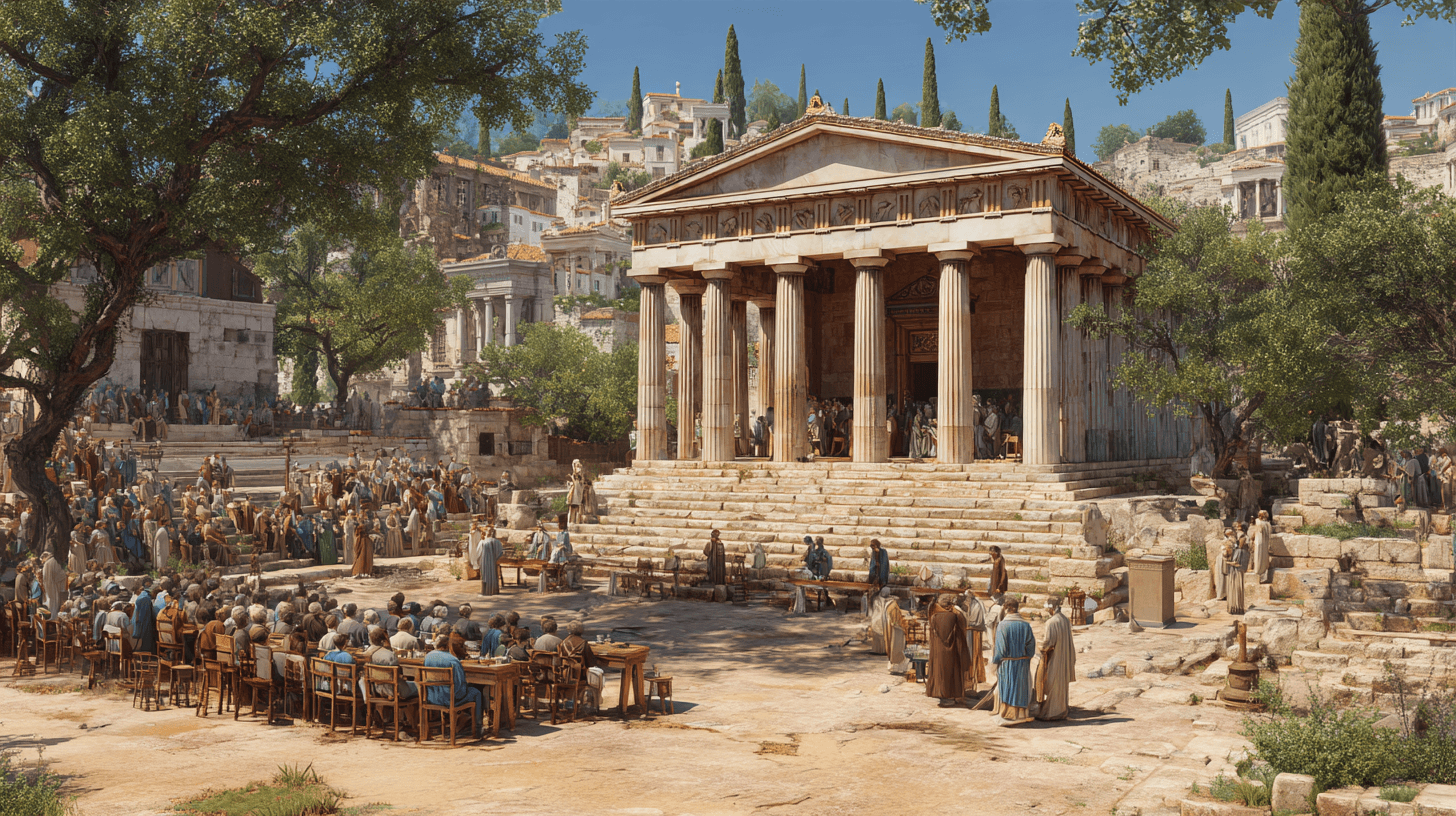
How Democracy Was Born
In the summer of 508 BC, an Athenian aristocrat named Cleisthenes made a decision that should not have worked. Losing a political struggle against a rival backed by Spartan soldiers, he did not raise an army or flee into exile quietly. Instead, he turned to a group that had never held real power in Athens: the common people, the demos. He asked them to back him against his own class.
They did. Within weeks, a Spartan garrison occupied the Athenian acropolis to install Cleisthenes’ rival as ruler, and the ordinary citizens of Athens rose up and besieged them. The Spartans surrendered. Cleisthenes returned, and Athens began building a system of government that had no real precedent: a state in which political authority rested, at least among free male citizens, with the people themselves.
This is usually where the story of democracy gets told as a triumph, a sudden flash of enlightenment in the ancient world. That version skips the more interesting question. Athens was not a uniquely wise or peaceful society. It had been ruled for generations by feuding aristocratic clans and, before that, by a tyrant. So why did democracy take root there, in that decade, and not somewhere else? The answer has less to do with philosophy and more to do with a specific chain of crises, none of which were originally designed to produce self-government at all.
Athens Before Democracy
Before Cleisthenes, Athenian political life belonged almost entirely to a narrow circle of noble families. Land, religious office, and legal authority were concentrated among them, while a large population of poorer farmers had few protections and fewer rights. Many small landholders had fallen into debt bondage, pledging their own labor, or even their families, against loans they had little hope of repaying.
This was not a stable arrangement. By the early sixth century BC, Athens was edging toward the kind of unrest that had already toppled aristocratic regimes elsewhere in the Greek world. The nobility’s response was not democracy. It was reform, meant to relieve pressure without giving up control.
Solon’s Reforms and the Idea That Wouldn’t Go Away
In 594 BC, the Athenians gave a respected lawgiver named Solon special authority to rewrite the city’s laws and defuse the crisis. Solon canceled outstanding debts secured against personal freedom and abolished debt slavery outright, a change that alone prevented a large share of the citizen population from being permanently reduced to servitude.
He also restructured political rights around wealth rather than birth alone, sorting citizens into four property classes and tying eligibility for office to income rather than ancestry. This did not hand power to ordinary Athenians. The highest offices remained reserved for the wealthiest citizens. But it introduced something the old aristocratic order had never allowed: the idea that political standing could be based on something other than which family you were born into.
Solon almost certainly did not intend to create democracy. Later Athenian writers even record him warning that he had given the people only as much power as they needed, not as much as they wanted. What he actually built was a pressure valve. It held for a while. Then it didn’t.
Tyranny as an Unlikely Ally
Roughly three decades after Solon’s reforms, an ambitious noble named Peisistratus seized power by force and made himself tyrant of Athens. In the ancient Greek sense, a tyrant was not automatically a cruel ruler. It meant someone who had taken power outside the normal constitutional channels, often with popular support against rival aristocrats.
Peisistratus and his sons ruled Athens for most of the following half-century. Their rule weakened exactly the group that had resisted broader participation: the old noble households, many of which lost land, influence, or family members to exile during the tyranny’s political purges. When the last of the Peisistratid tyrants, Hippias, was finally overthrown in 510 BC with Spartan help, the aristocratic families that returned to fight over Athens’s future were poorer and less entrenched than they had been a century earlier.
This is one of the more counterintuitive turns in the story. A period of one-man rule, meant to entrench the power of a single family, ended up clearing the ground for a much broader distribution of power than Athens had known before. Tyranny did not create democracy, but it broke the aristocratic monopoly that had stood in its way.
The Crisis That Produced a Constitution
With Hippias gone, two rival nobles competed to fill the vacuum: Isagoras, who had Spartan backing, and Cleisthenes, from the powerful Alcmaeonid family. Isagoras won the first round, securing the support of Sparta’s king, Cleomenes I, and driving Cleisthenes into exile along with hundreds of other Athenians labeled politically suspect.
It was at this point that Cleisthenes made the move that mattered most. Rather than trying to outmaneuver Isagoras through the traditional channels of aristocratic alliance-building, he appealed directly to the Athenian citizen assembly for support. According to the historian Herodotus, this is precisely when Cleisthenes “took the people into his party,” offering political inclusion in exchange for backing in a purely factional dispute.
The gamble paid off catastrophically for his opponents. When a Spartan force occupied the Acropolis to enforce Isagoras’s position, ordinary Athenians besieged the garrison until it capitulated. Cleomenes and Isagoras were expelled from the city, and Cleisthenes returned to implement the reforms the assembly had already approved in principle.
The origin of Athenian democracy, in other words, was not a philosophical proposal. It was a byproduct of one nobleman’s need for allies in a power struggle he was losing.
What Cleisthenes Actually Built
Cleisthenes’ central reform addressed something that sounds bureaucratic but was politically explosive: he tore apart the traditional four tribes that had organized Athenian citizenship along old family and regional lines, and replaced them with ten new tribes built from a deliberate mix of coastal, inland, and urban districts.
The effect was to break up the local power bases that noble families had relied on for generations. A citizen’s political identity was now tied to residence rather than lineage, which diluted the ability of any single aristocratic clan to dominate a tribe’s votes or leadership. The historian Herodotus credited Cleisthenes as the man who introduced both the tribes and the democracy, in that order, and the sequence reflects how the reform actually worked. Restructuring how citizens were grouped came first, because it was the mechanism that made broader participation possible.
Cleisthenes also created a new Council of Five Hundred, the Boule, with representatives drawn from each of the new tribes and rotated annually. This council prepared legislation for the citizen assembly and oversaw daily administration, giving a much larger circle of Athenian men direct, practical experience of governing rather than simply voting on decisions made elsewhere. Rotating leadership positions, including a presidency that changed hands regularly, made it harder for any individual to accumulate lasting personal power.
None of this created full political equality. It created something narrower but still radical for its time: political power distributed among free adult male citizens rather than concentrated in noble bloodlines.
From Constitution to Culture
Cleisthenes’ reforms of 508–507 BC established the mechanics of Athenian democracy, but the system did not fully mature for another half-century. Athenian participation in the Persian Wars, particularly the naval victories that depended on rowers drawn from the poorer citizen classes, gave ordinary Athenians new leverage to demand a greater political voice.
That leverage produced a further wave of reform around 462 BC under a statesman named Ephialtes, who stripped the aristocratic council known as the Areopagus of most of its remaining political authority and transferred it to the popular assembly and courts. Pericles, who rose to prominence in the years that followed, extended democratic participation further, including introducing payment for jury service so that poorer citizens could afford to take part in public life without losing a day’s wages.
Democracy in Athens, in short, was not installed in a single year. It was assembled across three generations, through a debt crisis, a tyranny, a foreign war, and a series of further reforms, each responding to specific pressures rather than following a single blueprint.
What Popular Memory Gets Wrong
Modern retellings sometimes describe Athenian democracy as though it anticipated modern universal citizenship. It did not. Political participation was restricted to free adult male citizens, a group that historians estimate made up a minority of the total population living in Attica. Women, enslaved people, and resident foreigners, who together made up the majority of people living under Athenian law, had no formal political voice.
It is also worth being careful about the word “invented.” Elements of collective decision-making existed in other early societies, and some historians point to earlier or parallel experiments with broader political participation elsewhere in the Greek world. What made Athens distinctive was not that it discovered the idea of shared governance from nothing, but that it built durable institutions, a specific citizen assembly, a rotating council, and popular courts, that put decision-making power directly and repeatedly in the hands of a broad body of ordinary citizens, and kept it there for generations.
Why Athens, and Why Then
Several conditions converged to make this experiment possible in Athens specifically. Its military increasingly depended on citizen-soldiers, hoplites who supplied their own armor and fought in the ranks alongside their neighbors, which gave ordinary property-owning men a stake in the city’s decisions that a purely mercenary or slave-based army would not have granted them. Its economy was commercial enough, particularly through maritime trade, to produce a substantial class of citizens who were neither desperately poor nor aristocratically wealthy. And critically, no single external power dominated Athens during the crucial reform decades in a way that could have simply imposed a different outcome by force.
None of these conditions guaranteed democracy. They created an opening, and the opening was seized through the ordinary, self-interested maneuvering of politicians trying to win power struggles rather than through any collective plan to establish self-government as an ideal.
Conclusion
The story of how democracy was born is not a story about a society discovering a noble truth about human equality. It is a story about accumulated institutional pressure, a debt crisis that a lawgiver only partly resolved, a tyranny that inadvertently dismantled the aristocratic order it was meant to preserve, and a losing politician who turned to the only allies he had left.
What makes Cleisthenes’ reforms significant is not that they were pure or complete. It is that they built structures, a reorganized citizenry, a rotating council, a body that met to decide the city’s fate, durable enough to outlast the crisis that produced them and flexible enough to expand further in the decades that followed. Democracy did not arrive in Athens because someone decided it was the right form of government. It arrived because a series of narrower, self-interested decisions happened to open a door that no one closed again.
That is perhaps the most useful thing the Athenian case can still teach. Self-government has rarely spread because societies agreed in advance that it was just. It has usually spread because specific crises left an opening, and someone chose to walk through it.