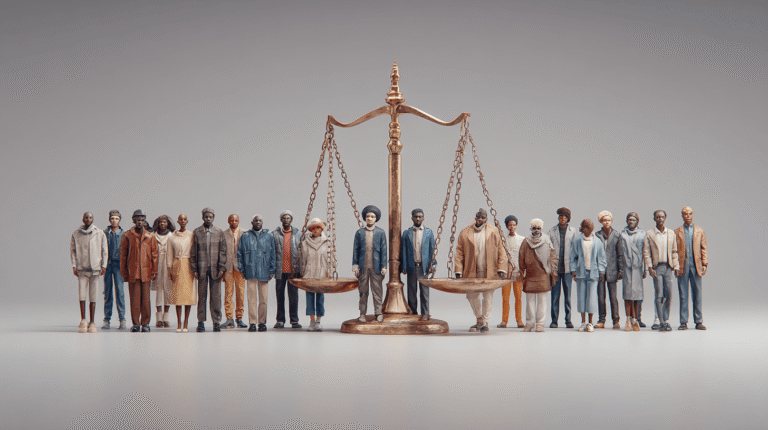
Are Humans Good or Evil by Nature?
The Question Every Moral System Has to Answer
A newborn cries the moment it enters the world, but it has not yet lied, stolen, or shown mercy. Its character is, in a sense, still unwritten. So when a toddler shoves another child off a swing, or when a stranger risks his life to pull someone from a burning car, we are watching something more than isolated behavior. We are watching a question play out that philosophers have argued over for more than two thousand years: is this what people are like underneath, or is it what circumstance made them?
The question of whether human beings are fundamentally good or fundamentally evil sounds like the kind of thing debated in a dorm room at midnight. In fact, it has shaped criminal law, political theory, child-rearing practices, and the design of entire governments. If people are naturally selfish and violent, then institutions need to restrain them. If people are naturally cooperative and kind, then institutions need to protect that goodness from corruption. Much of what separates one political philosophy from another traces back to this single disagreement.
This article looks at the strongest historical answers to the question, the evidence modern psychology and biology have added to the debate, and why the honest answer turns out to be more useful than a simple yes or no.
Mencius and the Argument for Natural Goodness
The Chinese philosopher Mencius, writing around the fourth century BCE, offered one of the earliest and most influential arguments that human nature is fundamentally good. His case rested on a simple thought experiment: imagine a child about to fall into a well. Anyone who sees this, Mencius argued, feels a sudden stab of alarm and concern, not because they calculated a reward or feared punishment, but instinctively.
Mencius called this instinct one of four “sprouts” of virtue built into every person: compassion, shame, deference, and a sense of right and wrong. These sprouts do not guarantee good behavior any more than a seed guarantees a healthy tree. They require cultivation. A person raised in a corrupt environment, starved of moral guidance, can grow crooked, but Mencius insisted this was a failure of cultivation, not proof that the original material was rotten.
This view had enormous influence on Confucian political thought. If people are naturally inclined toward virtue, then the central task of government is not to cage human impulses but to create the conditions in which virtue can grow: proper education, stable families, and rulers who lead by moral example rather than by force.
Xunzi and the Argument for Natural Selfishness
Not everyone in the same intellectual tradition agreed. Xunzi, writing a generation or two after Mencius, argued for nearly the opposite position. People are born with desires for profit, comfort, and gratification, he claimed, and if those desires are left alone, they inevitably lead to conflict, since there is never enough profit, comfort, or gratification to satisfy everyone at once.
For Xunzi, goodness was not a sprout waiting to be watered. It was something imposed from outside, through ritual, law, and education, the way a bent piece of wood is straightened by force against a press. Left to their own devices, people compete rather than cooperate. Civilization exists precisely because human nature, on its own, cannot be trusted to produce peace.
What is striking is that Mencius and Xunzi were not describing different populations. They were looking at the same behavior—children fighting over toys, adults competing for resources, occasional acts of spontaneous kindness—and drawing opposite conclusions about which behaviors reflected the “true” underlying nature and which were mere surface noise.
Hobbes, Rousseau, and the European Version of the Debate
Roughly two thousand years later and on the other side of the world, European philosophers arrived at a strikingly similar disagreement, largely independent of the Chinese tradition.
Thomas Hobbes, writing in the aftermath of the English Civil War, argued that in a hypothetical “state of nature,” without government or law, human life would be a war of all against all. People are driven by fear, competition, and a desire for glory, he claimed, and without a powerful authority to keep them in check, that life would be, in his famous description, solitary, poor, nasty, brutish, and short. For Hobbes, this bleak natural condition was the entire justification for strong centralized government. People consent to be ruled because the alternative, unrestrained human nature, is worse.
Jean-Jacques Rousseau, writing about a century later, inverted the picture almost completely. In his account, humans in their natural state were not vicious but simple, self-sufficient, and largely peaceful, guided by an innate sense of compassion for the suffering of others. It was civilization itself, Rousseau argued, particularly the introduction of private property and social comparison, that introduced greed, vanity, and inequality. Corruption was not the raw material. It was what society did to the raw material.
Neither Hobbes nor Rousseau was doing careful anthropological fieldwork. Both were constructing a story about the natural condition of humanity to justify a particular vision of how society should be organized. That is worth remembering: claims about “human nature” are rarely neutral descriptions. They tend to arrive already loaded with political conclusions.
What Modern Research Actually Shows
Contemporary psychology and evolutionary biology have not settled the ancient debate, but they have reframed it in a useful way.
Studies of very young infants, some conducted before a child is even old enough to have absorbed cultural norms, have found that babies show early preferences for individuals who help others over individuals who hinder them, suggesting some rudimentary sense of fairness may be present before extensive socialization occurs. At the same time, research on young children also documents early signs of resource hoarding, in-group favoritism, and resistance to sharing, particularly under conditions of scarcity or competition.
Evolutionary biologists studying cooperation have proposed that humans evolved strong prosocial instincts precisely because cooperation offered a survival advantage: groups that could coordinate hunting, share food, and defend against threats outcompeted groups that could not. But the same evolutionary logic that favors cooperation within a group can favor hostility toward outsiders, since resources and safety were often won at another group’s expense. On this view, humans were not shaped to be simply kind or simply cruel. They were shaped to be intensely loyal to their own group and wary, sometimes dangerously so, of everyone else.
Social psychology has added a further complication: situational pressure often predicts behavior better than personality does. Studies on obedience to authority and on the effects of anonymity and group pressure have repeatedly shown that ordinary people, under the right circumstances, can commit acts of cruelty they would never have predicted of themselves, while under different circumstances, the same people behave with striking generosity. The conclusion many researchers have drawn is not that humans are secretly evil or secretly good, but that human behavior is far more responsive to context, incentive, and social pressure than either Mencius or Xunzi assumed.
Why the Question Might Be the Wrong One
Put the historical arguments next to the modern evidence, and a pattern emerges. Every position in this debate can point to real behavior in support of itself, because humans reliably display both cooperative and selfish tendencies, often within the same day, sometimes within the same hour. That is not a failure of the theories. It suggests the theories are asking a question that assumes something false: that there is one single default setting called “human nature,” waiting underneath all that variation to be uncovered.
A more accurate description may be that humans are highly conditional creatures. People tend to cooperate when trust is established, resources feel sufficient, and consequences for betrayal are clear. People tend to turn selfish or hostile when resources feel scarce, trust breaks down, or a group perceives outsiders as a threat. Neither goodness nor cruelty needs to be switched on from outside; both are already present as capacities, and what determines which one shows up is largely the structure of the situation a person is in.
This reframing has practical consequences. If human nature were fixed and evil, the only reasonable response would be permanent restraint: strong punishment, strict surveillance, minimal trust. If human nature were fixed and good, restraint would seem almost insulting, an unnecessary cage around something that did not need one. But if human behavior is conditional, the more useful question is not “are people good or evil” but “what conditions bring out the better range of what people are capable of.” That question turns out to be answerable, and it has guided real institutional design, from how legal systems balance punishment with rehabilitation to how workplaces structure incentives to encourage honesty rather than reward deception.
What the Debate Still Gets Right
None of this makes Mencius or Xunzi, Hobbes or Rousseau, obsolete. Each captured something true about the range of human behavior, even if none of them captured the whole of it. Mencius was right that compassion often appears spontaneously and does not need to be taught from nothing. Xunzi was right that unchecked self-interest tends toward conflict without some structure to manage it. Hobbes was right that the absence of enforceable rules invites exploitation. Rousseau was right that certain social arrangements, particularly extreme inequality, can amplify greed and resentment that might otherwise stay dormant.
The lasting value of the debate is not that one side eventually won. It is that the disagreement forced every generation of thinkers to examine what conditions bring out cooperation and what conditions bring out cruelty, and to build laws, institutions, and communities accordingly.
The Honest Answer
Humans are not simply good, and they are not simply evil. They are creatures built with the capacity for both, and which capacity dominates in any given moment depends less on some fixed inner nature than on the pressures, incentives, and relationships surrounding them at the time.
That answer is less satisfying than a clean verdict. It offers no villain and no hero, no story of a corrupted paradise or a savage tamed by civilization. But it is closer to what the evidence actually shows, and it points toward a more productive question than the one philosophers have been arguing about for two thousand years. The point is not to decide, once and for all, what people are. It is to understand, carefully enough to act on, what brings out the best in them.