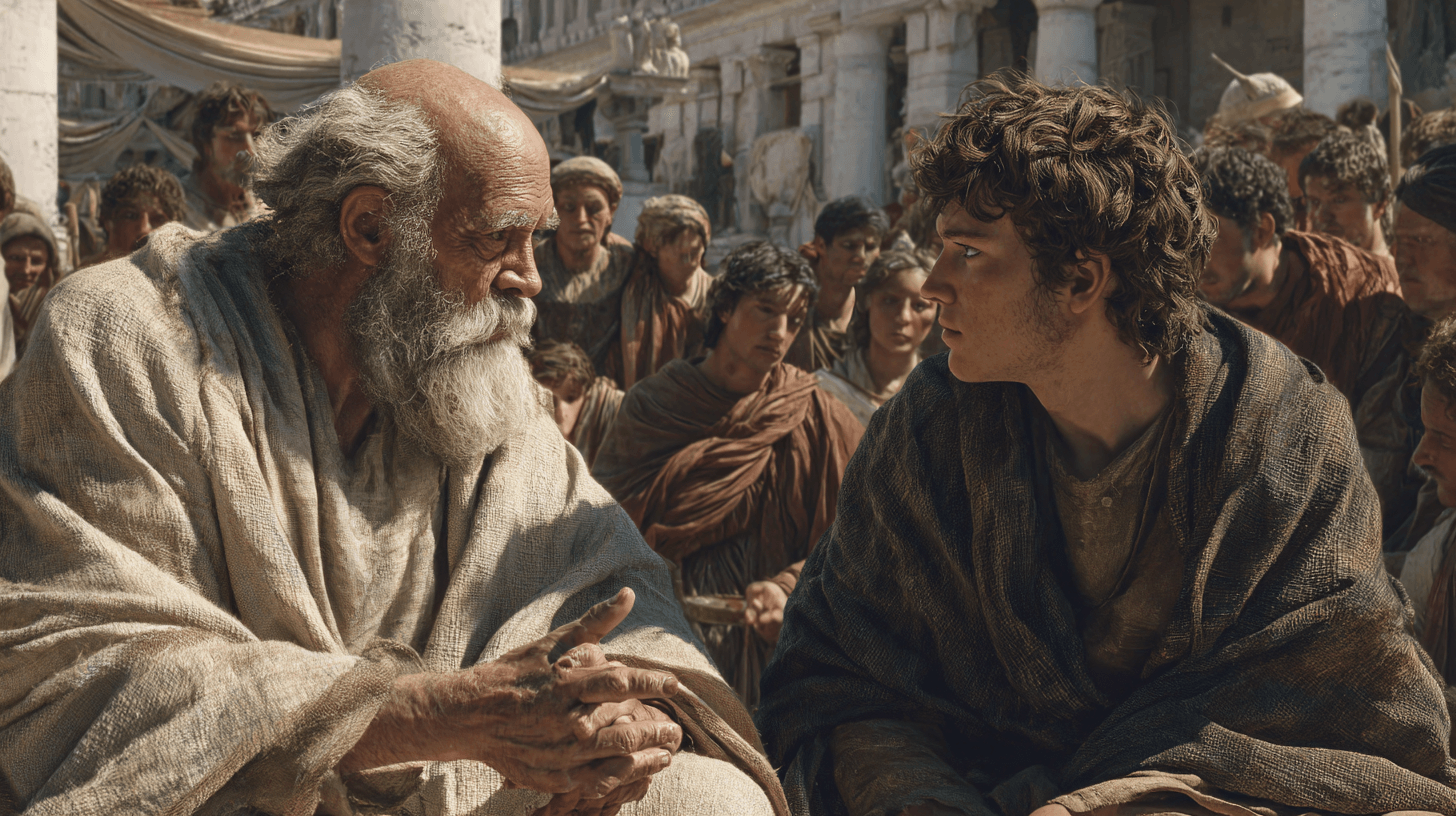
How Socrates Taught Athens to Question Everything It Knew
Imagine stopping a respected general in the middle of the Athenian agora and asking him to define courage. Not to insult him, not to test him for a grade, but because you genuinely want to know what courage is. He gives an answer. You ask a follow-up question. Within a few exchanges, his own definition collapses under its own logic, and he is left holding contradictions he didn’t know he believed.
This happened repeatedly in fifth-century Athens, and the man asking the questions was Socrates. He never wrote anything down, held no office, and claimed to have no special knowledge at all. Yet the way he talked to people became one of the most influential intellectual tools in Western history, and it eventually got him sentenced to death. Understanding why requires understanding a specific method: a way of asking questions designed not to teach an answer, but to expose what someone only thought they understood.
That method is what philosophers now call the Socratic method, or elenchus, and its purpose was more radical than it first appears.
The World Socrates Questioned
Athens in the late fifth century BCE was a city that took argument seriously. Its democracy required citizens to speak in the assembly and the courts, and a class of professional teachers called Sophists had built careers on training young men to argue persuasively for whatever side paid them. Rhetoric was a marketable skill, and skilled speakers could often win a debate regardless of whether their position was true.
Socrates found this deeply troubling. He was not interested in winning arguments. He was interested in whether the beliefs underneath those arguments could survive scrutiny. Where the Sophists sold the appearance of wisdom, Socrates spent his time in public spaces cross-examining anyone willing to talk with him: generals, poets, politicians, craftsmen, and young aristocrats eager to make a name for themselves.
This context matters because the Socratic method was not developed in a classroom or a text. It emerged from ordinary conversation in a city that prized public speech, aimed at a specific target: the confidence of people who had never been asked to justify what they believed.
How the Method Actually Worked
The structure of a Socratic conversation was remarkably consistent, and it appears across many of Plato’s dialogues, which are the primary source for how Socrates argued.
Socrates would ask an interlocutor to define a concept central to how they lived: justice, piety, courage, or knowledge itself. The person would offer a definition, usually a confident one. Socrates would then ask a series of narrower questions, testing the definition against specific cases. Almost without exception, the interlocutor’s own answers would generate an example the original definition couldn’t explain, or two claims that contradicted each other.
From Confidence to Contradiction
In the dialogue Euthyphro, a religious expert named Euthyphro insists he understands piety well enough to prosecute his own father for murder. Socrates asks him to define piety. Euthyphro’s first answer amounts to “what I am doing right now.” When Socrates points out that this defines piety by pointing at an example rather than explaining what makes it pious, Euthyphro tries again. Each revised definition runs into the same problem, until Euthyphro leaves the conversation abruptly, his certainty gone.
This end state had a name: aporia, a Greek word meaning something close to “impasse” or “puzzlement.” Socratic dialogues rarely conclude with a tidy answer. They conclude with the discovery that the question was harder than anyone assumed.
That was not a failure of the method. It was the method’s actual goal.
Why Socrates Claimed to Know Nothing
Socrates is famous for a claim that sounds like a paradox: he knew that he knew nothing. According to Plato’s Apology, this idea traces back to a story about the Oracle at Delphi, who reportedly declared that no one in Athens was wiser than Socrates. Socrates said this puzzled him, since he was certain he possessed no special wisdom.
To test the oracle, he went looking for someone wiser than himself, questioning politicians, poets, and craftsmen who were widely believed to be experts. He found that each of them was confident about matters they could not actually explain when pressed. Socrates concluded that his own advantage was narrow but real: unlike them, he did not mistake his lack of understanding for knowledge.
This is sometimes called Socratic ignorance, and it is easy to misread as false modesty or a rhetorical trick. It functioned instead as the foundation of the entire method. If you already believe you understand justice, you have no reason to examine it. Socrates’ questioning worked because he approached every conversation as someone still trying to figure the answer out, and he pushed his interlocutors to do the same.
What the Questions Were For
It would be a mistake to think Socrates was simply trying to embarrass people. The elenchus had a serious philosophical purpose: it treated self-examination as a moral obligation, not an intellectual game.
Socrates believed that living well required understanding concepts like justice and virtue clearly enough to act on them consistently. A person who could not explain what courage actually was, he argued, could not reliably act courageously when it mattered. Confused beliefs produced inconsistent lives. This is the reasoning behind his most famous line from the Apology: an unexamined life, he told the jury at his own trial, is not worth living for a human being.
The method mattered because the target mattered. Socrates was not cross-examining trivia. He was cross-examining the concepts people used to decide how to act, prosecute, vote, and raise their children.
What Popular Memory Gets Wrong
The Socratic method is often remembered today as simply “asking a lot of questions,” which flattens what made it distinctive. Two misunderstandings are especially common.
The first is assuming the method always produced a clear conclusion. In most of Plato’s early dialogues, it does not. The value of the exercise was the demonstrated gap between confidence and understanding, not a neatly packaged definition of virtue.
The second misconception involves authorship. Socrates left no writings of his own, and almost everything historians know about him comes from other people, primarily Plato, along with the historian Xenophon and the playwright Aristophanes, who portrayed Socrates satirically. Because Plato used Socrates as a character to develop his own philosophical arguments over decades, historians openly debate how much of the “Socratic method” in later dialogues reflects the historical Socrates versus Plato’s evolving ideas. Scholars refer to this as the Socratic problem, and it means some caution is appropriate whenever a specific dialogue is treated as a direct transcript of what Socrates actually said.
When Questioning Became Dangerous
Socrates’ habit of publicly dismantling other people’s confidence did not make him popular with everyone. In 399 BCE, he was brought to trial in Athens on charges of corrupting the youth and failing to honor the city’s gods. The political backdrop mattered: Athens had recently endured a brutal civil conflict, and several of Socrates’ former associates, including the once-powerful Alcibiades, had been linked to the city’s defeat and internal turmoil. Whether the formal charges reflected genuine religious concern or lingering resentment toward his circle remains debated among historians.
At his trial, described in Plato’s Apology, Socrates refused to abandon his method even to save his life. He told the jury that he would keep questioning people in the marketplace regardless of the verdict, because abandoning the practice would mean abandoning what he considered his duty. The jury convicted him and sentenced him to death by drinking hemlock, a poison derived from a plant in the carrot family that causes paralysis and eventual respiratory failure.
Socrates’ choice to accept the sentence rather than escape into exile, an option his friends reportedly arranged, turned his death into as powerful a demonstration of his convictions as anything he said while alive.
From Plato’s Dialogues to the Modern Classroom
The elenchus did not disappear with Socrates. Plato, his student, spent much of his life writing dialogues that preserved and developed the method, eventually using it as scaffolding for his own theories about forms, knowledge, and the soul. Aristotle, who studied under Plato, built on this tradition of systematic questioning even as he moved toward more formal logical structures.
Centuries later, the method resurfaced far outside philosophy departments. Law schools in the United States adopted a version of Socratic questioning to train students to defend their reasoning under pressure rather than memorize rules. Some approaches in cognitive behavioral therapy use structured questioning, sometimes explicitly called Socratic questioning, to help patients examine automatic beliefs they had never consciously scrutinized. Educators across many disciplines still use guided questioning instead of direct instruction, on the theory that a conclusion someone reaches through their own reasoning tends to stick better than one simply handed to them.
The specific technique changed with each new context, but the underlying premise stayed remarkably intact: confident belief and genuine understanding are not the same thing, and only sustained questioning reliably tells them apart.
Why It Still Matters
The Socratic method endures because the problem it addresses never went away. People still hold confident opinions about justice, fairness, and their own motivations without having examined whether those opinions hold together. Socrates offered no shortcut past that problem. He offered a discipline: ask what something actually means, follow the answer wherever it leads, and treat contradiction as information rather than defeat.
That discipline explains why a man who wrote nothing, held no office, and left his students in a state of puzzlement more often than certainty, still shapes how serious thinkers are trained to examine an idea. The method never promised comfortable answers. It promised something harder to obtain and, in Socrates’ judgment, considerably more valuable: an honest account of what you actually know.
Frequently Asked Questions
Did Socrates ever give straight answers to his own questions?
Rarely, at least in Plato’s earlier dialogues. Socrates generally positioned himself as a fellow inquirer rather than an instructor with a prepared answer. In several later dialogues, Plato has Socrates present more constructive theories, which is part of why scholars debate how much reflects the historical Socrates versus Plato’s own philosophical development.
Is the Socratic method the same as debate?
No. Debate typically aims to defend a fixed position and win. The elenchus aimed to test a position honestly, including the questioner’s own assumptions, and considered exposing a flawed belief a success rather than a loss.
Why is Socrates’ execution considered so significant?
Beyond the immediate political context, Socrates’ choice to accept his death sentence rather than compromise his principles or flee turned his life and his method into a unified statement. His willingness to die for the practice of questioning gave the elenchus a moral weight that outlived him by more than two thousand years.