How Data Centers Actually Run: Inside the Machines That Never Sleep
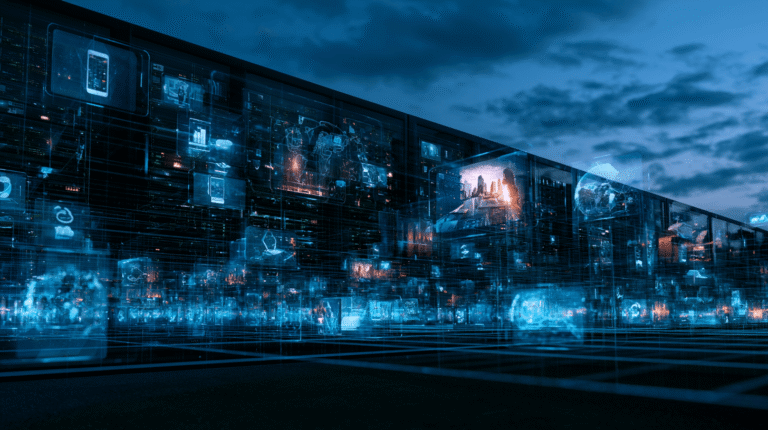
Every time a video call connects, a photo backs up, or an AI model answers a question, that action travels to a windowless building that most people will never see and few could locate. Inside, tens of thousands of machines run without pause, cooled by systems engineered to the degree and powered by circuits with no single point of failure. If any of it stops, the effect is not a glitch. It is data loss, financial damage, and for hospitals or emergency services, something closer to danger.
The strange part is how invisible this infrastructure remains. People talk about “the cloud” as though it were weather rather than concrete, steel, and diesel generators. A data center is not an abstraction. It is a physical building engineered around one uncompromising requirement: the servers inside must never lose power, and they must never overheat, because the computing they perform cannot pause even for a second without consequences somewhere else in the world.
Understanding how a data center actually operates means answering a more specific question than “where is the internet.” It means asking how a building manages to guarantee something that ordinary buildings never have to guarantee: continuous, uninterrupted operation, year after year, regardless of storms, equipment failures, or human error.
What a Data Center Actually Is
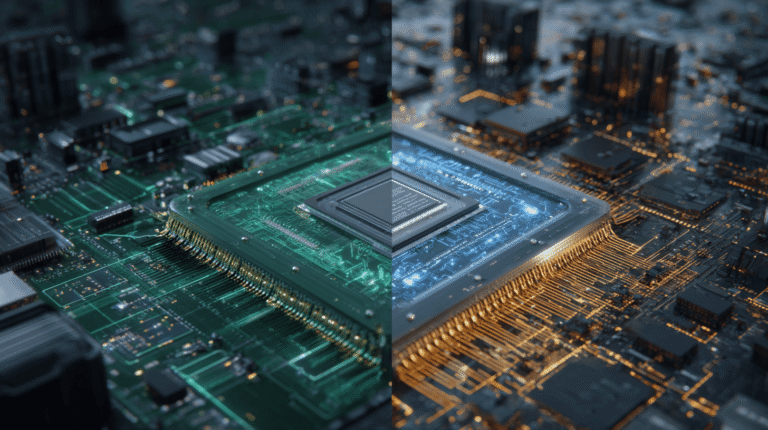
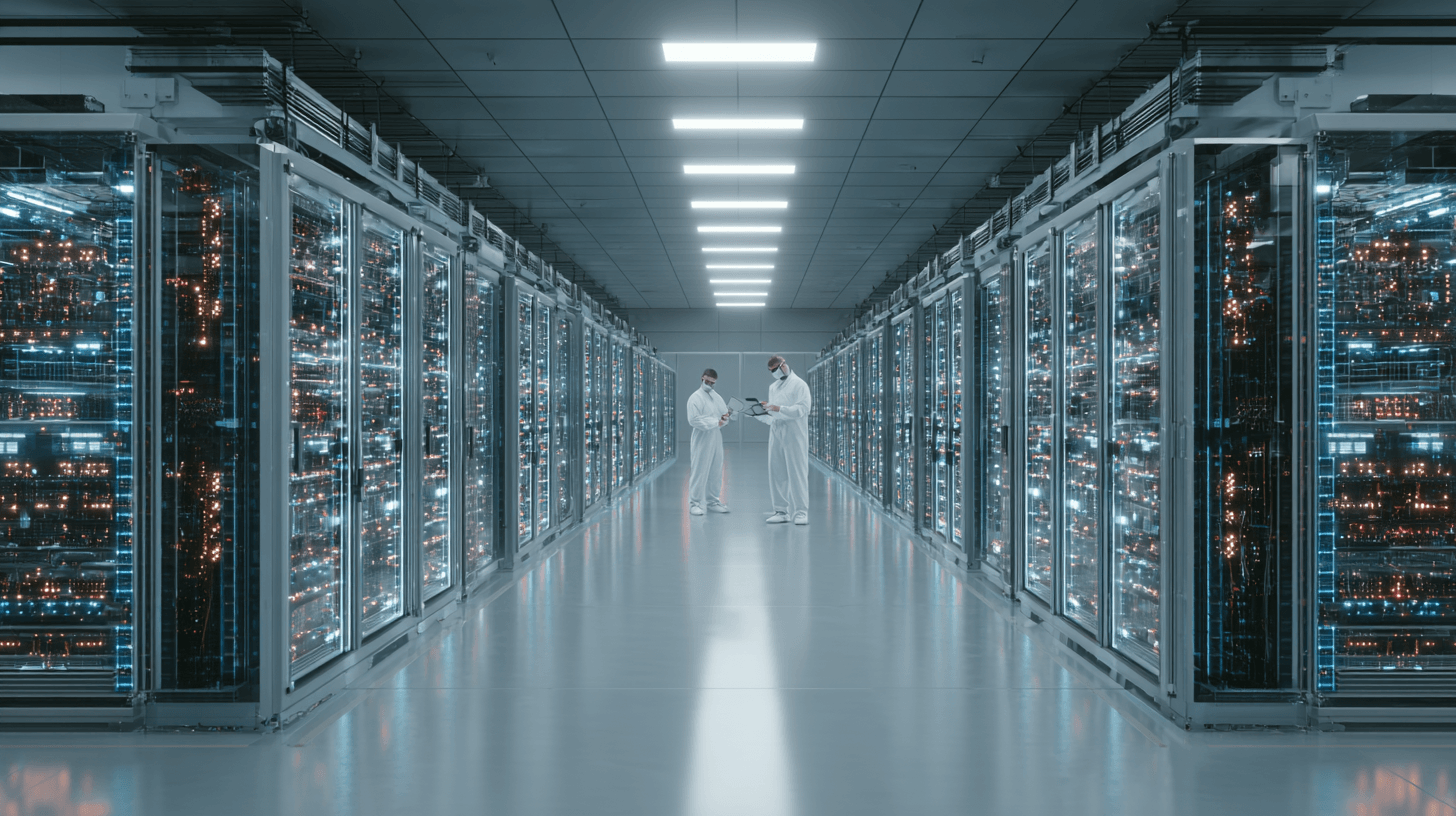
A data center is a purpose-built facility that houses servers, storage systems, and networking equipment, along with the electrical and mechanical systems required to keep that equipment running continuously. The servers themselves are the easy part to picture. Every other system in the building exists to serve them.
That includes the electrical infrastructure that delivers power from the utility grid down to individual server racks, the cooling systems that remove the heat those servers generate, the network connections that carry data in and out, and the physical security that protects it all. A modern hyperscale facility, the kind operated by companies like Amazon, Google, or Microsoft, can span more than a million square feet and draw as much electricity as a small city.
The building’s design starts from a single constraint: servers generate enormous heat and demand constant power, and both requirements have grown sharply as computing has shifted toward artificial intelligence. Rack densities that once sat around 5 to 10 kilowatts now regularly exceed 100 kilowatts in facilities built for AI training, and some new designs push past 200 kilowatts per rack. Every other system in the building has had to be redesigned around that shift.
How Power Actually Reaches a Server
Electricity arrives at a data center from the utility grid, but it never goes directly to a server rack. It passes through several stages, each designed to catch a failure before it reaches the computing equipment.
The first stage is the utility substation, which steps grid voltage down to a level the facility can use. From there, power moves through switchgear, the electrical equivalent of a set of valves that route current and can isolate a fault. Next comes the uninterruptible power supply, or UPS, a bank of batteries or flywheels that can carry the entire electrical load for several minutes if the utility feed drops. That gap exists to bridge the seconds it takes for backup generators to start and stabilize. From there, power distribution units break the supply down further, delivering the correct voltage to individual racks.
This chain matters because the most common cause of data center downtime is not a dramatic disaster. It is a power interruption, whether from a grid fault, a failed transformer, or a maintenance error. Power redundancy means backup systems, alternate power paths, and supporting infrastructure exist so that if one power source or component fails, another can continue supporting the environment.
Facilities describe their redundancy using a simple shorthand: N, N+1, and 2N. “N” represents the capacity actually needed to run the building. An N+1 design adds one extra unit of every critical system, so a single generator or UPS module can fail without consequence. A 2N design goes further, duplicating the entire power path, so two completely independent systems exist side by side and either one alone could run the whole facility. The most demanding commercial standard, Tier III as defined by the Uptime Institute, requires that every component in the power and cooling path be able to go offline for maintenance without ever interrupting the servers it supports.
None of this is theoretical redundancy sitting untouched in a closet. Modern facilities increasingly run backup systems in active operation rather than idle standby, because equipment that only turns on during emergencies is also the equipment most likely to fail when called upon. Running all systems simultaneously, including the redundant ones, at a lower load allows those redundant systems to absorb additional demand the instant something fails, rather than starting cold.
The Problem of Heat
A server rack converts nearly all the electricity it consumes into heat. A single rack running at 100 kilowatts produces roughly the thermal output of two dozen space heaters running continuously. Multiply that by thousands of racks in one building, and the central engineering challenge of a data center stops being about computing power and becomes about waste heat.
For decades, the standard answer was cold air. Facilities used a layout called hot-aisle/cold-aisle containment: racks are arranged in alternating rows, with cold air pushed into the front of one row of aisles and hot exhaust captured and removed from the back. Precision air-conditioning units, often called CRAC or CRAH units, hold the room to a narrow band, typically around 22°C with roughly 45 percent relative humidity, because both temperature swings and humidity extremes damage electronics over time.
Air cooling worked well enough when racks drew a few kilowatts each. It struggles badly at the densities AI hardware now demands. A rack pulling 100 kilowatts or more produces heat faster than air alone can practically remove, which is why the industry has shifted toward liquid cooling. In these systems, a coolant fluid circulates through cooling plates mounted directly on the hottest components, such as processors and GPUs, carrying heat away far more efficiently than air ever could. Coolant distribution units manage that fluid loop, and in the highest-density Tier III designs, even the pumps and valves in that loop are built with their own N+1 backup, because a single failed pump or valve cannot be allowed to bring down the entire cooling system.
This is not a cosmetic upgrade. It is a structural response to a physical limit. Air cooling has a ceiling; liquid cooling does not, at least not yet, which is one reason the current wave of AI-focused construction looks so different from the data centers built even five years earlier.
Redundancy Is Not Just a Backup Plan
It is tempting to think of redundancy as insurance, something that sits unused until disaster strikes. In practice, it is closer to a constant, active negotiation between capacity, cost, and risk.
Building 2N redundancy everywhere would be safest, but it roughly doubles the cost of power and cooling infrastructure, and much of that duplicated capacity would sit idle in normal operation. Building only N capacity is far cheaper, but it means any single failure, a blown transformer, a failed pump, a tripped breaker, can cascade into an outage. Operators choose their redundancy tier based on how much downtime their business, or their customers’ businesses, can actually tolerate.
This is where the industry’s thinking has genuinely shifted in recent years. Rather than treating backup systems as static, over-provisioned insurance, operators are exploring ways to make redundant capacity productive. Some facilities now use their standby power infrastructure to support the electrical grid during peak demand, effectively becoming, in industry terms, both consumers and producers of power. Others are optimizing server workloads dynamically, shifting computing tasks to make the most efficient use of the capacity that already exists rather than simply adding more hardware. The argument emerging across the industry is that smarter operation, not simply more equipment, is what will make the next generation of data centers both reliable and financially sustainable.
What Popular Imagination Gets Wrong
Most people who picture a data center imagine rows of blinking servers and not much else. What they miss is that the servers are often the smallest part of the engineering problem. The building around them, the electrical substations, the battery rooms, the diesel generators, the chillers, the pumps, the sensors monitoring every component in real time, represents the majority of the design complexity and a large share of the construction cost.
There is also a common assumption that data centers are simply “the internet,” diffuse and placeless. They are not. Each one is a specific building, in a specific location, chosen deliberately for access to cheap and reliable electricity, favorable climate for cooling, low risk of natural disaster, and proximity to network infrastructure. Iceland and parts of Scandinavia have attracted data center investment partly because their cold climates reduce cooling costs. Northern Virginia became a global hub largely because of its dense fiber-optic network and available power, not because of any inherent technological advantage.
Finally, people tend to assume that more computing automatically means more energy waste. That is not quite right, either. The metric operators use, called Power Usage Effectiveness or PUE, measures how much of a facility’s total energy consumption goes to computing versus overhead like cooling and power conversion. A PUE of 1.0 would mean perfect efficiency, with zero energy lost to anything but computing. Real facilities today often report PUE figures between 1.1 and 1.3, and the industry has spent two decades driving that number down through better cooling design, though the shift toward liquid cooling and denser AI hardware has complicated further gains in ways engineers are still working through.
The Constraint Nobody Can Engineer Away
For all the redundancy, containment, and precision engineering inside a modern data center, the industry’s biggest limitation right now is not technical. It is the electrical grid itself. AI-driven demand has pushed rack densities and total facility power draw to levels that utility grids in some regions cannot easily supply, and building new grid capacity takes years longer than building a data center. That mismatch is reshaping where new facilities get built, favoring regions with spare grid capacity or the ability to bring their own power generation online.
This is the quiet tension sitting underneath the entire industry. Data centers have become extraordinarily good at guaranteeing that computing itself never stops. The harder problem, increasingly, is guaranteeing there is enough power available to feed them in the first place.
A data center succeeds not by being clever in any single system, but by ensuring that power, cooling, and computing never depend on any one part working perfectly. The engineering inside these buildings is not really about speed or intelligence. It is about eliminating the possibility of a single failure mattering at all.