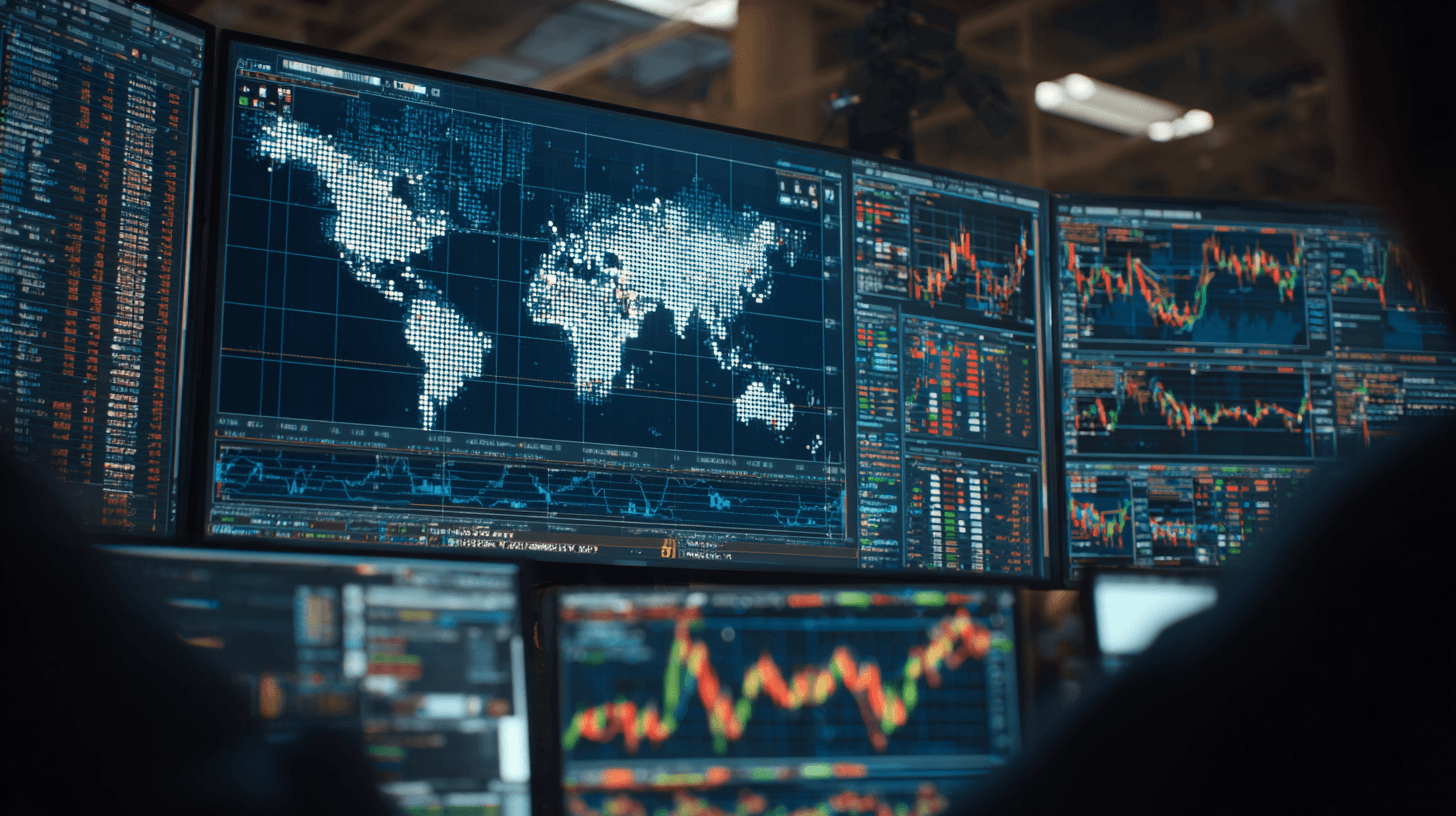
How Currency Exchange Rates Are Really Determined
A tourist checking into a hotel in Istanbul, a factory owner in Ohio buying steel from South Korea, and a pension fund in Tokyo buying U.S. government bonds are all, without realizing it, taking part in the same enormous negotiation. Every time money crosses a border, someone has to decide how much one currency is worth in terms of another. That decision happens roughly a few trillion times a day, and no single person, company, or government controls it.
This raises a question that seems simple but rarely gets a clear answer: what actually sets the exchange rate between two currencies? Many people assume a government or a central bank simply announces the number. Others assume it is purely about how strong or trustworthy a country appears. Neither answer is accurate on its own.
The real explanation involves a market, a set of competing forces, and a handful of mechanisms that interact continuously. Understanding how they fit together explains not only why currencies rise and fall, but why some countries can control their exchange rate and others cannot, and why a currency’s value can shift dramatically without any change in the country’s economy at all.
There Is No Single Market Setting the Price
Unlike a stock, a currency is not traded on one central exchange with a single opening bell. The foreign exchange market, often called forex or FX, is a decentralized network of banks, governments, investment funds, and trading platforms that quote prices to each other around the clock. According to the Bank for International Settlements’ triennial survey, global currency trading now averages roughly $7.5 trillion per day, making it by far the largest financial market in the world.
Because there is no single marketplace, the “exchange rate” reported on a phone app or a bank’s website is really an average of countless simultaneous trades happening in London, New York, Tokyo, and dozens of other financial centers. At any given second, banks are buying and selling currencies from each other to cover client orders, hedge risk, or bet on future movements. The rate is the point where the volume of buyers and sellers happens to balance.
This matters because it means exchange rates are not fixed by decree in most of the world. They are outcomes of trading activity, which is itself driven by deeper economic forces.
Trade Turns Currencies Into Something Bought and Sold
The most intuitive driver of currency value is trade. When a South Korean company sells electronics to a buyer in Germany, the buyer typically needs euros converted into Korean won to complete the payment. Multiply that transaction by millions of import and export deals happening every day, and a country’s trade activity becomes a steady source of demand or supply for its currency.
A country that exports more than it imports tends to see more foreign buyers seeking its currency to pay for those goods, which can push the currency’s value up. A country that imports heavily, sending its own currency abroad to pay for foreign goods, tends to see the opposite pressure. This is one reason economists watch a country’s trade balance as a rough signal of currency direction.
However, trade in goods and services is now a relatively small share of total currency trading. The vast majority of daily foreign exchange activity comes not from shipping containers but from financial transactions, which brings in a second, far more powerful force.
Why Interest Rates Move Currencies More Than Trade Does
Investors do not simply hold cash. They constantly search for the highest safe return on their money, and government bonds are one of the most common places to park large sums. If a country’s central bank raises interest rates, its government bonds suddenly pay more, which attracts investors from around the world. To buy those bonds, foreign investors first need to buy that country’s currency, increasing demand for it.
This relationship, sometimes called interest rate parity, helps explain why exchange rates can move sharply within minutes of a central bank announcement, even when nothing about the physical economy has changed. A rate decision in Washington or Frankfurt can shift the value of currencies on the other side of the world before the news has even been fully read.
This dynamic also created what traders call the carry trade: borrowing money in a currency with low interest rates, converting it into a currency with higher rates, and investing the difference. For years, investors borrowed heavily in Japanese yen, where rates were near zero, and invested the proceeds in higher-yielding currencies elsewhere. These flows can move billions of dollars based purely on interest rate gaps, independent of trade or production in either country.
Central Banks Are Players, Not Referees
It is tempting to think of a central bank as the authority that sets a currency’s value. In reality, most central banks in major economies do not set the exchange rate directly. Instead, they influence it indirectly, primarily through interest rate decisions and, in some cases, through direct intervention in currency markets.
Direct intervention means a central bank buys or sells its own currency in the open market to push the price in a preferred direction, similar to how a large investor might move a stock price by buying or selling large volumes. Japan and Switzerland have both intervened this way at various points, selling their own currency when it strengthened too quickly for their exporters’ comfort.
Fixed, Floating, and Managed Systems
Not every currency behaves the same way, because countries choose different exchange rate systems. In a floating system, used by countries such as the United States, Japan, and most of the Eurozone, the exchange rate is left mostly to market forces, moving continuously based on trade and investment flows. In a fixed or pegged system, a government commits to keeping its currency at a set value against another currency, usually the U.S. dollar, and defends that peg using its foreign currency reserves.
Pegs can work for years, but they carry a risk: if a government runs out of reserves to defend the peg, or if investors stop believing the peg is sustainable, the currency can collapse suddenly. The Swiss National Bank’s decision in January 2015 to abandon its cap on the franc’s value against the euro is a well-documented example. The franc jumped more than 20 percent against the euro within minutes, catching traders and companies around the world off guard.
Between these two extremes sits a managed float, where a currency mostly trades freely but the central bank intervenes occasionally to smooth out sharp swings. Most large emerging economies use some version of this hybrid approach.
What Anchors a Currency Over the Long Run
Day-to-day trading can look almost random, but over years and decades, exchange rates tend to drift toward a deeper economic anchor: purchasing power. The basic idea, known as purchasing power parity, is that identical goods should eventually cost roughly the same amount in different countries once you account for the exchange rate. If a basket of goods is much cheaper in one country than another after conversion, that gap creates pressure, through trade and arbitrage, for the exchange rate to adjust over time.
The Economist magazine’s long-running Big Mac Index is a well-known, deliberately simplified illustration of this idea, comparing the price of an identical product across countries to estimate whether currencies appear overvalued or undervalued. It is not a precise scientific tool, and the magazine itself presents it as a lighthearted guide rather than a rigorous model, but it captures a real economic principle: persistent, extreme mismatches between prices and exchange rates tend not to last forever.
Inflation plays a related role. A country with persistently higher inflation than its trading partners tends to see its currency weaken over time, because its money buys less at home, which eventually shows up in how much it can buy abroad.
Expectations Can Move Markets Before Anything Actually Happens
One of the least intuitive features of currency markets is that they often move on expectations rather than events. If traders widely anticipate that a central bank will raise interest rates next month, the currency can strengthen well before the decision is announced, because investors position themselves in advance. When the actual announcement arrives, the currency sometimes barely moves, or even reverses, because the expected outcome was already priced in.
This is why exchange rates can appear disconnected from a country’s immediate economic reality. A currency can weaken even after good economic news, if the news was less positive than what traders had already expected. Markets are constantly pricing in a forecast of the future, not just a snapshot of the present.
Common Misunderstandings About Exchange Rates
Several widely held beliefs about currencies do not hold up well under scrutiny. One is the assumption that a “strong” currency is automatically good for a country. A strong currency makes imports and foreign travel cheaper, but it also makes a country’s exports more expensive for foreign buyers, which can hurt manufacturers and workers in export-dependent industries.
Another common misconception is that governments can simply set their exchange rate wherever they like. Fixed exchange rates require substantial foreign currency reserves to defend, and history offers numerous examples, including several currency crises in Latin America and Asia during the 1990s, where governments were ultimately forced to abandon a peg because market pressure overwhelmed their reserves.
A third misunderstanding treats exchange rates as a simple scoreboard of national success. In reality, a currency’s value reflects a mix of interest rate differences, capital flows, trade patterns, inflation expectations, and investor sentiment, only some of which relate directly to how well a country’s economy is actually performing.
Why This Machinery Matters Beyond the Trading Floor
Exchange rates are not an abstract financial curiosity. They shape the price of imported medicine, the competitiveness of a country’s factories, the cost of a government’s foreign debt, and the value of a family’s savings if that family holds assets in more than one currency. A country that borrows heavily in a foreign currency can see its debt burden swell dramatically if its own currency weakens, even if the amount borrowed never changes in nominal terms. This dynamic has played a central role in debt crises across multiple regions and decades.
For ordinary consumers, exchange rate movements quietly determine how far a paycheck stretches on a trip abroad, how much an imported phone or car costs, and how competitive a domestic company’s products remain on the global market. Few people watch currency markets directly, but almost everyone is affected by where those markets end up settling.
The exchange rate that appears on a currency converter is not a fixed fact about the world. It is closer to a live vote, cast continuously by traders, investors, exporters, importers, and central banks, all responding to interest rates, inflation, trade flows, and their own expectations about what everyone else is about to do next. The number changes because the vote never stops.