How Frankenstein Became the World’s First Science Fiction Novel
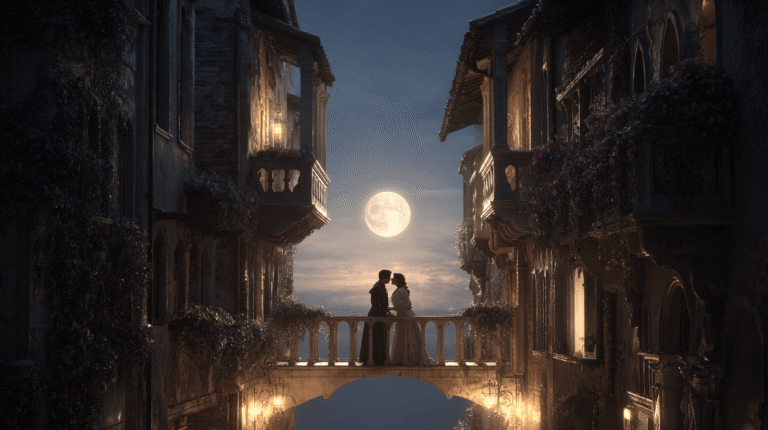
In June 1816, a group of young writers found themselves trapped indoors on the shores of Lake Geneva. Volcanic ash from a massive eruption on the other side of the world had darkened the sky for months, turning that summer into one of the coldest and wettest in memory. Bored and restless, Lord Byron proposed a challenge: each person in the house would write a ghost story.
Most of those stories were quickly forgotten. One was not. An eighteen-year-old named Mary Shelley began developing an idea about a scientist who assembles a living being from dead matter, and gives it life without any thought for what comes next. That idea became Frankenstein; or, The Modern Prometheus, published in 1818.
More than two centuries later, literary historians routinely describe it as the first true work of science fiction. That claim raises an obvious question. Ghost stories, monster tales, and fantastical voyages had existed for centuries before Mary Shelley picked up her pen. So what exactly separates her novel from everything that came before it, and earns it a title that has stuck for so long?
A Summer Without Sunlight
The strange weather that trapped Shelley’s group indoors was not a coincidence of bad luck. In April 1815, Mount Tambora in present-day Indonesia had erupted with a force unmatched in recorded history, throwing enough ash and sulfur into the atmosphere to disrupt weather patterns across the globe. The following year became known across Europe and North America as “the year without a summer,” marked by crop failures, unseasonal frosts, and skies that stayed gray for weeks at a time.
That darkness shaped the mood at Byron’s rented villa, where Mary Shelley, her future husband Percy Shelley, Byron himself, and their companions John Polidori and Claire Clairmont spent their evenings reading aloud from a collection of German ghost stories. The atmosphere of confinement and unease was real, not invented for dramatic effect. It gave the group’s storytelling contest an edge that a sunnier summer might never have produced.
Mary Shelley later described struggling for days to think of a story frightening enough to satisfy the challenge, until an idea came to her in a half-waking state after a late-night conversation about the scientific possibility of reanimating dead tissue. That conversation was not idle speculation. It reflected a real and heated scientific debate taking place across Europe at the time.
The Science Everyone Was Talking About
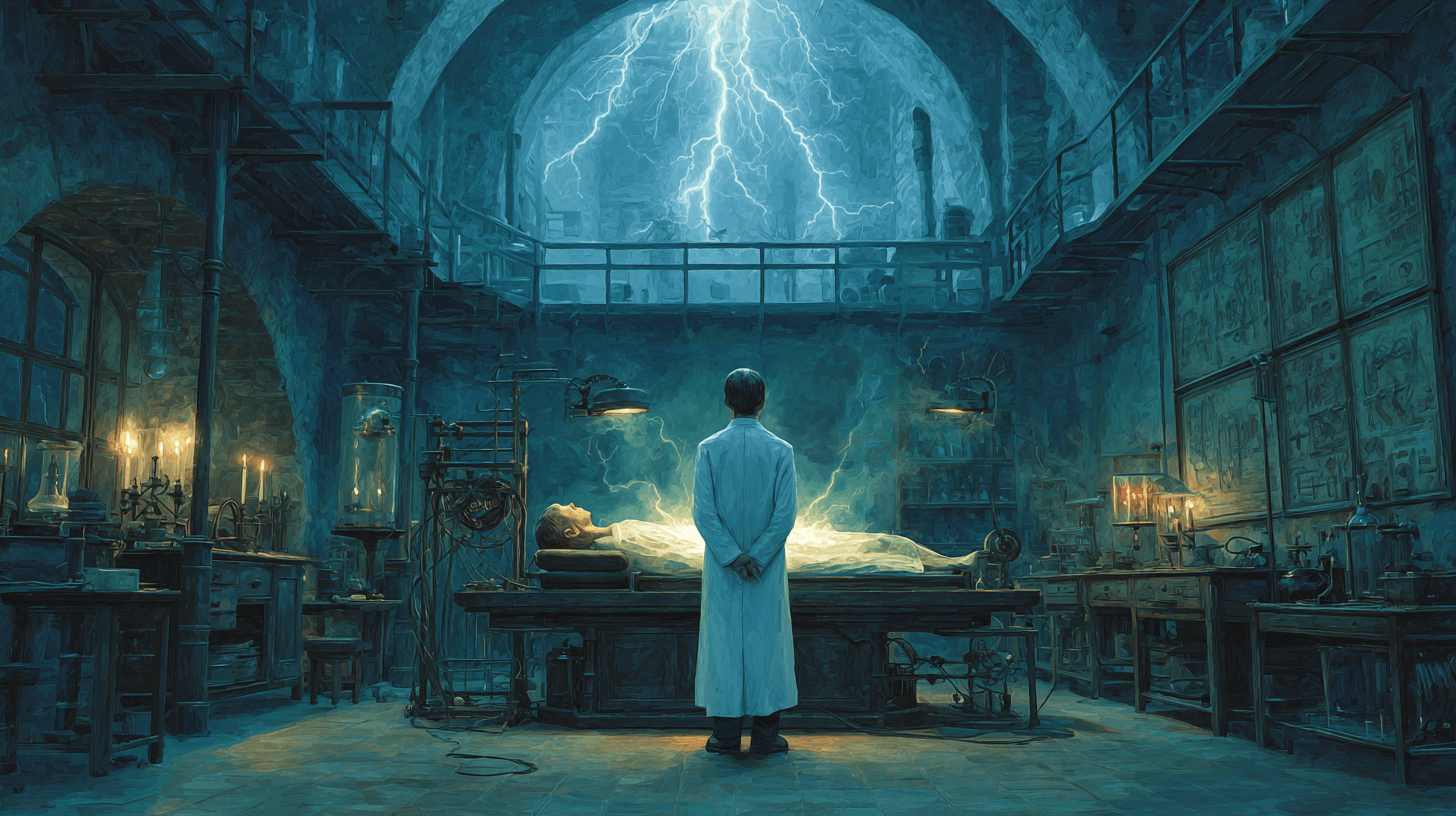
By 1816, educated readers across Britain and Europe were fascinated by a set of experiments involving electricity and dead tissue. The Italian physician Luigi Galvani had shown decades earlier that electrical current could make a dead frog’s leg twitch, and his nephew Giovanni Aldini extended the demonstration further, publicly applying electrical current to the corpses of executed criminals in London in 1803. Some witnesses reported that the bodies’ faces contorted and their limbs jerked, as though life itself might still be coaxed back into dead flesh.
These demonstrations fed into a broader scientific dispute known as the vitalism debate, in which researchers argued over whether life was the product of some special, non-physical force or simply the result of chemical and electrical processes that might, in principle, be replicated. Mary Shelley’s introduction to the 1831 edition of the novel specifically credits conversations about galvanism, along with speculation associated with the naturalist Erasmus Darwin, as the spark that led her toward the idea of Victor Frankenstein’s experiment.
This is the detail that separates Frankenstein from the ghost stories and Gothic romances that preceded it. Shelley did not reach for sorcery, curses, or divine punishment to explain how a corpse might be brought to life. She reached for the actual scientific debates of her own era, extending them into fiction rather than inventing something outside the natural world entirely.
A Monster Made by Method, Not Magic
Earlier Gothic fiction, including Horace Walpole’s The Castle of Otranto and the novels of Ann Radcliffe, relied on supernatural explanations for their horror: ancient curses, ghostly apparitions, and inexplicable omens that existed outside the rules of nature. Readers were meant to be unsettled precisely because the events defied rational explanation.
Victor Frankenstein’s creation works differently. He is a university-trained scientist who studies anatomy, chemistry, and the emerging science of electricity, and who applies that knowledge, however fictionalized, to create life through a process grounded in the natural world rather than the supernatural one. The novel deliberately withholds the technical details of exactly how he does it. Shelley has Victor refuse to describe his methods in full, warning that such knowledge is too dangerous to share. That vagueness is not a weakness in the plot. It is the point.
By framing his creation as an extension of real scientific inquiry rather than magic, Shelley created something new: a horror story whose danger comes from human ambition and capability rather than from forces beyond human control. This is the central reason many literary historians, most notably the science fiction writer and critic Brian Aldiss in his influential 1973 history Billion Year Spree, argue that Frankenstein deserves recognition as the first genuine science fiction novel. The threat in the story is not otherworldly. It is something people built themselves.
The Story Mary Shelley Chose to Tell
Shelley structured her novel as a series of nested narratives. An Arctic explorer named Robert Walton writes letters to his sister describing his encounter with a nearly frozen, half-dead Victor Frankenstein, who tells Walton his life story, which in turn includes the creature’s own account of his abandonment and suffering. This layered structure lets readers hear the story from multiple perspectives before deciding whom to believe and whom to blame.
That structure matters because the novel is less interested in the mechanics of creation than in what happens afterward. Victor succeeds in bringing his creation to life, then immediately recoils in horror at what he has made and flees the room. He abandons his creation without a name, without guidance, and without any plan for what a newly conscious being might need to survive in the world. The creature that follows him for the rest of the novel is shaped far more by that abandonment than by anything inherent in how he was built.
This is why summarizing Frankenstein as simply a story about a mad scientist and his monster misses what the novel is actually doing. The creature learns language, reads philosophy, and longs for companionship before violence enters the story at all. His transformation into a killer follows a long series of rejections by every person he encounters, including his own creator.
Why Critics Call It the First Science Fiction Novel
The claim that Frankenstein is the first science fiction novel is influential, but it is not universally settled among scholars. Earlier works have their own defenders. Johannes Kepler’s Somnium, written in the early seventeenth century, imagines a journey to the moon grounded in astronomical reasoning. Margaret Cavendish’s The Blazing World, published in 1666, combines fantastical elements with speculation about alternate societies and natural philosophy.
What distinguishes Frankenstein for many critics is the combination of three elements working together: a novel-length narrative, a premise built from contemporary scientific debate rather than folklore or fantasy, and a sustained exploration of the ethical consequences that follow from a scientific act. Earlier speculative works tend to emphasize the journey or the discovery itself. Shelley’s novel is built around what happens after the discovery, when a person must live with the consequences of what science has allowed them to do.
That emphasis on consequence over invention became the template for much of the science fiction that followed. From H.G. Wells’s scientist-driven catastrophes to modern fiction about artificial intelligence and genetic engineering, the recurring question is rarely whether something can be built. It is what happens to the people, and the newly created beings, once it has been.
What the Novel Actually Warns About
Frankenstein‘s subtitle, The Modern Prometheus, points directly at its central concern. In Greek mythology, Prometheus steals fire from the gods to give to humanity, an act of transgression that brings both progress and punishment. Victor Frankenstein steals something far larger: the power to create life itself, without securing any of the wisdom or responsibility that might guide what to do with that power.
The novel is frequently misread as a warning against science itself, and the popular habit of calling the creature “Frankenstein” reflects that misreading. In the text, Frankenstein is the name of the scientist, not his creation, who is never given a name at all. That absence is not an accident. The creature’s namelessness reflects his creator’s refusal to acknowledge him as anything more than a failed experiment, and readers who conflate the two are, in a sense, repeating Victor’s own failure to recognize what he made.
The deeper warning in the novel is not about scientific knowledge but about the responsibility that should accompany it. Victor’s failure is not that he pursued forbidden knowledge. His failure is that he abandoned what that knowledge produced. Shelley’s novel does not condemn ambition. It condemns the refusal to take responsibility for what ambition creates.
The Shadow Frankenstein Still Casts
The influence of Frankenstein extends well beyond literature. Its central structure, a creator whose invention escapes their control and forces a reckoning with unintended consequences, has become one of the most reused frameworks in modern storytelling and public debate alike. It shaped early robot fiction, including Karel Čapek’s 1920 play R.U.R., which introduced the word “robot” to the world, and it continues to shape how commentators frame debates over artificial intelligence, genetic engineering, and cloning.
The phrase “Frankenstein’s monster” has entered everyday language as shorthand for any creation that turns against its creator, applied to everything from financial instruments to social media algorithms. That linguistic afterlife is itself a kind of evidence for the novel’s originality. Few works of fiction produce a phrase so durable that people use it without ever having read the book it came from.
What makes the novel endure is not that it predicted any specific technology. It predicted a recurring human situation: the moment when capability outruns responsibility, and someone has to decide what to do with a power they were not fully prepared to hold. That situation has repeated itself in nuclear physics, in genetic research, and now in artificial intelligence, each time renewing interest in a novel written nearly two hundred years ago by a teenager confined indoors during an unusually dark summer.
Mary Shelley did not set out to invent a genre. She set out to win a ghost story contest with her friends. That she ended up doing both at once says something about how new ideas often arrive: not through a deliberate plan to break new ground, but through someone taking an existing fear seriously enough to ask where it actually comes from.