Why Laozi Believed That Non-Action Was the Answer to Chaos
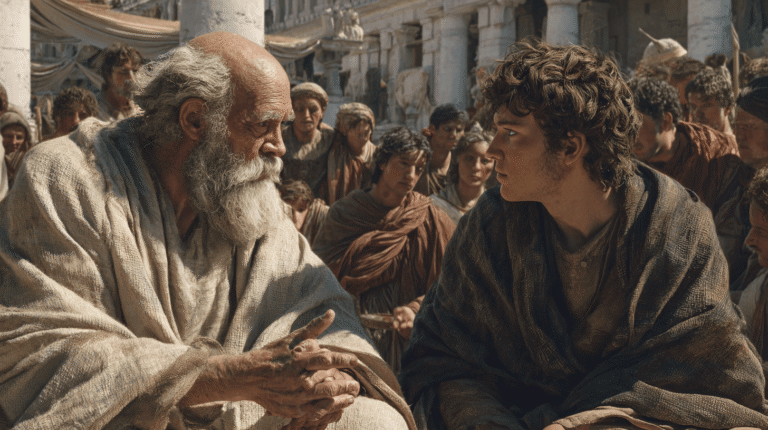
A ruler surrounded by ministers wants order. His instinct is to tighten control: issue more edicts, punish more harshly, plan every outcome in advance. Laozi, according to the tradition that produced the Daodejing, offered the opposite advice. The wisest ruler, he suggested, governs so lightly that the people barely notice they are being governed at all.
This is the paradox at the center of wu wei (無爲), usually translated as “non-action” or “effortless action.” It sounds like a philosophy of passivity, even laziness. But the idea Laozi was pointing to is far more demanding than simply doing nothing. It asks a ruler, or anyone facing a difficult situation, to stop forcing outcomes and start working with the grain of things instead of against it.
The question worth asking is not just what wu wei means, but why a thinker living through one of the most violent periods in Chinese history would conclude that restraint, not control, was the answer.
The World That Produced the Daodejing
The text traditionally attributed to Laozi emerged sometime during the late Spring and Autumn period or the Warring States period, an era stretching roughly from the 6th to the 3rd century BCE. China at the time was not a single country but a patchwork of rival states, each competing for territory, tribute, and survival. Older feudal loyalties were breaking down, and ambitious rulers were replacing them with harsher, more centralized forms of control: larger armies, heavier taxation, and increasingly rigid law codes.
This was also an intensely creative period for Chinese thought. Faced with the same instability, philosophers proposed very different solutions. Confucius and his followers argued that social harmony could be restored through moral cultivation, correct ritual, and well-ordered relationships between ruler and subject, parent and child. Legalist thinkers went further in the opposite direction, arguing that only strict laws, harsh punishments, and centralized authority could hold a state together.
Laozi’s tradition offered a third path. Instead of adding more structure, more virtue, or more law, it suggested that the underlying problem was human insistence on forcing the world into a particular shape. Excessive intervention, in this view, was not the cure for disorder. It was frequently the cause.
Who Was Laozi, Really?
Traditional accounts describe Laozi as a court archivist in the state of Zhou who grew disillusioned with politics and rode west on an ox, writing the Daodejing at a border guard’s request before disappearing from history. It is a vivid story, and it may be exactly that: a story.
Modern scholarship treats Laozi’s historical existence as uncertain. Many specialists in early Chinese thought now believe the Daodejing was not written by a single author at one moment, but compiled and edited over generations, drawing on older sayings and oral traditions before reaching something close to its current form by the 4th or 3rd century BCE. The debate over dating and authorship remains unresolved, and readers should treat “Laozi” as much as a name representing a philosophical tradition as a single, verifiable historical person.
What is not in dispute is the influence of the text itself. Whoever compiled it produced one of the most consequential works in Chinese intellectual history, one that would shape governance, religion, and personal ethics for more than two thousand years.
What Wu Wei Actually Means
The literal translation of wu wei, “no action,” is misleading if taken at face value. The Daodejing does not recommend inactivity, indifference, or withdrawal from responsibility. It recommends acting without unnecessary force, without excessive planning, and without imposing an artificial structure on situations that already have their own natural direction.
The text’s favorite image for this idea is water. Water yields to whatever it meets, taking the shape of any container, flowing around obstacles rather than confronting them directly. Yet over time, it wears down even stone. Its power comes not from resistance but from persistence combined with adaptability. Laozi’s tradition treated this as a model for how a person, or a ruler, should engage with the world: not through domination, but through alignment with existing tendencies.
Applied to governance, this became a warning against overmanagement. A ruler who issues constant new laws, reorganizes constantly, and intervenes in every dispute creates instability precisely because subjects can never settle into a predictable rhythm of life. A ruler who intervenes only when necessary, and otherwise allows natural social patterns to continue, produces a kind of order that does not need to be constantly enforced because it was never disrupted in the first place.
The Reasoning Behind the Idea
Underlying wu wei is the concept of the Dao, often translated as “the Way.” The Daodejence describes the Dao as the underlying pattern or process according to which the natural world unfolds: seasons change, rivers find their course, living things grow and decline, all without external command. Human institutions, in this framework, are healthiest when they follow a similar logic rather than imposing an artificial order on top of it.
This produces a specific criticism of ambition. Excessive striving, in Laozi’s tradition, tends to provoke resistance and unintended consequences. A ruler who taxes too heavily to fund glory eventually faces rebellion. A general who seeks total victory eventually creates enemies determined to fight to the death rather than surrender. A moralist who insists on rigid virtue eventually breeds hypocrisy, because people learn to perform goodness rather than live it.
The text is notably skeptical of Confucian solutions for exactly this reason. Where Confucius emphasized cultivated virtue, ritual propriety, and defined social roles, the Daodejing suggests that the need to promote virtue explicitly is itself a symptom of decline. In a genuinely well-ordered society, the argument goes, people would not need to be taught to be good, because goodness would already be woven into ordinary life. The moment a society must actively campaign for virtue, something has already gone wrong.
Wu Wei in Governance
This philosophy translated into concrete political advice. The Daodejing repeatedly praises rulers who remain nearly invisible to those they govern, intervening rarely and avoiding grand displays of power. Heavy taxation, elaborate legal codes, and constant military campaigns are treated not as signs of strength but as signs of a ruler who has lost the ability to govern through natural order and must compensate with force.
This did not mean rulers should have no policies at all. Later interpreters, particularly during the early Han dynasty, understood wu wei as advocating restraint rather than total inaction: fewer large-scale projects, lower taxes, minimal interference in local customs, and a general suspicion of grand schemes imposed from above. Some Han-era officials explicitly drew on Daoist ideas to justify a period of reduced government intervention after decades of costly wars, a policy sometimes credited with allowing the economy to recover.
The lesson, in other words, was strategic rather than mystical. Excessive intervention often creates the very problems it is meant to solve, and a wise government recognizes when withdrawing is more effective than acting.
Common Misconceptions
Wu wei is frequently flattened into a vague endorsement of relaxation or “going with the flow” in a purely personal, feel-good sense. This misreads the concept in two important ways.
First, it is not indifference to outcomes. The Daodejing is deeply concerned with order, stability, and the wellbeing of subjects. Its argument is about method, not goals: how to achieve stability without triggering the resistance that heavy-handed control tends to provoke.
Second, it is not the absence of skill or effort. Later Daoist writers, particularly in the Zhuangzi, describe wu wei through images of supremely skilled craftsmen, such as a butcher whose knife moves so precisely along the natural joints of an animal that it never needs sharpening. The skill lies in reading the underlying structure of a situation so well that action becomes almost effortless, not in avoiding action altogether.
Objections and Ongoing Debates
Confucian critics argued that a philosophy built around minimal intervention risked leaving injustice unaddressed. If a ruler avoids acting whenever possible, what happens to the poor, the powerless, or the victims of local corruption who depend on active intervention for protection? Legalist thinkers pushed back from the opposite direction, arguing that only strict, consistently enforced law, not restraint, could prevent the strong from exploiting the weak in a competitive, multi-state world.
Modern scholars raise a further complication. Because the Daodejing was compiled over time from multiple sources, it contains passages that sit uneasily together, some emphasizing political strategy, others focused on personal spiritual cultivation, and others closer to mystical cosmology. Interpreters continue to debate how much of the text should be read as practical governance advice and how much as metaphysical reflection largely detached from statecraft. There is no single scholarly consensus on which reading was primary, or whether the distinction would have made sense to the text’s original compilers at all.
Why the Idea Endured
Wu wei did not remain confined to political philosophy. It became foundational to Daoist religious practice, influenced Chinese medicine’s emphasis on balance over aggressive intervention, and shaped artistic ideals that valued suggestion over explicit statement, most visibly in landscape painting and classical poetry, where empty space carries as much meaning as filled space.
The concept also traveled into Chan Buddhism, later known in Japan as Zen, where similar ideas about effortless, unforced action reappear in different vocabulary. Centuries later, elements of the idea would resurface again in unexpected places, including modern discussions of management and design that warn against overengineering systems that would function better with fewer imposed rules.
None of this means wu wei offers a universal solution to every organizational problem. It was developed as a response to a specific historical crisis: an era of escalating state violence, in which every competing philosophy was trying to answer the same urgent question of how to restore order. Laozi’s tradition answered it by turning the usual assumption inside out. Where other thinkers asked how to control more effectively, the Daodejing asked whether the desire for control was itself the deeper problem.
That is the insight worth carrying forward, independent of any particular political program. Some problems are made worse by the very effort used to solve them, and recognizing the difference between necessary action and forced intervention remains as difficult, and as valuable, today as it was in ancient China.