Why Nietzsche Declared That God Was Dead
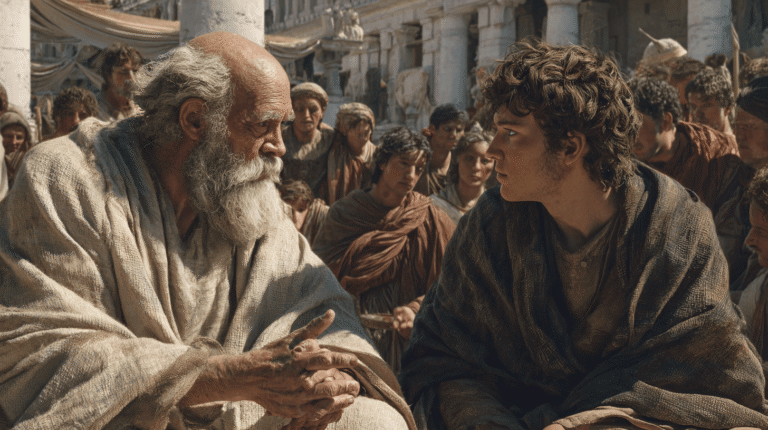
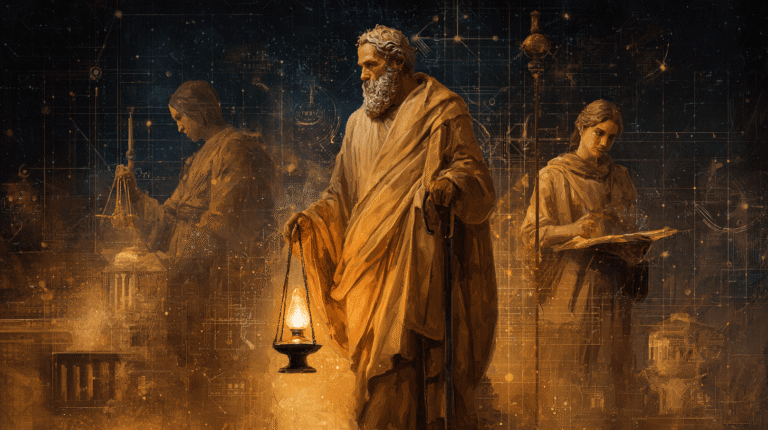
In 1882, a philosopher many considered a philologist with strange enthusiasms wrote a short parable about a madman who runs into a marketplace carrying a lantern in broad daylight, screaming that he is looking for God. The crowd laughs. Some assume he is drunk, others that he is merely lost. Then the madman turns on them: God is dead, he says, and we have killed him.
Friedrich Nietzsche did not intend this as a boast. He was not celebrating the death of religious belief the way a triumphant atheist might. He was issuing a warning about a civilization that had quietly removed its own foundation and had not yet noticed the walls were falling.
The phrase “God is dead” has since become one of the most quoted and most misunderstood lines in modern philosophy. It is often read as a simple declaration of atheism, or worse, as an expression of nihilistic celebration. Neither reading captures what Nietzsche was actually trying to say, or why he thought the consequences of this event would take generations to fully arrive.
The Sentence That Started in a Marketplace, Not a Sermon
The line first appears in The Gay Science, published in 1882, in a passage titled “The Madman.” It reappears later in Thus Spoke Zarathustra. In both cases, Nietzsche places the idea in the mouth of a figure who is treated as insane by the people around him, which is itself part of the point.
The madman does not argue that God never existed. He argues that European civilization has already stopped believing, in practice, even while continuing to use the language and moral structure that belief in God once supported. People have kept the furniture of a house whose foundation they removed.
This is a crucial distinction. Nietzsche was not making a metaphysical claim about the universe. He was making a cultural and historical observation: the intellectual and social forces of modern Europe—the rise of science, biblical criticism, secular politics, and Enlightenment rationalism—had made the Christian God, as a lived, structuring force in culture, no longer credible to the very people who still claimed to believe.
What Nietzsche Meant by “Killing” God
The most striking part of the parable is not the announcement of God’s death but the accusation that follows it. “We have killed him,” the madman says, “you and I.” This was Nietzsche’s way of assigning responsibility rather than simply reporting a fact.
For centuries, Christian metaphysics had supplied Europe with more than religious ritual. It supplied a total framework: an account of where morality came from, why suffering had meaning, why truth mattered, and what the universe was ultimately for. Nietzsche believed that the same intellectual traditions built on searching for truth—traditions Christianity itself had encouraged—had eventually turned that scrutiny back on Christianity’s own claims and found them wanting.
In other words, the pursuit of truth had outgrown the religious system that once justified it. Science, historical criticism, and philosophy had slowly dismantled the credibility of the Christian worldview, even as the moral and cultural habits built on that worldview remained largely intact. Nobody had fired a single shot. The death Nietzsche described was gradual, collective, and largely unintentional.
Why the Crowd in the Marketplace Laughs
One detail in the parable is easy to skip past: nobody in the marketplace understands what the madman is talking about. They laugh at him, or ignore him, and eventually he gives up and throws his lantern to the ground.
Nietzsche included this reaction deliberately. He believed most people in his own time had not yet grasped the scale of what had happened. They had abandoned genuine belief in a transcendent, judging, purpose-giving God, but they still assumed that moral concepts such as good, evil, duty, and universal human worth would simply continue to make sense without their original source.
Nietzsche thought this assumption was mistaken, and dangerously so. If moral values had depended on a divine lawgiver and a cosmic order for their authority, removing that lawgiver did not leave the values untouched. It left them unsupported. The marketplace crowd was living on inherited moral capital without noticing that the account funding it had been closed.
The Real Danger Nietzsche Feared: Nihilism
This is the part of Nietzsche’s argument that gets lost most often in popular summaries. He was not enthusiastic about the death of God in any straightforward sense. He treated it as an enormous and destabilizing event, one whose consequences would unfold slowly over what he expected to be roughly two centuries.
The primary danger, in Nietzsche’s view, was nihilism: the condition in which people no longer believe that existence has any inherent meaning, purpose, or value, yet continue living as though it does out of habit, fear, or inertia. Nietzsche did not think nihilism was an exotic philosophical position confined to a few radical thinkers. He thought it was the logical destination of European culture once its metaphysical foundation collapsed, whether or not people admitted it to themselves.
He worried that without a serious response, the death of God would not lead to liberation but to a kind of moral exhaustion: a culture that retained the vocabulary of good and evil while losing any coherent reason to believe in either. This is why the madman calls the event “the greatest deed” in human history and immediately admits that humanity is not yet ready to bear its weight.
Nietzsche’s Response Was Not Despair, But a Demand
Where many readers assume Nietzsche wanted to leave humanity stranded in meaninglessness, his actual project moved in the opposite direction. He believed the collapse of inherited religious morality created both a crisis and an opportunity: the chance, and the obligation, to build new values honestly, rather than inheriting them unexamined from a tradition that no longer held up.
This is the context for two of Nietzsche’s most famous and most frequently distorted ideas. The first is his call for a “revaluation of all values,” an insistence that human beings examine where their moral assumptions actually came from rather than treating them as self-evident truths handed down from outside history. The second is his concept of the Übermensch, or “overman,” a figure who creates meaning and value through his own will rather than discovering it ready-made in scripture or tradition.
Neither idea was meant as a celebration of moral chaos. Nietzsche was deeply concerned that a poorly handled transition away from religious morality could produce something worse than the belief systems it replaced: cynicism, aggressive nationalism, or a hollow will to power detached from any serious values at all. He was, in effect, trying to prevent the very outcome that a shallow reading of his work is sometimes accused of encouraging.
A Common Misreading: Nietzsche the Nihilist Cheerleader
Because the phrase “God is dead” sounds so final, it is often treated as though Nietzsche were an early and enthusiastic prophet of secular liberation, sweeping away religious constraint to make room for individual freedom. This reading captures only part of his position and ignores the anxiety that runs through nearly everything he wrote on the subject.
A second and more troubling misreading emerged after Nietzsche’s death, when his unpublished notebooks were edited by his sister, Elisabeth Förster-Nietzsche, who held nationalist and antisemitic views that Nietzsche himself had explicitly criticized during his lifetime. This editorial distortion contributed to Nietzsche’s later, deeply misleading association with Nazi ideology. Contemporary scholars broadly agree that this appropriation misrepresented Nietzsche’s actual arguments, which were often hostile to nationalism, herd conformity, and antisemitic politics.
Understanding “God is dead” correctly requires separating Nietzsche’s diagnosis of a cultural crisis from later political movements that borrowed his language while abandoning his philosophical seriousness.
Why the Idea Still Matters
Nietzsche’s parable was written for a nineteenth-century European audience grappling with the erosion of a specifically Christian metaphysical order. But the underlying structure of his argument extends further than that particular historical moment.
His deeper claim was that moral and existential frameworks are historically constructed, not eternally fixed, and that when a civilization’s foundational framework changes, the consequences ripple through every corner of that civilization’s thinking, whether or not people notice at the time. Twentieth-century existentialist philosophers, including Jean-Paul Sartre and Albert Camus, took up versions of this problem directly, asking what human freedom, responsibility, and meaning could look like once inherited metaphysical guarantees were gone.
The question Nietzsche raised—how a society constructs and justifies its values once it can no longer appeal to an unquestioned cosmic authority—remains active in contemporary debates about secular ethics, moral relativism, and the search for meaning in a scientifically disenchanted world.
The Insight the Marketplace Missed
Nietzsche’s madman eventually stops shouting. He concludes that his message has arrived too early, that the deed, though already done, has not yet reached the ears of those who did it. He walks into several churches and sings a requiem, because, he says, are not these churches now the tombs and sepulchers of God?
That final image captures Nietzsche’s real argument better than the famous phrase alone ever could. He was not announcing the absence of religious belief as a victory. He was describing a civilization still performing rituals inside a structure whose foundation had already given way, and warning that sooner or later, someone would have to notice, and decide what to build in its place.