Why Ordinary People Obey Authority Even When It Feels Wrong
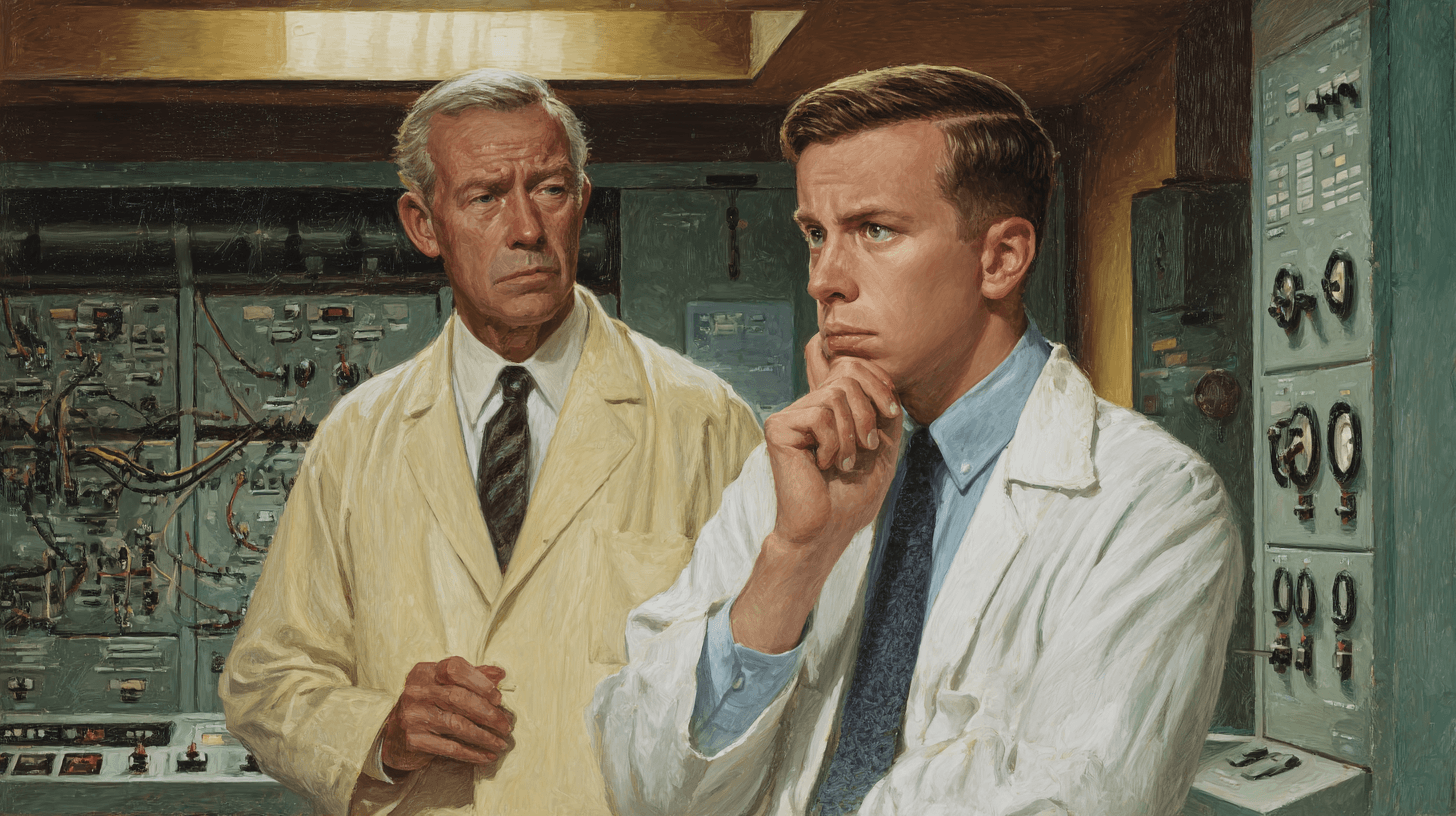
In the summer of 1961, a rotating cast of ordinary New Haven residents walked into a laboratory at Yale University to take part in what they believed was a study of memory and learning. A man in a gray lab coat explained the task: they would read word pairs to another volunteer strapped into a chair in the next room, and every time that volunteer answered incorrectly, they were to deliver an electric shock. The shocks began mild. They did not stay that way.
The volunteer in the chair never actually received a shock. He was an actor, and the switches on the “shock generator” did nothing at all. The real subject of the experiment was the person holding the switch, and the real question was simpler and more unsettling than anything about memory: how far would an average, decent person go simply because someone in authority told them to continue?
The psychologist behind the study, Stanley Milgram, had a specific event on his mind. Earlier that year, the trial of Adolf Eichmann had opened in Jerusalem, and Eichmann’s defense rested almost entirely on one claim: he was only following orders. Milgram wanted to know whether that defense described something rare and monstrous, or something disturbingly common. His answer, delivered through one of the most famous experiments in the history of psychology, is still debated today — not because the data was wrong, but because what it actually explains turns out to be more complicated than most people assume.
A Question Born From a War Crime Trial
Hannah Arendt, reporting on the Eichmann trial for The New Yorker, described the defendant not as a fanatical monster but as an unremarkable bureaucrat who processed the logistics of mass murder the way another man might process shipping invoices. Her phrase for this, “the banality of evil,” became one of the most influential ideas of twentieth-century moral thought. It suggested that atrocity did not always require hatred. Sometimes it only required compliance.
Milgram, a social psychologist trained at Harvard, set out to test whether Arendt’s uncomfortable idea could be reproduced under controlled conditions, far from any battlefield or genocide. He wanted to isolate obedience itself — stripped of ideology, propaganda, and wartime pressure — and measure how much of it lived in ordinary Americans who had never harmed anyone and had no reason to think they ever would.
The Experiment That Redefined Obedience
The design was deceptively simple. A participant, always told they had been randomly assigned the role of “teacher,” sat before a shock generator with switches labeled from 15 volts up to 450 volts. Labels beneath the switches moved from “Slight Shock” to “Danger: Severe Shock” and finally to a stark, unlabeled red zone. As the actor in the next room gave wrong answers, the experimenter instructed the teacher to increase the voltage with each mistake.
The actor’s responses were pre-recorded and escalated on cue: grunts of discomfort, then shouts of pain, then pleas to stop, then silence. If the participant hesitated or objected, the man in the lab coat did not argue or threaten. He simply repeated a short series of prompts — “Please continue,” “The experiment requires that you continue,” “You have no other choice, you must go on.” No punishment was ever offered for stopping. The only pressure was the quiet, procedural insistence of a person in a position of authority.
Before running the study, Milgram asked psychiatrists, psychology students, and colleagues to predict the results. Their estimates converged on the same reassuring number: fewer than 1 percent of participants, they guessed, would go all the way to the maximum shock. Most people, the experts assumed, would refuse once the suffering became audible.
They were wrong by a wide margin. In the original 1963 study, roughly 65 percent of participants delivered the maximum 450-volt shock. Nearly two-thirds of ordinary volunteers — teachers, clerks, engineers, laborers — continued administering what they believed were increasingly agonizing shocks to a stranger, simply because someone in a lab coat told them the experiment required it.
Why the Numbers Surprised Everyone
The gap between prediction and result is the real starting point for understanding the study’s impact. This was not a finding about a small number of unusually cruel individuals. It was a finding about the ordinary distribution of obedience in a general population. Many participants showed visible distress — sweating, stammering, nervous laughter, pleading with the experimenter to check on the other man — and continued anyway.
Milgram’s experiment did not reveal that people are secretly cruel. It revealed how easily situational pressure can override personal conscience. That distinction matters, because it points toward prevention rather than blame. If harmful obedience were simply a matter of bad character, there would be little to do about it except identify and exclude the cruel. If it is instead a predictable response to specific conditions, those conditions can be studied, and in some cases, resisted.
What Made Obedience Easier — And What Made It Harder
Milgram did not stop at one experiment. Over the following years, he ran more than a dozen variations, changing a single factor at a time to see which conditions increased or decreased obedience. The pattern that emerged showed that compliance was not a fixed trait. It moved sharply depending on the surrounding circumstances.
Distance From the Victim
When participants could hear the learner’s protests through a wall, obedience hovered around 65 percent. When they were placed in the same room and could see him, it dropped to about 40 percent. When they were required to physically press the learner’s hand onto a shock plate, it fell further still, to roughly 30 percent. Physical and psychological distance from the consequences of an action made those consequences easier to ignore.
The Physical Presence of Authority
When the experimenter left the room and issued instructions by phone instead of standing beside the participant, obedience collapsed to about 20 percent. Some participants even claimed to continue the shocks while quietly stopping, misleading the experimenter over the phone. Authority, it turned out, worked best at close range. Its power thinned out with distance, much like a signal losing strength.
The Power of a Dissenting Voice
In one especially telling variation, the participant worked alongside two other “teachers” — both actors — who refused to continue partway through the procedure. With visible peer resistance in the room, obedience among real participants dropped dramatically, to around 10 percent. A single person willing to say no in front of others made it substantially easier for everyone else to say no as well.
These variations show that Milgram’s result was never really about a fixed 65 percent of humanity being secretly willing to hurt strangers. It was about a set of interacting conditions — proximity, authority, and social example — that could push the same population anywhere from roughly 10 percent to roughly 65 percent compliance. The number moved. The mechanism behind it is what needed explaining.
The Psychological Mechanism: Milgram’s Agentic State
Milgram’s own explanation centered on what he called the agentic state. In his account, people ordinarily operate as autonomous agents, weighing their actions against their own values. But within a hierarchical structure — a job, an institution, a chain of command — people can shift into a different mode, seeing themselves as the instrument of someone else’s will rather than the author of their own actions.
In this state, a person does not stop having a conscience. They redirect responsibility for the outcome onto the authority issuing the orders. Several participants in the original study, once debriefed, said some version of the same thing: they had not felt personally responsible for hurting the learner, because they were simply doing what they were told by someone who presumably knew what he was doing. The shift is subtle, but its consequences are not. Responsibility does not disappear in this process. It is relocated.
A Different Explanation: Obedience as Identification, Not Automatic Compliance
Not every psychologist accepts the agentic state as the full explanation, and this is one of the genuinely unsettled debates in the field. Social psychologists Alexander Haslam and Stephen Reicher, after reexamining Milgram’s original recordings and archival notes, argue that most participants were not passively surrendering their will at all. Instead, they were actively identifying with the experimenter’s cause — the pursuit of scientific knowledge — and continuing because they believed, at least provisionally, that the research served a worthwhile purpose.
Under this view, sometimes called engaged followership, obedience is not blind. It is conditional on belief. Participants who openly doubted the value of the research, or who were told the study was funded by an unnamed private company rather than Yale, were measurably less likely to comply. People were not simply obeying a man in a lab coat. They were cooperating with what they understood to be a legitimate and meaningful project, run by an institution they trusted.
This distinction has real consequences for how the findings apply outside the laboratory. If obedience depends partly on people believing in the legitimacy of the cause, then undermining that perceived legitimacy — showing people that an order serves no defensible purpose — becomes a genuine tool for reducing harmful compliance, not just an appeal to individual willpower.
What Popular Memory Gets Wrong
Milgram’s study is often summarized as proof that ordinary people will do almost anything if ordered to. That summary overstates the case in two directions.
First, it ignores how much obedience depended on specific conditions. Physical distance from authority, proximity to the victim, and the presence of dissenting peers could cut compliance by more than half. Obedience was common, not universal, and it was highly sensitive to context — which means it is also sensitive to deliberate changes in that context.
Second, the study has drawn serious methodological criticism that popular retellings tend to skip. Researcher Gina Perry, after reviewing Milgram’s original archives and interviewing surviving participants decades later, found evidence that a significant number of subjects suspected the shocks were not real, and that some had reported this suspicion to the experimenter, who reassured them the shocks were genuine. This does not erase Milgram’s findings, but it complicates any claim that the results give a precise, literal measure of how humans behave when they truly believe they are causing suffering.
The study’s core insight has, however, held up in less controversial settings. In a real hospital study conducted a few years after Milgram’s work, researchers had an unfamiliar caller identify himself by phone as a doctor and instruct on-duty nurses to administer a drug at double its labeled maximum dose — a request that violated hospital policy in multiple ways at once. In the vast majority of cases, the nurses prepared to comply before being stopped by the research team. A 2009 partial replication of Milgram’s own procedure by psychologist Jerry Burger, conducted under updated ethical safeguards, found obedience rates only modestly lower than the original — suggesting the underlying pattern was never a product of one unusual era.
Why This Still Matters
The value of this research was never really about a fixed percentage from a 1963 laboratory. It is about recognizing that the line between an ordinary person and someone capable of causing serious harm can be thinner, and more circumstantial, than most people assume. Historians studying atrocities like the mass shootings carried out by German reserve police battalions during the Holocaust, or the killings of unarmed civilians by American soldiers at My Lai in 1968, have consistently found that the people involved were, in the vast majority of cases, not sadists or ideological fanatics beforehand. They were often ordinary men placed inside a hierarchy that made refusal difficult and continuation feel procedural.
This has practical implications far beyond extreme cases. Corporate scandals, medical errors, and institutional cover-ups frequently share a common structural feature: a hierarchy in which individuals felt they were simply following established procedure, deferring to someone with more authority or expertise, while responsibility for the outcome quietly diffused across the chain of command. Understanding obedience as a situational and social phenomenon, rather than a fixed personality trait, is what allows institutions to design better safeguards — clear channels for dissent, distributed accountability, and structures that make it easier for one person’s refusal to give others permission to refuse as well.
The Central Insight
Milgram’s experiment did not prove that people are naturally obedient to the point of cruelty. It proved something more precise and more useful: that ordinary conscience can be redirected, gradually and almost imperceptibly, by proximity to authority, distance from consequences, and the belief that one is contributing to something legitimate. None of those factors require a villain. They only require a structure.
That is the uncomfortable center of the research, and also its most practical lesson. The people most likely to resist harmful orders are rarely defined by extraordinary courage alone. They are often simply positioned differently — closer to the person being harmed, further from the authority giving the order, or standing next to someone else who has already said no. Obedience turns out to be less a fixed trait than a variable one, which means resistance to it can be built, not just hoped for.
Frequently Asked Questions
Would the Milgram experiment be allowed under today’s research ethics rules?
No. The original study involved deceiving participants about the nature and purpose of the experiment and exposed many of them to genuine psychological distress without full informed consent. Modern ethics boards require safeguards that make an exact replication impossible, which is why later researchers like Jerry Burger redesigned the procedure with stricter limits, including stopping well before the maximum voltage.
Did every participant fully believe the shocks were real?
Not necessarily. Later archival research by Gina Perry found evidence that some participants doubted the shocks were genuine, and this remains one of the more significant criticisms of the original study’s validity. Even accounting for this, related research in real-world institutional settings, such as the hospital obedience study, has found comparable patterns of compliance without relying on any deception about harm.
Does this research mean anyone would commit atrocities if ordered to?
No single experiment can establish that. The variations Milgram ran show obedience rates shifting dramatically — from roughly 10 percent to roughly 65 percent — depending on distance, authority, and peer example. This suggests obedience is highly responsive to circumstances rather than a fixed, universal capacity for cruelty, and that specific conditions can make harmful compliance either more or less likely.