How Perspective Changed the World Inside a Painting
A Flat Wall Learns to Have Depth
In the early 1420s, in front of Florence Cathedral, an architect held up a small painted panel and a mirror and asked a stranger to look through a hole drilled in the wood. What the man saw stopped him cold: a painted image of the Baptistery across the square that matched the real building so precisely he could barely tell the two apart.
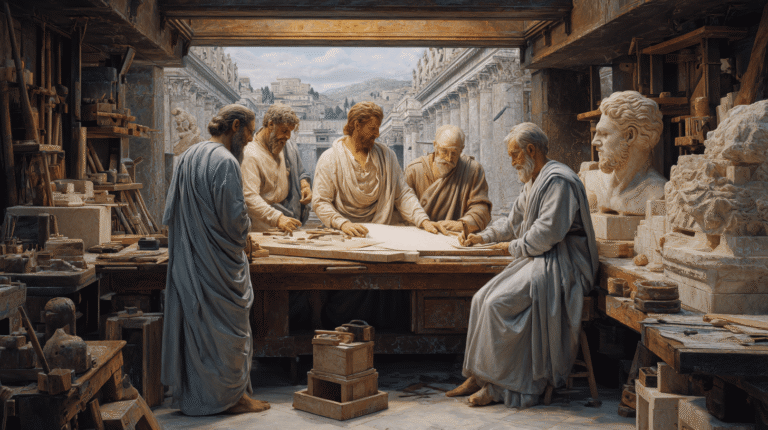
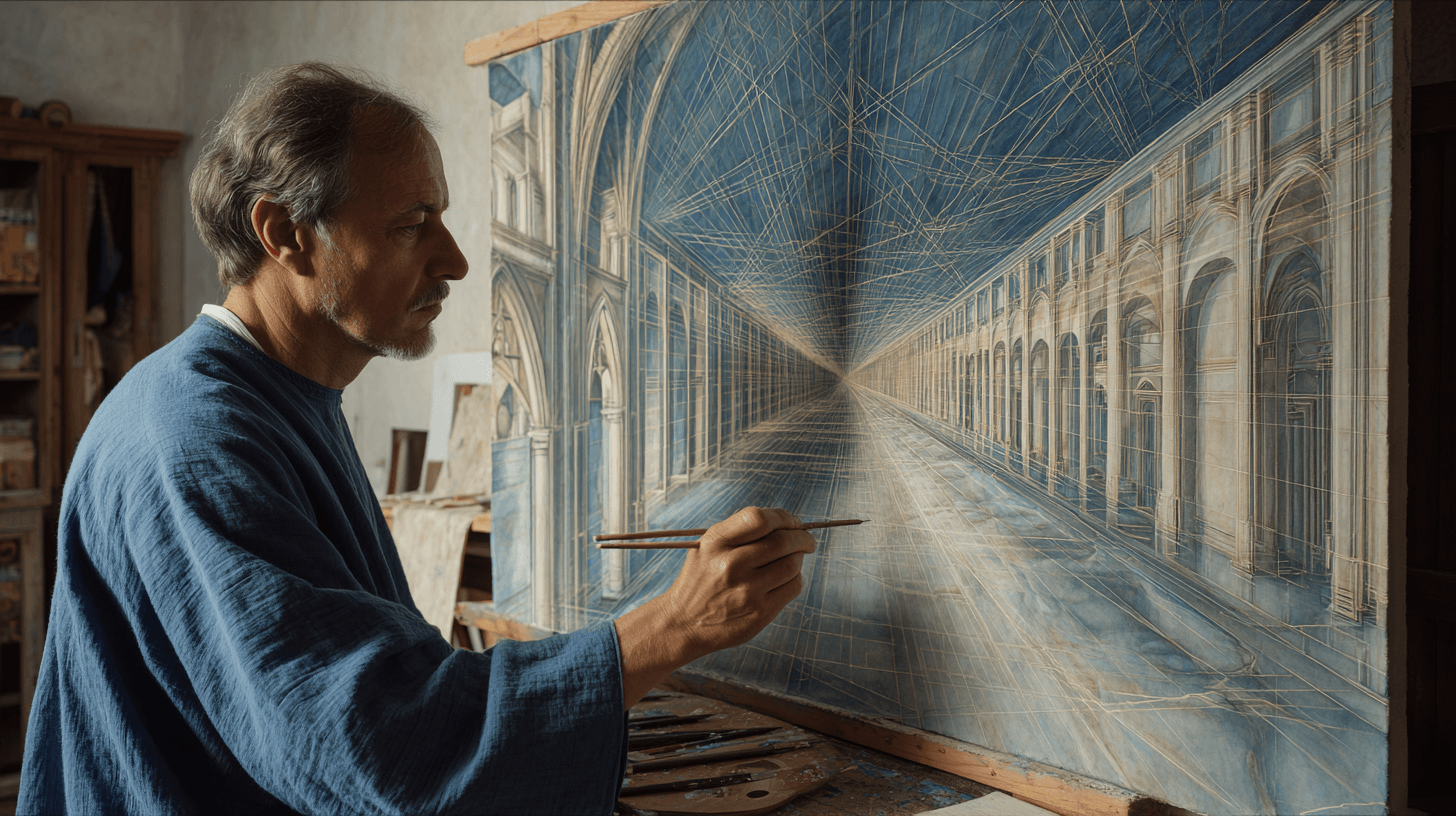
The architect was Filippo Brunelleschi, better known today for engineering the cathedral’s enormous dome. But this smaller experiment may have mattered just as much. He had figured out how to make a flat surface behave like a window onto three-dimensional space, using a single vanishing point and a set of converging lines to calculate exactly how large or small, how near or far, every object in a scene should appear.
Painters had been trying to suggest depth for centuries, with mixed and often inconsistent results. Brunelleschi’s demonstration offered something different: a reliable method, almost a formula, for translating the geometry of real space onto a two-dimensional panel. Within a generation, it would change not just how paintings looked, but how European culture understood the relationship between an image and the world it claimed to represent.
This is the story of how a geometric trick became an entire way of seeing.
What Painting Looked Like Before Perspective
To understand why Brunelleschi’s demonstration mattered, it helps to look at what came before it. Medieval and early Gothic painting was not trying, and largely not failing, to create the illusion of real space. It was doing something else entirely.
Figures in a medieval altarpiece were often sized according to their spiritual importance rather than their physical distance from the viewer. A saint might tower over a kneeling donor not because he stood closer, but because he mattered more in the hierarchy the painting was expressing. Backgrounds were frequently flat panels of gold leaf, signaling a sacred, timeless realm rather than a specific place.
Some artists, particularly in the fourteenth century, had already begun experimenting with converging lines and receding architecture. Painters such as Ambrogio Lorenzetti and Giotto produced scenes with real spatial ambition, using intuitive cues like overlapping figures and diminishing size to suggest depth. But these efforts were empirical rather than systematic. Two architectural elements in the same painting might converge toward different points, or a floor tile pattern might quietly contradict the geometry of the walls around it. The results were often convincing at a glance and incoherent under scrutiny.
What was missing was not talent. It was a unified mathematical system that any trained artist could learn and apply consistently. That is precisely what Brunelleschi supplied.
The Experiment That Made Geometry Visible
According to Antonio Manetti, who wrote a biography of Brunelleschi decades later, the architect painted a small panel showing the Florence Baptistery as seen from just inside the cathedral’s main doors. He drilled a small hole through the panel at the vanishing point and coated the sky above the painted buildings with polished silver, so it would reflect the real, shifting clouds overhead.
A viewer held the panel backward, pressed one eye to the hole, and looked through it at a mirror held at arm’s length. The mirror reflected the painting back at the viewer, positioned exactly where the real Baptistery stood. When the mirror was pulled away, the real building appeared in precisely the same place the painted one had. The illusion, by every surviving account, was startling.
Brunelleschi had not simply painted a building skillfully. He had measured it. He calculated the distances between the viewer’s eye, the picture plane, and the receding lines of the architecture, then used those measurements to determine exactly where every edge and corner belonged on the flat panel. The key insight was that parallel lines receding into the distance, such as the edges of a tiled floor or the sides of a building, appear to converge toward a single point on the horizon: the vanishing point. Once an artist fixed that point and calculated distances from it, every element of a scene could be sized and positioned with mathematical consistency.
This was not merely a painting technique. It was applied optics, drawing on the study of vision that Islamic scholars such as Ibn al-Haytham had advanced centuries earlier and that had since filtered into European universities. Brunelleschi, trained as a goldsmith and practicing as an architect, brought an engineer’s precision to a problem that painters had previously solved by instinct.
From Demonstration to Doctrine
An experiment performed once in a Florentine piazza does not reshape an artistic tradition by itself. What turned Brunelleschi’s discovery into a shared professional method was a short book written about fifteen years later.
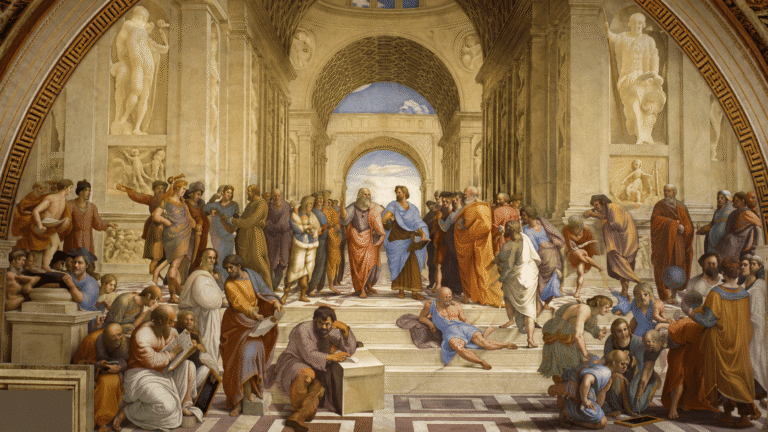
In 1435, the humanist and architect Leon Battista Alberti wrote Della Pittura (On Painting), the first known treatise to lay out linear perspective as a teachable system. Alberti described a technique now known as the “costruzione legittima,” or legitimate construction: draw a horizon line, place a single vanishing point on it, and use a grid of receding lines to map out a floor plane with mathematical accuracy. Anything positioned according to that grid would appear correctly scaled relative to its distance from the viewer.
Alberti’s genius was not inventing the geometry himself. It was translating Brunelleschi’s demonstration into portable instructions that any workshop could follow without needing to witness the original mirror trick or reconstruct its physics from scratch. He also gave the emerging technique a memorable justification, describing the picture surface as an open window through which the painter looks out onto the visible world. That metaphor would define Western painting’s ambitions for the next four centuries.
The timing mattered enormously. Florence in the 1420s and 1430s was a wealthy commercial republic with a class of merchants, guilds, and religious confraternities competing to commission increasingly impressive art. A demonstrable, teachable system for creating convincing spatial illusion was exactly the kind of innovation that ambitious patrons and workshops were primed to adopt quickly.
Masaccio Puts the Theory on a Wall
Perspective did not remain a theoretical curiosity for long. Around 1427, the painter Masaccio applied it to a fresco in the Florentine church of Santa Maria Novella known as the Holy Trinity.
The fresco depicts a barrel-vaulted chapel that appears to recede several feet into the solid wall of the church, framing figures of God the Father, the crucified Christ, the Virgin Mary, and two kneeling donors. Every architectural line in the painted chapel, from the coffered ceiling to the receding columns, converges toward a single vanishing point positioned at roughly the eye level of a viewer standing on the church floor.
The effect, especially for a fifteenth-century congregation unaccustomed to such precision, must have been remarkable: a devotional image that seemed to open an actual chamber into the church wall. Vasari, writing over a century later, claimed that viewers believed a real hole had been cut into the wall. That specific claim cannot be independently verified, but it captures something real about the fresco’s impact. Masaccio had shown that Brunelleschi’s geometry was not limited to architectural demonstrations. It could serve religious narrative, giving sacred figures a physically coherent space to inhabit rather than a symbolic gold backdrop.
Masaccio died the following year, only in his mid-twenties, but his brief career had already demonstrated something crucial: perspective was not just a mathematical exercise. It was a storytelling tool.
Why This Was More Than a Technical Fix
It would be easy to treat linear perspective as simply a better rendering technique, a way to make paintings look more “correct.” That undersells what the innovation actually did.
Perspective gave painters a fixed, singular viewpoint from which a scene made complete geometric sense. Every element in the composition, human figures, architecture, furniture, and landscape, now had to occupy a coherent position within one unified space, rather than being arranged according to symbolic importance or decorative convenience. This forced artists to think in fundamentally new terms about composition: not simply what to include, but where, precisely, everything belonged relative to everything else.
It also changed the relationship between the viewer and the image. A perspectival painting implies a specific standing point, a place where the viewer’s eye is meant to be, from which the illusion resolves correctly. The painting is no longer a flat surface bearing symbolic information. It is constructed as a window with an implied observer on the other side of the glass.
This shift connected naturally to broader intellectual currents of the early Italian Renaissance. Humanist scholars were reviving interest in classical mathematics, optics, and natural philosophy. Alberti himself moved fluidly between architecture, painting theory, and humanist scholarship. Perspective fit comfortably within a wider fifteenth-century project: applying rational, measurable systems to domains that had previously relied on convention and symbolic hierarchy.
What Popular Accounts Often Get Wrong
Perspective is sometimes described, especially in simplified accounts, as though Brunelleschi single-handedly “invented realism” or as though medieval artists simply lacked the skill to paint convincing depth. Neither claim holds up well.
As noted earlier, painters before Brunelleschi had already developed sophisticated, if inconsistent, methods for suggesting spatial recession. The change was not from incompetence to competence. It was from intuitive approximation to systematic calculation.
It is also worth noting that historians continue to debate exactly how much of the underlying mathematics Brunelleschi worked out himself, versus how much he absorbed from contemporary discussions of optics and geometry circulating among Florentine mathematicians and architects. Manetti’s biography, written decades after the fact, is the primary surviving account of the mirror experiment, and like most Renaissance biographical writing, it likely compresses and dramatizes events for narrative effect. The broad outline, that Brunelleschi demonstrated a working system of linear perspective around 1415 to 1420, is well supported by art historians. The precise details of the demonstration are necessarily reconstructed rather than directly documented.
Finally, it is worth resisting the idea that perspective represents an unambiguous artistic “upgrade” that every tradition would naturally adopt. Many sophisticated painting traditions, including Chinese landscape painting and Japanese scroll painting, developed entirely different conventions for representing space, often deliberately avoiding a single fixed viewpoint in favor of compositions the eye could travel through from multiple angles. Linear perspective was a powerful and historically consequential system, but it was a choice suited to a particular set of Renaissance priorities, not a universal solution that all visual cultures were destined to reach.
The Long Reach of a Vanishing Point
Within decades, perspective had spread far beyond Florence. Painters including Paolo Uccello, famously preoccupied with perspectival geometry to the point of obsession, and later Piero della Francesca, who wrote his own treatise on the mathematics of painting, refined and extended Alberti’s methods. By the later fifteenth century, perspective construction was a standard part of workshop training across Italy, and it spread northward into Flemish and German painting through trade, travel, and shared texts.
The technique also reshaped how architecture itself was imagined and communicated. Architects could now use perspective drawings to show patrons, with real persuasive force, exactly how a proposed building or public square would look before a single stone was laid. This gave design decisions a new visual authority, decades before construction began.
Perspective’s influence extended well past painting and architecture into the broader Renaissance sense that the visible world could be measured, modeled, and predicted. The same mathematical confidence that let an artist calculate exactly where a column should appear on a flat panel echoed through contemporary advances in cartography, astronomy, and engineering. A painting constructed according to strict geometric rules was, in its own way, a small argument for a larger idea: that careful observation and calculation could make sense of the physical world.
By the sixteenth century, linear perspective was simply assumed background knowledge for any ambitious European painter, so thoroughly absorbed into training that its original novelty had faded from view. It would take the emergence of photography, and later the deliberate perspectival experiments of artists such as Cézanne and the Cubists, for painters to seriously question whether a single fixed viewpoint was the only valid way to represent space at all.
Why the Vanishing Point Still Matters
Brunelleschi’s demonstration in front of the Florence Baptistery did not simply make paintings look more realistic. It gave European art a shared mathematical language for describing space, one precise enough to be taught, tested, and built upon by generations of painters who never witnessed the original experiment.
That is the real significance of the moment: not that one clever architect tricked a crowd with a mirror, but that his trick could be reduced to a method, written down by Alberti, and passed on as a durable technical inheritance. Few artistic innovations manage that transition from personal insight to shared discipline so cleanly.
The next time a straight road narrows toward the horizon in a photograph, or a video game renders a hallway receding into the distance, that image is quietly obeying rules worked out in fifteenth-century Florence. The vanishing point Brunelleschi identified on a small wooden panel is still, in a very real sense, the point where much of our visual culture converges.