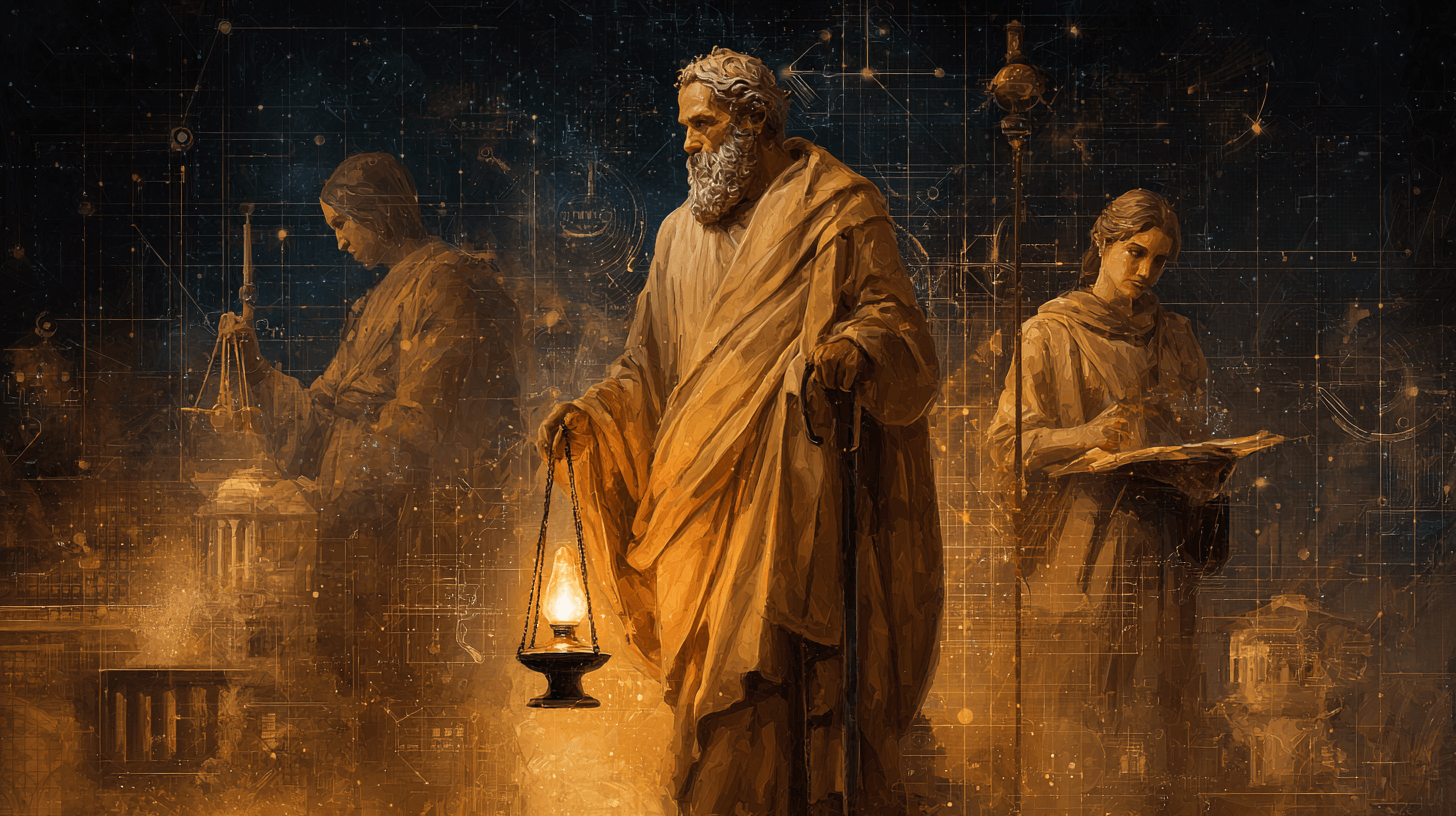
How Do We Really Know Something Is True?
A jury sits through three days of testimony. Two witnesses swear they saw the defendant at the scene. One expert says the fingerprint evidence is conclusive. And yet, by the end, several jurors still aren’t certain. They believe something happened. But do they know it happened?
That gap between belief and knowledge sits at the center of one of philosophy’s oldest and most stubborn problems. People rely on their senses, their memory, and the testimony of others every day without much hesitation. But philosophers have spent more than two thousand years asking a harder question: what actually justifies calling any of that “true”? The question sounds abstract, but it shapes how courts weigh evidence, how scientists design experiments, and how ordinary people decide what to believe on a crowded, contradictory internet.
This article looks at how some of history’s most influential thinkers tried to answer that question, why their answers kept running into trouble, and why the debate has become newly urgent in an age of manufactured images and confident misinformation.
The Question Behind Every Other Question
Philosophers call the study of knowledge epistemology, from the Greek word episteme, meaning knowledge. Its central question is deceptively simple: what does it take for a belief to count as knowledge, rather than just a guess that happened to be right?
Most people assume the answer is obvious. You know something if it’s true and you have good reason to believe it. That definition, refined over centuries, became known as “justified true belief.” For a long time, it looked like a solid foundation. As later sections show, it wasn’t nearly as solid as it seemed.
Before examining where that definition broke down, it helps to understand two very different traditions that tried to explain where justified belief comes from in the first place: one trusting reason above all, the other trusting experience.
The Doubt That Started Modern Philosophy
In 1641, the French philosopher René Descartes tried an unusual experiment. He decided to treat every belief he held as false unless he could find some reason it couldn’t possibly be doubted. He questioned his senses, since they had deceived him before. He questioned his memories, since dreams can feel just as real as waking life. He even questioned mathematics, imagining a powerful deceiver capable of making him miscalculate without his noticing.
Descartes wasn’t trying to become a skeptic for its own sake. He wanted to find one belief so certain that no deception could touch it, and then rebuild knowledge from that single foundation. He found it in the act of doubting itself. If he was thinking—even if only doubting—then something had to exist to do the thinking. That gave him his famous conclusion: I think, therefore I am.
From that single certainty, Descartes tried to reconstruct everything else: the existence of God, the reliability of clear and distinct ideas, and eventually the external world. Many later philosophers found this reconstruction far less convincing than the initial doubt. Still, the method itself changed philosophy. Descartes had shown that even the most obvious-seeming beliefs—that a table is solid, that other people have minds, that the past really happened—rest on assumptions that can be questioned. This approach, which treats reason rather than the senses as the most trustworthy source of knowledge, became known as rationalism.
Why the Senses Seemed Safer to Some Thinkers
A different tradition, developing largely in Britain over the following century, took the opposite starting point. Philosophers such as John Locke and later David Hume argued that the mind begins as something close to a blank slate. Every idea, they claimed, ultimately traces back to sensory experience: things we’ve seen, heard, touched, or felt.
This position, called empiricism, sounds intuitive at first. If you want to know whether it’s raining, you look outside. If you want to know whether water boils at a certain temperature, you run the experiment. Experience seems like the most direct route to truth available.
Hume pushed this idea to an unsettling conclusion. He pointed out that when people say one event causes another—fire causes heat, gravity causes objects to fall—they never actually observe causation itself. They observe one event, then another event, repeated many times. The connection between them is something the mind supplies, not something the senses directly detect. Hume argued that even the assumption that the future will resemble the past, the basis of nearly all scientific reasoning, cannot be proven through experience alone. It’s a habit of expectation, not a logical guarantee.
This left both major traditions with a serious weakness. Rationalism struggled to explain how pure reason connects to the physical world at all. Empiricism struggled to explain how repeated observation could ever justify a general law, rather than just a long list of individual instances.
Reason and Experience Working Together
The German philosopher Immanuel Kant, writing in the late eighteenth century, tried to resolve this standoff rather than simply choosing a side. He argued that both camps had gotten something right and something wrong.
Kant proposed that the mind isn’t a passive recorder of sensory data, as empiricists suggested, nor a self-sufficient source of truth detached from experience, as some rationalists implied. Instead, he argued that the mind actively structures raw sensory information using built-in categories—concepts like space, time, and causation—that make organized experience possible in the first place. Without those mental structures, sensory input would be nothing but chaotic noise. Without sensory input, those structures would have nothing to organize.
This meant that human knowledge is always shaped by the particular way human minds process reality. We can know how things appear to us, filtered through those categories. Whether we can ever know things exactly as they exist independent of any mind, what Kant called the “thing in itself,” is a separate and much harder question. Kant’s answer didn’t end the debate between rationalism and empiricism, but it reframed it. Knowledge, in his account, is neither pure reason nor pure sensation. It’s a collaboration between the two, and neither one works alone.
The Problem With “Justified True Belief”
For most of the twentieth century, philosophers largely accepted the “justified true belief” definition of knowledge as a reasonable working standard, even if its philosophical foundations remained contested. Then, in 1963, the American philosopher Edmund Gettier published a three-page paper that upended it.
Gettier described situations where someone holds a belief that is both true and reasonably justified, yet most people’s intuition says the person doesn’t actually know it. In one classic version: imagine someone reasonably believes a coworker owns a Ford, based on solid evidence like seeing him drive one for years. That belief turns out to be false—the coworker sold the car—but by pure coincidence, another statement built on that false belief happens to be true anyway, for entirely unrelated reasons. The person has a justified, true belief. Most people still hesitate to call it knowledge, because the truth was accidental rather than genuinely connected to the justification.
Cases like this, now called Gettier problems, showed that justification and truth can align by luck rather than by real connection. Philosophers have proposed dozens of refinements since then, adding conditions like reliability, sensitivity to error, or the absence of certain kinds of luck. No single fix has won universal agreement. The episode is a useful reminder that even a definition philosophers had relied on for centuries can turn out to have a hidden gap once someone finds the right counterexample.
What Popular Culture Gets Wrong About Truth
Outside philosophy departments, discussions about truth often collapse into a simpler and less accurate framing: either something is completely certain, or it’s “just an opinion.” That framing misses most of what epistemologists actually study.
Between total certainty and pure opinion sits a wide range of claims supported by different strengths of evidence: mathematical proofs, which offer near-total certainty within their own logical system; well-replicated scientific findings, which offer strong but revisable confidence; historical claims, which depend on the quality and consistency of surviving evidence; and everyday testimony, which varies enormously in reliability. Treating all of these as equally uncertain, or equally certain, erases distinctions that matter enormously in practice.
It’s also a common misconception that skepticism, in the philosophical sense, means believing nothing. Descartes’ method of doubt wasn’t an argument for permanent uncertainty. It was a tool for identifying which beliefs could withstand scrutiny and which couldn’t. Modern epistemologists use skeptical scenarios the same way: not to conclude that knowledge is impossible, but to clarify exactly what would have to be true for a given belief to count as knowledge.
Why This Debate Matters Now
These questions can sound like intellectual exercises detached from ordinary life. They aren’t. Every time someone evaluates a news article, a scientific claim, or an AI-generated image, they’re implicitly relying on some theory of justification, whether they’ve thought about it explicitly or not.
Consider a photograph. For most of the twentieth century, a clear photograph functioned as strong evidence almost by default, roughly equivalent to direct sensory testimony. Advances in image generation and editing have weakened that default. A convincing image no longer reliably indicates that the depicted event occurred. This is, in effect, a Gettier problem at societal scale: the appearance of strong justification (a photo that looks authentic) can now be disconnected from truth in ways that are difficult for an untrained eye to detect.
The same challenge applies to written claims. A confident, well-formatted statement circulating online can look justified without being justified at all, since confidence and formatting say nothing about the underlying evidence. Epistemology’s oldest lesson, that justification and truth don’t always travel together, has become a practical skill rather than a classroom abstraction. Recognizing the difference between a claim that merely sounds credible and one that has actually earned credibility is now something people need to do dozens of times a day.
Frequently Asked Questions
What is the difference between knowledge and belief?
A belief is simply something a person accepts as true. Knowledge, in the traditional philosophical definition, requires that the belief also be true and supported by adequate justification. The Gettier problem showed that even meeting all three conditions doesn’t always feel sufficient for genuine knowledge, which is why the exact boundary remains debated.
Is philosophical skepticism the same as refusing to believe anything?
No. Philosophical skepticism, as used by Descartes and later thinkers, is a method for testing which beliefs can survive rigorous doubt. It’s a tool for finding reliable foundations, not a conclusion that nothing can be known.
Why did Kant think neither pure reason nor pure experience was enough?
Kant argued that raw sensory experience needs mental structure to become organized knowledge, while pure reason needs sensory content to have anything to reason about. He concluded that reliable knowledge depends on both working together, not on choosing one source over the other.
What the Oldest Question in Philosophy Still Teaches
The search for a definition of knowledge hasn’t ended in agreement. Rationalists and empiricists identified real strengths and real limitations in reason and experience alike. Kant’s synthesis reframed the problem rather than solving it outright. Gettier’s short paper revealed that even a widely accepted definition can hide an unnoticed flaw.
What connects all of these attempts is not a final answer but a shared discipline: the habit of asking not just what do I believe, but what actually justifies believing it, and could that justification be present even if the belief were false. That question turns out to be far more useful than a tidy definition would have been anyway.
In an environment where convincing images, confident text, and persuasive claims can be produced faster than they can be checked, that habit of separating the appearance of justification from the substance of it isn’t just a philosophical curiosity. It’s one of the few reliable tools people have for telling the difference between what looks true and what actually is.