What Happened Before the Big Bang?
At some point, everything that exists—every star, every planet, every scrap of empty space—was compressed into a single, unimaginably dense state. Then it began to expand. That expansion never stopped. It is still happening today, stretching the space between galaxies a little farther with each passing second.
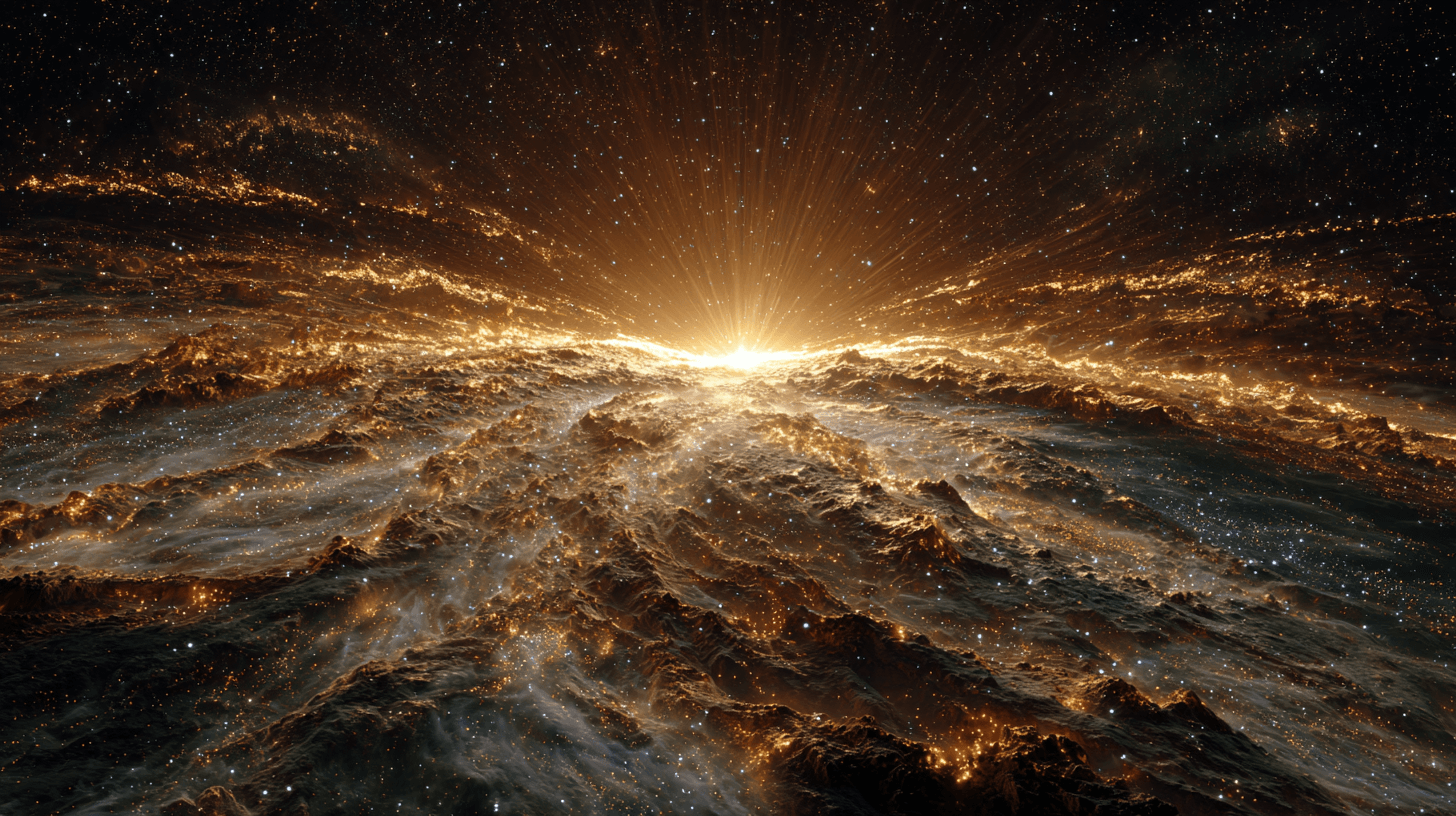
This is the Big Bang, and most people think they understand it: a cosmic explosion, a fireball erupting into nothingness, the universe’s opening bang. That picture is almost entirely wrong. The Big Bang was not an explosion into space. It was the expansion of space itself, and it left behind evidence so precise that scientists can describe conditions from a fraction of a second after it began.
What they cannot describe, at least not with confidence, is what came before it—or whether “before” is even a meaningful word in this context. That gap between what cosmology can prove and what it can only guess at is one of the strangest boundaries in modern science. Understanding where that boundary sits, and why it exists, says as much about the limits of physics as it does about the universe’s origin.
The Universe Is Expanding — And That Changes Everything Backward
The story begins not with the birth of the universe but with an observation about its present behavior. In the 1920s, the astronomer Edwin Hubble measured the light coming from distant galaxies and noticed something odd: nearly all of them were moving away from us, and the farther away a galaxy was, the faster it appeared to be receding.
This pattern, now called Hubble’s Law, had a striking implication. If galaxies are moving apart today, they must have been closer together in the past. Run the expansion backward far enough, and everything converges toward a single point of extreme density and temperature.
That single insight—cosmic distances are not fixed, they are growing—turned the universe from a static backdrop into a story with a beginning. It is the reason cosmologists talk about the universe having an age, currently estimated at roughly 13.8 billion years, rather than treating it as something that simply always existed in its present form.
What the Big Bang Actually Describes
The name “Big Bang” is misleading, and it was originally coined half-mockingly by the astronomer Fred Hoyle, who favored a rival theory. The phrase conjures an image of matter blasting outward into an empty void that was already there. Physics describes something different.
Space itself is expanding. Galaxies are not flying through a pre-existing emptiness the way shrapnel flies from a bomb. Instead, the distances between them are increasing because the fabric of space is stretching. A useful comparison, though an imperfect one, is a loaf of raisin bread rising in the oven: as the dough expands, every raisin moves farther from every other raisin, and no raisin can claim to be at the center of the expansion.
This has a strange consequence: the Big Bang did not happen at a point in space that we could, in principle, point a telescope toward. It happened everywhere at once, because it was the origin of space itself. There is no center of the universe and no direction you could travel to find the site of the explosion, because the expansion is a property of space, not an event within it.
The Evidence Behind the Theory
None of this would carry much weight without evidence, and the case for a hot, dense early universe is unusually strong for a claim about events billions of years in the past.
The Afterglow of Creation
In 1965, two radio astronomers, Arno Penzias and Robert Wilson, detected a faint hiss of microwave radiation coming from every direction in the sky, with no obvious source. They initially suspected equipment trouble or pigeon droppings on their antenna. What they had actually found was the cosmic microwave background: relic radiation left over from a period roughly 380,000 years after the Big Bang, when the universe had cooled enough for light to travel freely for the first time.
This background radiation has since been mapped in extraordinary detail by satellites, revealing tiny temperature variations that match, with remarkable precision, what theoretical models predicted. It functions as a kind of baby picture of the universe, and its existence is one of the strongest pieces of evidence that the early universe really was hot and dense.
The Elements the Universe Left Behind
A second line of evidence comes from chemistry. Big Bang models predict that in the first few minutes of the universe’s existence, nuclear reactions would have fused simple particles into hydrogen, helium, and small amounts of lithium in specific, calculable proportions. Astronomers measuring the actual abundance of these elements in ancient stars and gas clouds find a close match to those predictions. It is difficult to explain this precise chemical signature without an early universe hot enough to fuse atomic nuclei on a cosmic scale.
Together, the expansion of galaxies, the cosmic microwave background, and the observed abundance of light elements form three independent lines of evidence pointing toward the same conclusion. That convergence is why the Big Bang model is not treated as one theory among many, but as the foundation of modern cosmology.
Why Physics Hits a Wall at the Beginning
The evidence above describes the universe from a fraction of a second after its earliest moments onward. The very beginning is a different matter entirely.
If you run the equations of general relativity—the theory that describes gravity and the large-scale structure of space—all the way back, they predict a singularity: a point of infinite density and zero size where the equations simply stop producing sensible answers. Infinite density is not a physical description; it is a signal that the theory has been pushed past the point where it can be trusted.
Physicists suspect the true story lies in a regime governed by quantum mechanics, the physics of the extremely small, which becomes important at scales smaller than what is known as the Planck length and times shorter than the Planck time—about 10⁻⁴³ seconds after the conventional starting point. The trouble is that no one has a complete, tested theory that successfully merges quantum mechanics with gravity. String theory, loop quantum gravity, and several other frameworks attempt this merger, but none has been experimentally confirmed.
This is the honest limit of current physics: the Big Bang model works extremely well from a tiny fraction of a second onward, but the instant of origin itself sits inside a gap where the tools of contemporary science are not yet equipped to give a confident answer.
The Leading Guesses About What Came Before
Because the singularity marks the edge of what general relativity can describe, several competing ideas have emerged to fill in what lies beyond it. None of them currently counts as an established scientific conclusion. They are serious, mathematically developed proposals, not certainties.
Cosmic Inflation and the Multiverse
Many cosmologists support a theory called cosmic inflation, which proposes that in an extraordinarily brief interval after the universe began, space expanded at a staggering rate before settling into the slower expansion observed today. Inflation helps explain several features of the universe, including why the cosmic microwave background looks so uniform in every direction.
Some versions of inflation suggest that once it starts in a given region, it never fully stops everywhere at once, spinning off separate “bubble universes” endlessly. This has led to speculation about a multiverse, a vast collection of separate universes with our own being just one instance. Inflation itself has meaningful observational support; the multiverse extension built on top of it is far more speculative and, by most current proposals, may be untestable in principle.
A Universe Without a Boundary
Physicists James Hartle and Stephen Hawking proposed an alternative in which time itself behaves differently near the universe’s origin. In their “no-boundary” proposal, time gradually blends into something resembling an additional spatial dimension as you approach the beginning, so that asking what happened “before” the Big Bang becomes similar to asking what lies north of the North Pole. There simply is no further “before” to describe, not because it is hidden, but because the concept stops applying.
This is a mathematically elegant idea, but it remains a hypothesis rather than a confirmed description of nature.
Cyclic and Bouncing Models
A third family of theories proposes that the Big Bang was not an absolute beginning at all, but a transition—the end of a previous contracting universe that “bounced” back into expansion, possibly as part of an endless cycle of expansion and contraction. Some versions draw on ideas from string theory involving colliding higher-dimensional structures. These models are actively studied, but they also lack direct observational confirmation, and some proposed versions have run into theoretical difficulties.
The honest summary is this: multiple serious frameworks exist, they are not mutually compatible, and physicists currently lack a way to test which one, if any, correctly describes the universe’s true origin.
What Popular Culture Gets Wrong About the Big Bang
Several persistent misunderstandings are worth correcting directly.
The Big Bang was not an explosion of matter into empty space; it was the expansion of space itself, with no location and no center. The universe did not expand into anything, because there is no evidence of a pre-existing container it was expanding into. And the popular question “what came before the Big Bang” may rest on a hidden assumption—that time extended backward in the same way it does now—which several leading theories directly challenge.
None of this means the question is meaningless to ask. It means that answering it may require abandoning ordinary intuitions about time itself, intuitions built entirely from experience inside a universe where time already flows in one direction.
Why the Question Still Matters
It might seem like an abstract puzzle for physicists with no bearing on ordinary life, but the search for the universe’s origin has repeatedly forced scientists to build better tools, sharper instruments, and more precise theories, many of which have found uses elsewhere. The cosmic microwave background was found by accident while testing communications equipment. Precision measurements developed for cosmology have improved timekeeping, navigation, and materials science.
More than that, the question sits at the intersection of two of physics’ most successful but incompatible theories: general relativity, which governs the very large, and quantum mechanics, which governs the very small. A satisfying answer to what happened at the Big Bang would likely require reconciling those two theories into something new, a task some physicists consider the most important unfinished problem in the field.
The universe’s expansion is not in serious scientific dispute. Its earliest instant remains genuinely unresolved, and that distinction is easy to lose in popular retellings that treat the Big Bang as a fully solved story.
What makes this gap remarkable is not that physics has failed to answer the question, but that it has succeeded well enough to know precisely where its own knowledge runs out. Few scientific theories can point to the exact edge of their reliability with such honesty. The Big Bang model does exactly that: it explains, with impressive precision, everything after a certain moment, and it explains, with equal precision, why that moment itself may be the wrong place to keep asking “what came before.”