Why Raphael Is Called the Last Master of the Renaissance
On April 6, 1520, Raphael died in Rome at thirty-seven. According to a detail long repeated in his biography, it was his birthday as well as the day of his death, and both fell on Good Friday. Historians treat that coincidence with appropriate caution, but the date itself is not in dispute, and neither is what happened next: within a decade, the artistic world he had helped define began to come apart.
Michelangelo was still alive. So were dozens of talented painters trained in the workshops of Florence and Rome. Yet art historians consistently describe Raphael as the last master of the High Renaissance, as though a specific era of art had a closing figure rather than a slow fade. That label raises an obvious question. How can one painter mark the end of a movement he did not outlive by decades, in a city that kept producing extraordinary art for years afterward?
The answer has less to do with Raphael being the final great artist and more to do with what he represented: a brief, unusually stable balance between technical mastery, intellectual ambition, and classical harmony. Understanding why that balance was so fragile—and why it broke apart so quickly after his death—explains why “last master” became the phrase historians reach for.
A Painter Who Arrived After the Masters Were Already Made
Raphael was younger than both of the artists he is most often compared to. Leonardo da Vinci was already established and internationally known by the time Raphael left his native Urbino for Florence around 1504. Michelangelo, only eight years older, had already carved the David and was becoming a legend in his own lifetime.
This timing mattered. Raphael did not have to invent a visual language from nothing. He arrived in Florence able to study Leonardo’s innovations in composition and atmospheric shading, and Michelangelo’s command of the human body, as finished achievements rather than experiments in progress. What he did with that inheritance was unusual: instead of choosing one influence over the other, he absorbed both and folded them into a style distinctly his own.
Contemporary accounts describe him as remarkably quick at learning from other artists’ work, adapting techniques he observed without simply copying them. This talent for synthesis, rather than raw originality in the sense of invention, became the foundation of everything that followed.
The Vatican Rooms and the Art of Synthesis
In 1508, Pope Julius II summoned Raphael to Rome to decorate a set of private rooms in the Vatican Palace, now known as the Stanze di Raffaello. He was twenty-five years old, working in the same building where Michelangelo would soon begin painting the Sistine Chapel ceiling.
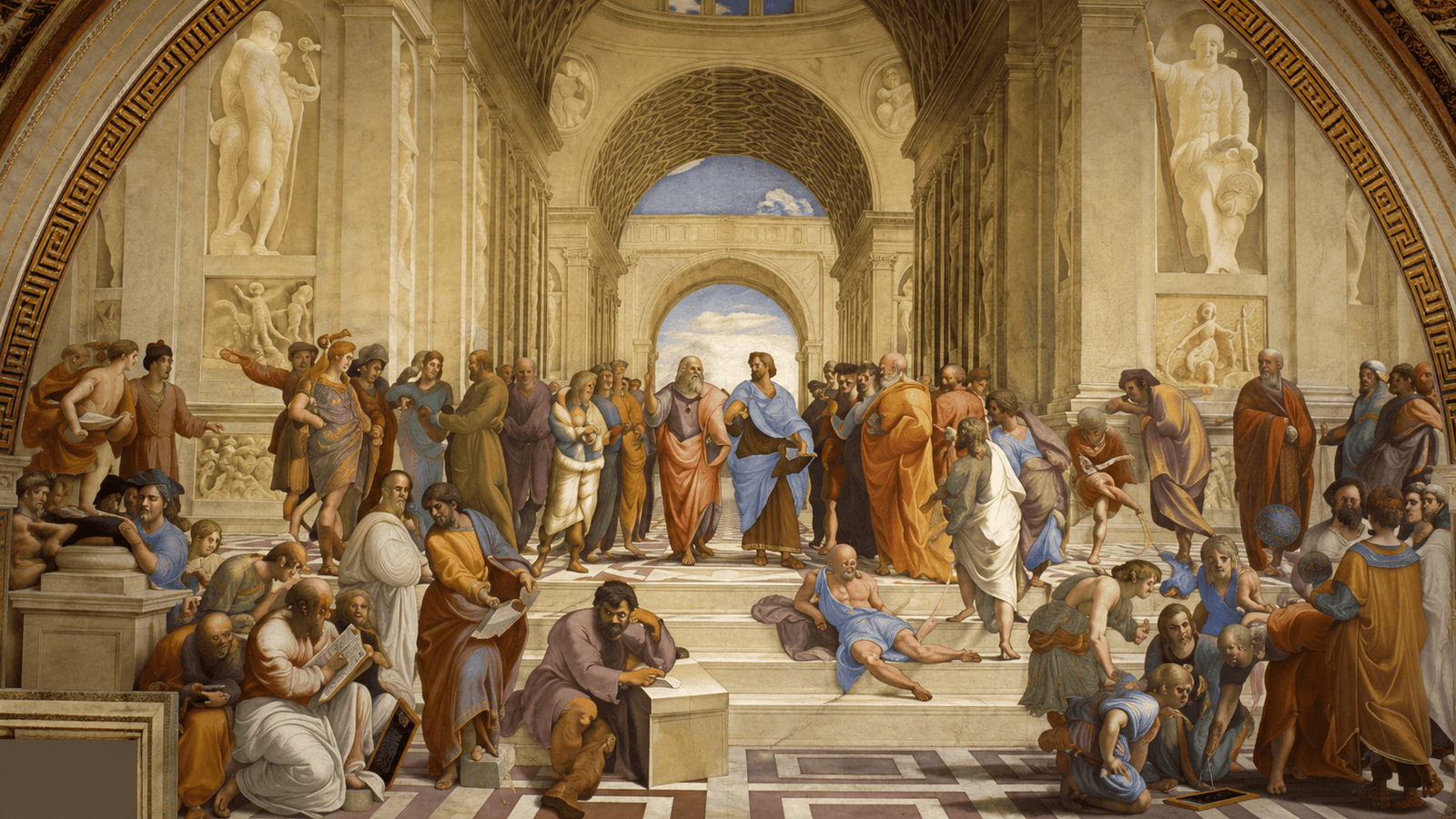
The most famous result of this commission is The School of Athens, a fresco depicting ancient philosophers gathered beneath vast classical architecture. Plato and Aristotle stand at the center, surrounded by dozens of thinkers arranged with mathematical precision. The architecture itself echoes plans by Donato Bramante, the Vatican’s chief architect at the time, showing how closely Raphael worked within Rome’s broader artistic circle rather than in isolation.
What makes the fresco remarkable is not any single technical breakthrough. It is the way Raphael combined Leonardo’s approach to grouping figures in psychologically coherent clusters with Michelangelo’s sculptural confidence in rendering the human body, all organized within a rigorously balanced perspective. Nothing in the composition feels accidental, yet nothing feels rigid. Figures gesture, argue, and think, but the overall effect is one of calm intellectual order.
This was Raphael’s signature achievement: taking two of the most powerful artistic personalities of his century and producing something that felt neither derivative nor competitive, but complete on its own terms.
Why His Contemporaries Called Him the Perfect Painter
Giorgio Vasari, the sixteenth-century painter and biographer whose Lives of the Artists shaped how the Renaissance is remembered, praised Raphael above nearly every other painter of the period. Vasari’s account should be read with some caution, since he wrote decades after Raphael’s death and was prone to dramatic framing. Still, his central judgment reflects a view widely shared among Raphael’s contemporaries: that Raphael combined grace, clarity, and technical control more completely than any painter before him.
The comparison to Michelangelo is instructive. Michelangelo’s work often carries what art historians call terribilità, a quality of overwhelming power and tension, visible in the twisting bodies of the Sistine ceiling. Leonardo’s paintings, by contrast, are defined by ambiguity and psychological mystery, most famously in the unresolved expression of the Mona Lisa.
Raphael’s paintings pursued neither tension nor mystery. They pursued equilibrium. His Madonnas are tender without being sentimental. His compositions are complex without appearing crowded. Where Michelangelo’s figures seem to strain against the confines of the canvas or ceiling, Raphael’s figures occupy their space with apparent ease, as though the composition could not have been arranged any other way.
This is not a claim that Raphael was simply more skilled than his rivals. Historians do not treat that question as settled, and there is no need to rank the three masters against each other to understand why Raphael’s particular contribution stood out. He offered something the other two did not: a model of harmony that later generations would treat as the definition of classical perfection.
A Death That Coincided With an Ending
Raphael’s death in 1520 did not, by itself, end anything. But it arrived close to a set of larger disruptions that reshaped the conditions under which Renaissance art had flourished.
Martin Luther had posted his Ninety-Five Theses just three years earlier, in 1517, setting off a religious upheaval that would eventually split European Christianity and destabilize the Church’s authority as a patron of the arts. In 1527, seven years after Raphael’s death, mutinous troops loyal to the Holy Roman Emperor sacked Rome itself, looting churches, killing thousands of residents, and forcing Pope Clement VII to flee. The city that had funded the Vatican frescoes, commissioned St. Peter’s Basilica, and drawn artists from across Italy was, for a period, in ruins.
Michelangelo lived for decades after these events, but the art he produced changed. His later work, including The Last Judgment on the Sistine Chapel’s altar wall, is more anguished and less classically composed than his earlier sculptures. Younger painters working in Florence and Rome in the 1520s, including Jacopo Pontormo and Rosso Fiorentino, began deliberately distorting proportion, exaggerating color, and abandoning the balanced compositions Raphael had perfected. Art historians call this shift Mannerism, and they generally treat it as a reaction against, rather than a continuation of, the High Renaissance style.
Raphael did not die because the Renaissance ended. But the world that had made his particular style possible—a Rome confident in its wealth, its papal authority, and its classical ideals—did not survive much longer than he did.
What the “Last Master” Label Gets Wrong
The phrase can create a misleading impression if taken too literally. Raphael was not the final significant artist of the Renaissance, and treating 1520 as a hard boundary oversimplifies a far messier transition. Michelangelo’s greatest sculptural and architectural work, including his design for St. Peter’s dome, came after Raphael’s death. Venetian painting, particularly the work of Titian, reached new heights throughout the following decades. The idea of a single ending point is a convenience of art history, not a fact etched into the historical record.
Historians also debate how sharply Mannerism actually broke from the preceding style, since many Mannerist painters trained directly in workshops shaped by High Renaissance principles and continued to draw on them even as they distorted them. The transition was gradual and uneven across different cities, patrons, and individual careers.
What the label captures accurately is not a literal endpoint but a symbolic one. Raphael’s death removed, at a moment of growing instability, the artist most associated with the era’s defining quality: confident, resolved harmony. What came after pursued different values entirely.
Why the Distinction Still Matters
The contrast between Raphael’s era and what followed illuminates something broader about how artistic movements actually end. They rarely stop the way a single event stops. They lose the specific conditions, patrons, confidence, and stability that made a particular style possible, and artists respond by pursuing different questions altogether.
Mannerism was not a decline in skill. It was a deliberate turn away from balance toward tension, elongation, and psychological unease, developed by painters responding to a Rome that no longer felt secure or triumphant. Raphael’s harmony had suited a moment when papal Rome seemed to be recovering classical antiquity’s grandeur without contradiction. That moment did not last.
Raphael has often been used as shorthand for classical ideals in Western art more broadly. Later academies, especially in France and Britain, held his compositional balance up as a standard against which student work was measured for centuries. This influence outlasted the High Renaissance itself by hundreds of years, shaping how art schools defined technical mastery well into the modern era.
A Painter Who Completed an Era Rather Than Closing It
Raphael did not end the Renaissance any more than one painter can end an artistic period through the act of dying. What he did was complete something rare: a style that fully resolved the ambitions of his predecessors without straining against them, produced at the exact historical moment when Rome had both the confidence and the resources to support it.
Calling him the last master, then, is less a claim about chronology than about character. He represents the final expression of a particular kind of certainty—technical, intellectual, and cultural—before political upheaval, religious rupture, and a new generation of restless painters pulled European art toward tension rather than resolution.
Raphael’s harmony was not surpassed after his death. It was set aside.