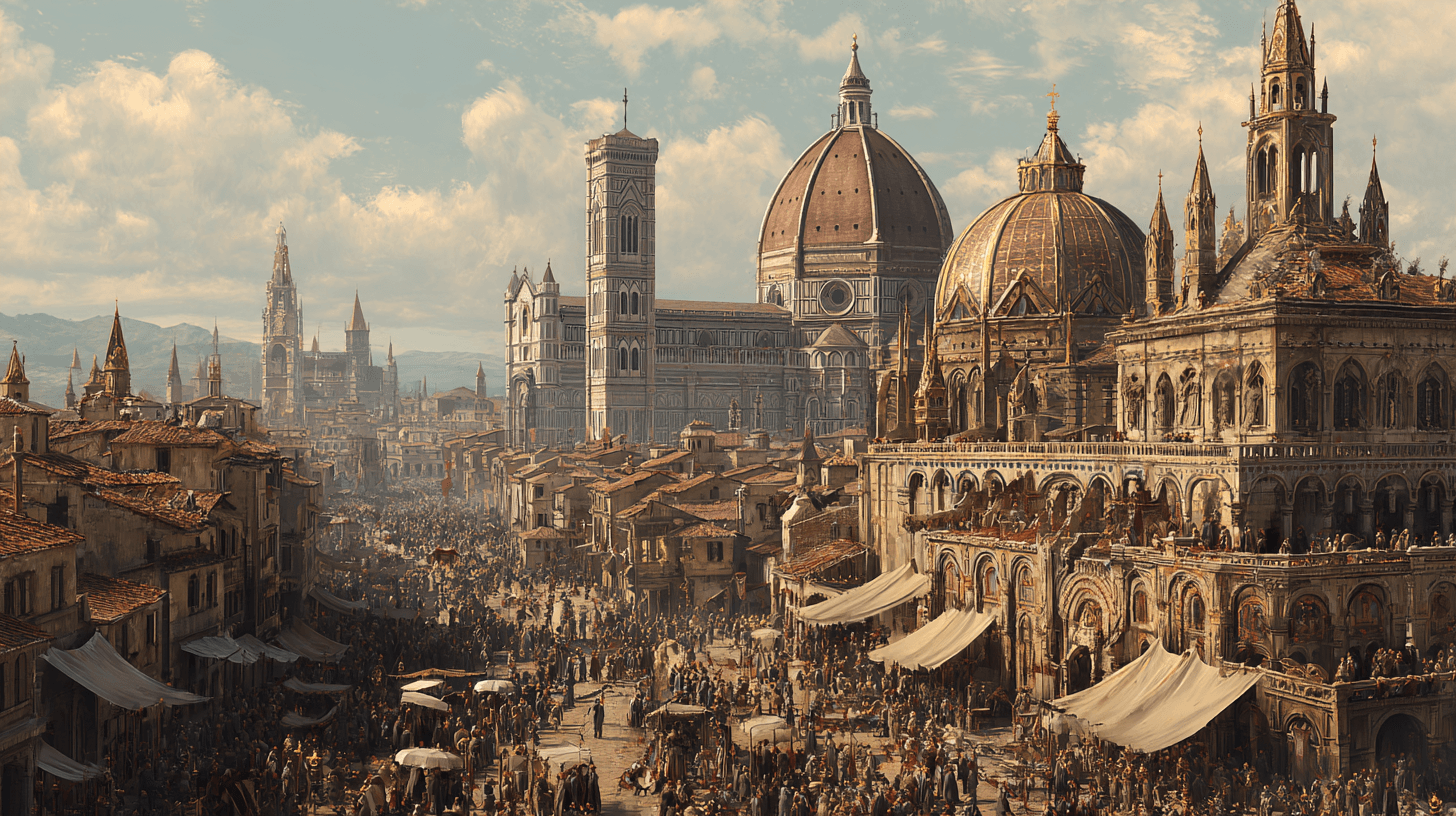
Why the Renaissance Began in Italy
In the middle of the fourteenth century, the Italian peninsula was not a country. It was a quarrelsome collection of city-states, some ruled by merchant oligarchies, others by despots, all competing for trade routes, territory, and prestige. Plague had recently killed perhaps a third of the population. Wars between neighboring cities were routine. By almost any measure, this was not a promising setting for one of the most consequential cultural transformations in European history.
And yet it was here, not in the centralized kingdoms of France or England, that a new way of thinking about art, knowledge, and human potential first took hold. Painters began solving problems of light and perspective that no one had solved before. Scholars started reading ancient texts not as religious instruction but as models of eloquence and civic wisdom. Bankers financed chapels and commissioned sculptures with the same ambition they brought to trade deals.
The puzzle is not simply what the Renaissance was. It is why this particular set of ideas emerged first in this particular place. What did Italy have that the rest of Europe, for the moment, did not?
The answer is not a single invention or a single genius. It is a convergence of conditions—political, economic, intellectual, and even demographic—that came together in Italy more completely than anywhere else on the continent.
A Continent Still Organizing Itself
By the 1300s, most of Western Europe was moving toward consolidation. France and England were building stronger royal governments, standing armies, and national tax systems. Power was becoming more centralized, funneled upward toward a single court and a single monarch.
Italy was moving in the opposite direction. The peninsula had no king. Since the collapse of centralized imperial authority centuries earlier, real power in Italy had settled into cities: Florence, Venice, Milan, Genoa, Siena, and dozens of smaller communes, each governing itself and jealously guarding its independence.
This mattered because a single royal court can support only one center of culture. Italy, by contrast, had many competing centers, each with its own government, its own wealthy families, and its own reasons to demonstrate its importance through art, architecture, and learning.
The Ghosts of Rome
Italy also had something no other part of Europe possessed in the same way: the physical and legal inheritance of ancient Rome.
Roman ruins were not distant memories in Italy. They were visible, walkable, and inescapable. Aqueducts, arches, and fragments of temples stood in Italian cities as everyday landmarks rather than archaeological curiosities. Roman law had never fully disappeared from Italian civic life, and Latin remained the language of the church, the university, and the notary’s office.
This proximity to the classical past gave Italians a particular relationship to antiquity. When scholars in Florence began reading Cicero or Livy with fresh eyes in the 1300s, they were not discovering a foreign civilization. They were rediscovering, quite literally, the history of their own soil.
That sense of inheritance shaped an intellectual movement historians now call humanism: a renewed focus on classical texts, rhetoric, and the study of human affairs, pursued for their own value rather than strictly as preparation for theology. The poet and scholar Petrarch, often credited as an early figure in this movement, spent years tracking down forgotten Latin manuscripts in monastery libraries, treating the recovery of ancient words as an urgent and worthy task in itself.
Cities Without a King
Political fragmentation did more than prevent a single royal court from monopolizing culture. It created an unusual incentive structure.
In a unified kingdom, a talented architect or painter had essentially one patron worth pursuing: the crown. In Italy, an ambitious artist could work for the Medici in Florence, a cardinal in Rome, a duke in Milan, or a merchant guild in Venice. Cities were not just governments. They were also, in effect, competing brands, each trying to outshine its rivals through visible achievement.
This rivalry had direct consequences. When Florence commissioned a new dome for its cathedral, other cities took notice. When Venice built increasingly elaborate churches funded by trading wealth, Florence and Milan felt the pressure to match it. Civic pride was not an abstract sentiment. It was expressed in stone, paint, and sculpture, and it was expensive.
Fragmentation is usually described as a weakness. In Renaissance Italy, it functioned as an engine of competitive investment in culture.
The Wealth That Made Art Possible
None of this competition would have mattered without money to fund it, and Italy had an unusual amount of it.
Italian city-states sat at the crossroads of Mediterranean trade, connecting Northern Europe with the eastern Mediterranean, North Africa, and, through intermediaries, Asia. Venice and Genoa built substantial fortunes on maritime commerce. Florence grew wealthy through wool and textile manufacturing, and through banking.
The Medici family, originally wool merchants, became one of the most powerful banking dynasties in Europe, with branches across the continent handling deposits, loans, and currency exchange for popes, kings, and merchants alike. Banking wealth on this scale created a class of families with more disposable capital than most European nobility, and with fewer inherited obligations dictating how that capital should be spent.
Patronage of art and scholarship became one of the most effective ways for this new merchant elite to convert commercial wealth into social prestige. A banking family could not claim ancient noble bloodlines, but it could commission a chapel, a painted altarpiece, or a library, and in doing so purchase a kind of permanence that money alone could not buy.
Wealth did not simply pay for Renaissance art. It gave newly powerful families a reason to want it.
The Scholars Who Carried Greek Learning West
Italy’s Mediterranean position brought more than trade goods. It brought people, and with them, texts.
As the Byzantine Empire weakened in the fourteenth and fifteenth centuries, and especially after the fall of Constantinople in 1453, Greek scholars increasingly moved westward, many settling in Italian cities. They brought with them manuscripts of Plato, Aristotle, and other classical authors that had been largely inaccessible to Latin-speaking Europe for centuries, along with direct knowledge of the Greek language itself.
Italian humanists had already been searching monastery libraries for forgotten Latin texts. The arrival of Greek scholars and manuscripts extended that recovery project dramatically, giving Italian thinkers access to a much wider range of ancient philosophy, science, and literature than had circulated in medieval Europe.
This is one of the clearer causal threads in the story: increased access to classical sources fed directly into humanist education, which shaped how artists and patrons thought about the human body, civic virtue, and the purpose of art itself.
What the Black Death Left Behind
Any honest account of Renaissance Italy has to reckon with an uncomfortable companion to its cultural flowering: mass death.
The Black Death arrived in Italy in 1347 and killed an enormous share of the urban population within a few years, with best estimates suggesting somewhere between a third and half of Europe’s population died in the initial outbreak and its recurring waves. Historians continue to debate exactly how directly this catastrophe shaped the Renaissance, but several plausible connections deserve mention.
Mass mortality concentrated wealth in fewer hands, as inheritances passed to surviving family members. Labor shortages after the plague increased wages for skilled workers, including artisans and builders. Confrontation with mass death also appears to have sharpened certain cultural preoccupations, including a heightened interest in the individual life, its meaning, and its legacy—themes that align closely with humanist concerns about human dignity and achievement.
None of this means the plague caused the Renaissance in any simple sense. It means the demographic and economic disruption of the mid-1300s reshaped Italian society in ways that likely made the cultural changes that followed more possible, even if it could never have produced them alone.
What Popular Memory Gets Wrong
The word “renaissance,” meaning rebirth, has encouraged a popular image of medieval Europe as a dark, stagnant age suddenly illuminated by a single burst of genius. This image is misleading in two important ways.
First, medieval Italy was never as intellectually static as the myth suggests. Universities in Bologna and elsewhere had preserved and developed sophisticated traditions in law, medicine, and philosophy for centuries before Petrarch picked up his first forgotten manuscript. The Renaissance built on existing institutions more than it replaced them.
Second, the transformation was neither instant nor centralized. It unfolded unevenly across decades and across different Italian cities, driven by many overlapping patrons, scholars, and artists rather than a single coordinated movement. Florence’s early leadership in humanist scholarship, Venice’s distinct visual traditions, and Rome’s later concentration of papal patronage all developed on different timelines, shaped by local conditions rather than a unified plan.
The Renaissance was not one door swinging open. It was many doors, in many cities, opening at slightly different speeds.
Why It Mattered Beyond Italy
The conditions that produced the Italian Renaissance were, in several respects, unusually local. But its consequences were not contained by Italy’s borders for long.
Humanist education, with its emphasis on classical rhetoric and the study of human affairs, gradually spread through European universities and shaped how later generations approached law, politics, and science. Techniques developed by Italian artists, including systematic approaches to linear perspective, became foundational reference points for European painting for centuries. The competitive patronage model pioneered in Florence and elsewhere previewed a broader European pattern in which cultural achievement became a recognized tool of political prestige.
Perhaps most significantly, the Renaissance helped popularize an idea that would prove enormously influential well beyond the visual arts: that individual human beings, through study, skill, and effort, could achieve excellence worth remembering on its own terms, independent of noble birth or religious office. That assumption, radical in its own moment, would go on to shape modern ideas about merit, education, and individual achievement.
Conclusion
There is no single answer to why the Renaissance began in Italy, and any explanation that offers one is probably leaving something out. The peninsula’s fragmented politics created competing patrons rather than a single royal court. Its trade wealth gave merchant families the resources and motivation to fund ambitious art. Its physical and legal closeness to ancient Rome gave classical learning an unusually direct path back into public life. The arrival of Greek scholars and manuscripts widened that classical revival further, while the demographic shock of the plague reshuffled wealth and sharpened cultural attention on the value of individual lives.
None of these conditions existed only in Italy. What was distinctive was how completely they overlapped there, in the same cities, in the same decades, reinforcing one another rather than working separately.
The Renaissance did not begin in Italy because one city or one family decided to reinvent European culture. It began there because Italy, for a particular stretch of history, was arranged in exactly the right way to turn old ideas, new wealth, and old ruins into something genuinely new.