What the Code of Hammurabi Reveals About the Birth of Law
A Stone Monument Found Far From Home
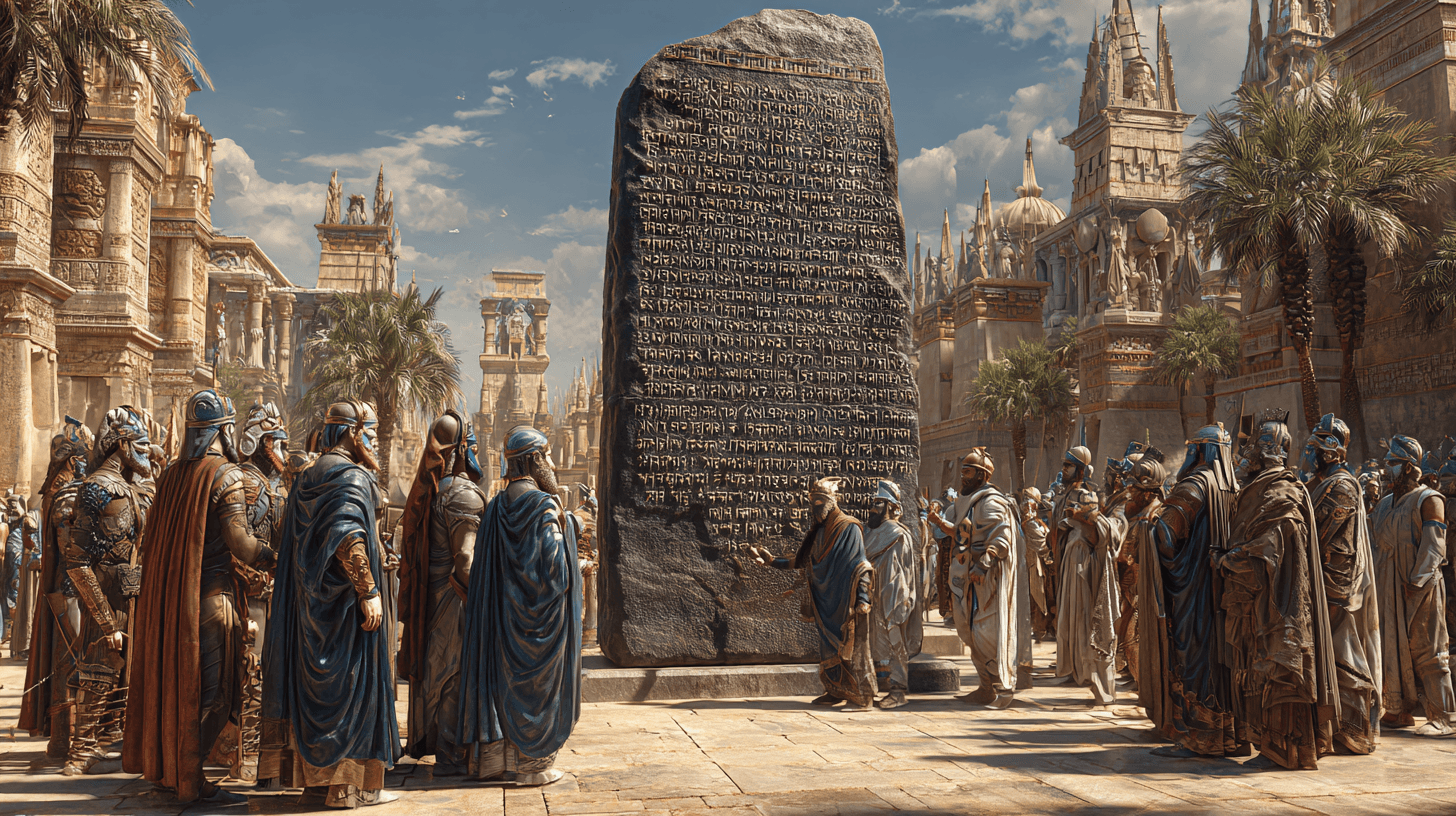
In December 1901, French archaeologists digging at Susa, in what is now southwestern Iran, uncovered a black stone pillar more than seven feet tall, covered in cuneiform script. The find was strange from the start. Susa was the capital of ancient Elam, a rival power to Babylon, and nothing about the site suggested it should hold a monument celebrating a Babylonian king. The answer, it turned out, was theft: Elamite raiders had carried the stele off as war booty centuries after it was carved, hauling a piece of Babylonian law all the way into enemy territory.
The stele belonged to Hammurabi, who ruled Babylon from roughly 1792 to 1750 BCE. Carved into its surface was a prologue praising his reign, an epilogue defending his justice, and, between them, 282 legal provisions covering theft, marriage, debt, medical malpractice, and much more. Today the stone sits in the Louvre, one of the most visited legal artifacts on Earth.
The natural question is why a nearly 3,800-year-old list of Babylonian rules still commands this much attention. The code is often introduced to students as “the oldest known law,” which is not actually true, and that inaccuracy points toward a more interesting question. What Hammurabi’s monument reveals is not the invention of law itself, but something arguably more consequential: the moment a king turned law into a public claim about the nature of just rule.
Babylon Before Hammurabi
To understand what Hammurabi was doing, it helps to see the world he inherited. Mesopotamia in the early second millennium BCE was not a single kingdom but a patchwork of competing city-states — Babylon, Larsa, Mari, Eshnunna, Assyria — each ruled by its own dynasty and each capable of overwhelming its neighbors when the balance of power shifted. Hammurabi inherited a modest kingdom from his father and spent roughly his first three decades as king mostly at peace, building canals and temples rather than armies.
Then, in the final years of his reign, he turned decisively toward conquest. Through a rapid sequence of campaigns and shifting alliances, he defeated Larsa, Eshnunna, Mari, and other rivals, unifying most of southern and central Mesopotamia under Babylonian rule for the first time. The result was an empire that was militarily new but administratively fragile: newly conquered cities had their own customs, their own local elites, and no automatic loyalty to a Babylonian king.
This is the political problem the law code was built to solve. Conquest could take a city. It could not, by itself, make that city’s people believe their new ruler was legitimate.
The Code as a Political Argument
The 282 laws that make up the code’s core are the part most people remember, but they are framed on both ends by something closer to political theater. The prologue lists dozens of cities Hammurabi claims to have blessed with prosperity and divine favor, city by city, in a kind of legitimacy tour across his newly won territory. The epilogue goes further, declaring that the great gods Anu and Enlil had personally commissioned him to promote the welfare of the people and to prevent the strong from oppressing the weak. <br>
That framing matters more than it first appears. Hammurabi was not simply publishing a legal reference manual. He was making a public argument: that his rule rested on justice, not merely on conquest. The laws in the middle of the stele functioned as evidence for that claim — proof, displayed in a public square, that this king had put concrete rules behind his promise.
This explains a puzzle that troubles many readers: the code contains no provisions for treason, rebellion, or crimes against the king himself. A modern reader might expect a conqueror’s law to be obsessed with protecting his own power. Instead, the code overwhelmingly addresses disputes between ordinary people — a farmer’s flooded field, a builder’s collapsed house, a merchant’s unpaid loan. The absence is the point. Hammurabi wanted the stone to say that his justice served his subjects, not merely his throne.
How the Laws Actually Worked
The code organizes its provisions largely by scenario rather than abstract principle, a structure closer to a long list of case rulings than to a modern statute. A law does not usually state “theft is illegal.” It states what happens if a specific person steals a specific thing from a specific kind of victim under specific circumstances.
This case-based structure produced the code’s most famous feature: punishments that varied sharply depending on the social status of everyone involved. Babylonian society under Hammurabi recognized at least three broad classes — the awilum, free persons of high status; the mushkenum, a lower free class with fewer legal protections; and wardum, enslaved people, who had essentially no independent legal standing. The penalty for the same injury could differ enormously depending on which class the victim and the offender belonged to.
The code’s best-known principle, often summarized as “an eye for an eye,” appears in provisions demanding that an injury be met with an equivalent injury — but strictly within the same social class. If a member of the awilum destroyed the eye of another awilum, the punishment was the loss of his own eye. If the same injury was inflicted on a mushkenu, the penalty was a monetary fine instead. The logic was not equality before the law in the modern sense. It was proportionality within a hierarchy the law took entirely for granted.
Other provisions reveal a surprisingly commercial society. There are rules governing interest rates on loans of silver and grain, liability for a boat that sinks under a careless captain, and the fees owed to a doctor who successfully performs surgery — alongside a startling penalty if the surgery fails and the patient dies. There are also detailed family provisions: a wife’s right to a dowry, the conditions under which a man could divorce his wife, and inheritance rules for children born to a concubine. Read together, these laws sketch a society far more concerned with property, contracts, and household stability than with abstract crime and punishment.
What Popular Memory Gets Wrong
The claim that Hammurabi’s code was the first law in history is one of the most persistent misconceptions surrounding it, and it is simply inaccurate. Archaeologists have recovered at least two earlier Mesopotamian law collections: the Code of Ur-Nammu, from the city of Ur around 2100 BCE, roughly three centuries before Hammurabi, and the Code of Lipit-Ishtar, from around 1930 BCE. Hammurabi’s version is far better preserved and more extensive, which is why it became famous, but it stands in a tradition rather than starting one.
A second, more scholarly debate concerns what the code actually was in practice. For much of the twentieth century, historians assumed the 282 provisions functioned as active statute — that Babylonian judges consulted the code directly when deciding cases. That assumption has weakened considerably. Thousands of surviving Babylonian court records from Hammurabi’s era and after almost never cite the code by name or quote its specific provisions, even in cases the code appears to address directly. Historians such as Jean Bottéro and Martha Roth have argued instead that the code likely functioned as a kind of royal treatise on justice — a scholarly and propagandistic composition meant to be copied by scribes and displayed as a monument to good kingship, rather than a working legal handbook judges carried into court.
This does not make the code less significant. It changes what the significance actually is. The code endures less as evidence of how individual Babylonian trials were conducted and more as evidence of how an ancient king wanted justice, and his own legitimacy, to be understood.
Why the Code Still Matters
The Code of Hammurabi’s influence on the later history of law is real, though it is easy to overstate. It almost certainly was not a direct source for the Torah’s legal material, despite superficial similarities in provisions like talionic punishment; both instead likely drew on a much older, shared Near Eastern legal culture that shaped multiple societies independently. What the code demonstrates convincingly is that written law, backed by royal authority and displayed for public view, was already a functioning tool of governance nearly four thousand years ago — not a later invention of Greek city-states or Roman jurists, as older Western histories of law sometimes implied.
The stele’s own physical journey adds a final layer of meaning. Carved to proclaim a Babylonian king’s justice, looted by Elamite raiders, buried for over three thousand years, then unearthed by French archaeologists and shipped to Paris, it has spent most of its existence far from the people it was written for. Iraqi scholars and cultural institutions have long pointed to the code as part of a national heritage still held abroad, a reminder that the history of ancient artifacts is often inseparable from the politics of empire, war, and archaeology that moved them.
A Ruler’s Case for His Own Legitimacy
The question of why Hammurabi’s code still matters ultimately has less to do with legal firsts and more to do with what the stone reveals about power. A newly crowned emperor of a fractured region needed his conquered subjects to see him as something more than a conqueror. The laws carved beneath his prologue were his evidence.
Read as a working rulebook, the code offers a flawed and partial window into Babylonian justice. Read as a political document, it offers something rarer: a nearly four-thousand-year-old record of a ruler trying to convince his people that force alone was not what held his kingdom together. That argument, inscribed in stone and stolen twice over by history, is what still speaks from the Louvre today.
Frequently Asked Questions
Was the Code of Hammurabi the first law code in history?
No. Earlier Mesopotamian law collections survive, including the Code of Ur-Nammu from around 2100 BCE and the Code of Lipit-Ishtar from around 1930 BCE. Hammurabi’s code is the most complete and famous example, not the earliest.
Did Babylonian judges actually use the code to decide cases?
The evidence is uncertain. Surviving court records from the period rarely cite the code directly, leading many historians to conclude it functioned primarily as a royal declaration of just kingship rather than a statute book judges consulted case by case.
Did the code apply the same punishment to everyone?
No. Punishments varied significantly based on the social class of the people involved — free persons of high status, a lower free class, and enslaved people all faced different consequences for identical offenses.
Where is the Code of Hammurabi now?
The stele has been on display at the Louvre in Paris since shortly after its discovery in 1901 at Susa, in present-day Iran, where it had been taken as war booty in antiquity.