How the Steam Engine Rewired the Rules of Human Power
In the flooded coal mines of early 18th-century England, workers faced a problem that no amount of muscle could solve. Dig deep enough for coal, and water seeps in faster than horses and buckets can remove it. Some mines drowned before they could be fully worked. The value of the coal below ground meant nothing if the water above it couldn’t be cleared.
This unglamorous drainage problem, not some grand vision of industrial transformation, is where the steam engine’s story actually begins. The machine that would eventually power factories, trains, and ships started as a pump — a way to keep mine shafts dry enough to dig one more layer of coal.
The central question worth asking isn’t simply “what did the steam engine do.” Steam-powered machinery had existed in limited forms for over a century before it changed anything. The more useful question is why this particular technology, refined at this particular moment, ended up dissolving limits on human productivity that had held for thousands of years. Understanding that shift explains far more about the modern world than a list of inventions ever could.
The Ceiling That Muscle and Water Could Never Break
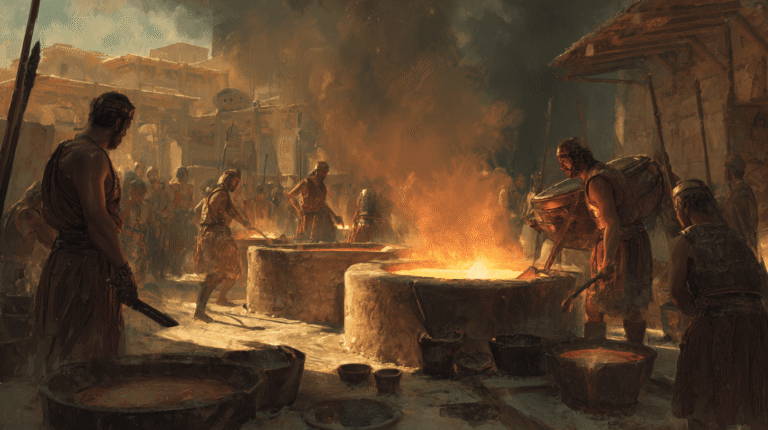
Before steam power, every economy on Earth ran on the same handful of energy sources: human labor, animal labor, flowing water, and wind. Each had a hard ceiling.
A horse can pull only so much weight for only so many hours. A watermill needs a river, and rivers don’t move to where the work is. Wind is powerful but unreliable, and it cannot be stored for a day it doesn’t blow. These weren’t inefficiencies to be optimized. They were physical limits baked into the nature of the energy source itself.
Manufacturing output, transportation speed, and even city size were all constrained by this ceiling. A textile mill could only be as productive as its water wheel allowed. A shipment could only travel as fast as wind or muscle could carry it. Growth was possible, but it was incremental, and it was capped.
The steam engine mattered because it broke that ceiling for the first time in human history. It converted heat, produced by burning abundant and transportable fuel, directly into mechanical force. Unlike a river, coal could be shipped anywhere. Unlike a horse, an engine didn’t tire. This is the foundational shift, and everything else in the story follows from it.
Solving a Mine’s Problem, Not the World’s
The earliest practical steam engines weren’t built to launch an industrial revolution. They were built to solve the drainage crisis in English coal and tin mines.
In 1712, Thomas Newcomen introduced an “atmospheric engine” designed for exactly this purpose. Steam filled a cylinder, and then cold water sprayed inside caused the steam to condense, creating a vacuum. Atmospheric pressure then pushed a piston down, and that motion powered a pump. It was crude, wildly inefficient by later standards, and consumed enormous quantities of coal. But at a coal mine, fuel was essentially free, so the inefficiency didn’t matter. The engine did its one job: it kept mines dry enough to operate.
For roughly six decades, that’s largely what steam engines did. They were stationary, expensive, and tied almost exclusively to mining. If the technology had stalled there, it would be a footnote in the history of mining equipment rather than a turning point in world history.
The Fix That Changed What Was Possible
The decisive shift came from James Watt, a Scottish instrument maker, in the 1760s and 1770s. Watt didn’t invent the steam engine — a common misconception that undersells what he actually contributed. What he identified was a specific, fixable flaw in the Newcomen design.
Every cycle of a Newcomen engine required cooling the cylinder to condense the steam, then reheating it to accept new steam. That constant heating and cooling wasted enormous amounts of energy. Watt’s solution was to add a separate condenser, a second chamber where the steam could condense without cooling the main cylinder at all. The cylinder stayed hot; the condenser stayed cold. The engine no longer fought itself every cycle.
The result was an engine that used a fraction of the coal for the same output. That single improvement in efficiency is what allowed steam power to escape the coal mine. Once an engine no longer needed to sit beside a nearly free fuel supply to be economical, it could go anywhere fuel could be transported — which, as it turned out, was almost everywhere.
Watt partnered with the manufacturer Matthew Boulton to commercialize the design, and by the 1780s their engines were driving rotary machinery directly, not just pumping water. That rotary motion — a wheel turning continuously — is what made the steam engine useful for an entirely different kind of work: running machines.
From Pumping Water to Powering Factories
Textile production was the first industry transformed by this new capability, and the transformation reveals exactly how the technology reshaped economic life.
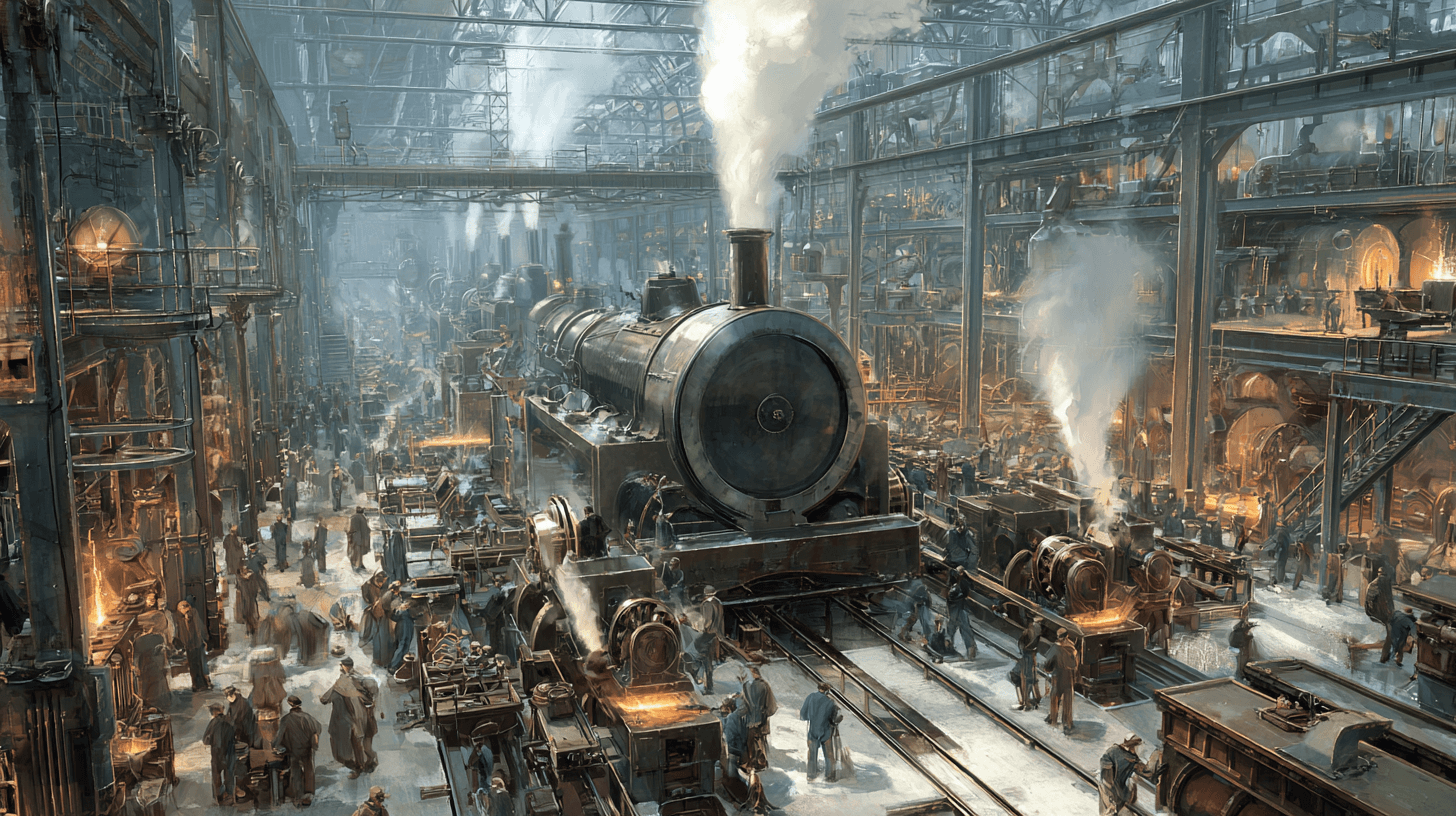
Spinning and weaving had traditionally been dispersed work, done in homes and small workshops, often constrained by access to a water wheel if any mechanization was involved at all. A steam engine changed the location logic entirely. A mill no longer needed to sit on a riverbank. It could be built wherever labor, capital, and transportation converged, and coal could be delivered to keep it running regardless of season or drought.
This is the point where “more powerful machines” becomes “a different way of organizing human work.” Production concentrated into large buildings full of workers operating machinery on a schedule set by the engine, not by daylight or weather. The factory system, with its fixed hours, centralized supervision, and mechanized pace, grew directly out of steam power’s ability to run continuously wherever it was placed.
Textile output in Britain expanded dramatically through the late 18th and early 19th centuries, and steam-powered mills were central to that expansion, though water power remained important for decades longer than popular narratives sometimes suggest. The transition was gradual and uneven, not a single overnight switch.
The Leap to Movement
Stationary power was only half the transformation. The second half came when steam engines became light and efficient enough to move under their own power.
Richard Trevithick built early steam locomotives in the first years of the 1800s, and by the 1820s and 1830s, railways using more refined designs — including those developed by George Stephenson — began connecting cities at speeds no land transport had ever achieved. Steamships followed a similar arc, eventually freeing ocean travel from complete dependence on wind.
The significance here goes beyond speed. Before railways, moving heavy goods overland across long distances was often uneconomical; water transport had always been cheaper and faster for bulk cargo. Steam-powered rail changed that calculation. Coal, iron, grain, and manufactured goods could move inland, quickly and cheaply, in volumes that horse-drawn transport could never match. Markets that had been effectively separate — a coastal city and an inland town, for instance — became economically connected in ways they had never been before.
What Changed Beyond the Machines Themselves
The steam engine’s deepest impact wasn’t mechanical. It was the reorganization of where people lived, how they worked, and how wealth was created.
Cities built around mills and railway junctions grew explosively, often faster than housing, sanitation, or infrastructure could keep pace with. Manchester’s population, for example, expanded severalfold within a few decades as textile manufacturing concentrated there. This rapid urbanization brought overcrowding and serious public health problems alongside new economic opportunity — the growth was real, but so was the cost.
Labor itself changed character. Work shifted from tasks paced by natural rhythms — daylight, seasons, a household’s own schedule — to tasks paced by machinery that didn’t tire and didn’t care what time of year it was. This is a genuine trade-off, not simply progress: mechanized production created new jobs and new goods at unprecedented scale, while also introducing long factory hours, dangerous machinery, and, in many mills, child labor, which reformers and lawmakers only gradually curtailed over the course of the 19th century.
Economically, the steam engine helped make possible a kind of sustained growth that simply hadn’t existed before. Historians studying long-run economic data generally agree that steady, compounding increases in output per person are largely a phenomenon of the industrial era onward, though the precise causal weight of steam power relative to other factors — capital markets, scientific institutions, colonial trade networks, coal geology — remains genuinely debated among economic historians. The steam engine was a necessary enabler of this growth, not its sole cause.
What Popular Memory Gets Wrong
A persistent myth credits James Watt with inventing the steam engine outright, sometimes tied to a story about him watching a kettle as a boy. Steam-powered devices date back to antiquity in limited experimental forms, and practical industrial steam engines existed decades before Watt was born. His real contribution — the separate condenser — was narrower and more technical than popular retellings suggest, but it was also precisely the kind of narrow, technical fix that made the difference between a mining curiosity and a general-purpose power source.
Another common oversimplification treats the Industrial Revolution as something that happened suddenly once steam power arrived. In reality, water power, human labor, and steam coexisted in industry for generations, and the shift to a fully steam-dominated economy took most of the 19th century to complete.
Why the Story Still Matters
The steam engine’s real legacy isn’t the specific machine, which was eventually replaced by internal combustion engines and electric motors. Its legacy is the principle it demonstrated for the first time: that human productivity did not have to be bound by muscle, wind, or water.
Every subsequent leap in energy technology — electrification, the internal combustion engine, nuclear power — has followed the same underlying logic the steam engine established. Find a way to convert stored energy into reliable, transportable mechanical force, and you remove a limit that previously defined what an economy, a city, or a society could become.
That is the more precise answer to how the steam engine changed the world. It didn’t just move goods faster or spin more thread. It severed the ancient link between human effort and human output, and nothing about how people work, live, or build has been governed by the old limits since.