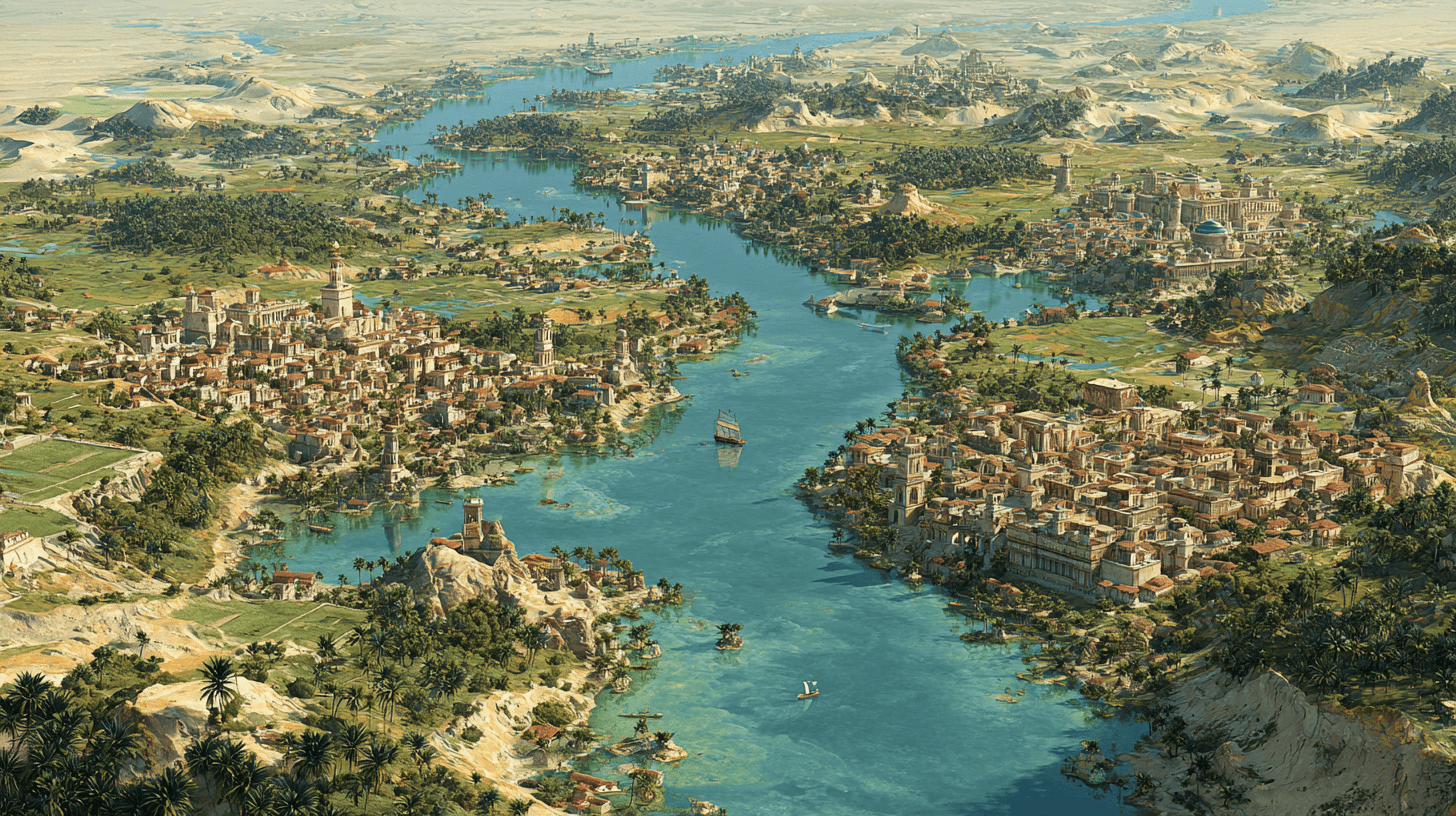
Why Every Ancient Civilization Grew Up Beside a River
The Pattern No One Planned
Separated by thousands of miles and centuries of time, the earliest complex societies on Earth made the same choice without ever consulting one another. Mesopotamia rose between the Tigris and Euphrates. Egypt organized itself along a single, predictable waterway. The Indus Valley civilization built its cities on a river system in what is now Pakistan and northwest India. Chinese civilization took root along the Yellow River.
None of these societies borrowed the idea from the others. They were separated by deserts, mountains, and, in some cases, oceans of unexplored land. Yet they all arrived at the same geographic answer to the same underlying problem: how do you feed, organize, and sustain a population large enough to build cities?
This is not a coincidence of history. It is a pattern with a cause. Rivers did not simply provide water. They created the specific conditions that made large-scale, settled civilization possible in the first place — and understanding those conditions explains far more about the ancient world than the rivers themselves.
The Problem Every Early Society Had to Solve
Before agriculture, human groups were small and mobile. Hunting and gathering could support only a limited number of people in a given area, and food supply depended on constant movement. Civilization, in the sense of cities, writing, government, and specialized labor, required something hunting and gathering could not provide: a reliable, storable food surplus.
A surplus changes everything. If a farming community produces more grain than it needs to survive, some members no longer have to farm. They can become soldiers, priests, record-keepers, or artisans. Surplus is the raw material of specialization, and specialization is the raw material of civilization.
The question, then, is not why people wanted surplus. It is where surplus first became possible. And the answer, in almost every early case, was the flat, well-watered land beside a major river.
Why Rivers Solved the Surplus Problem
Rivers offered three advantages that dry or hilly land could not easily match.
The first was water itself, delivered predictably and in large quantities. Farming without irrigation depends entirely on rainfall, which in much of the ancient Near East and North Africa was too sparse or too irregular to support dense population. A river solved this by acting as a constant water source that people could redirect through irrigation channels, independent of whether it happened to rain that season.
The second advantage was soil fertility. Rivers that flood seasonally, as the Nile, the Tigris and Euphrates, and the Yellow River all once did, deposit fresh layers of silt across the surrounding land each year. This silt functions as a natural fertilizer, replenishing nutrients that intensive farming would otherwise strip from the soil within a few growing seasons. Ancient Egyptian farmers did not need crop rotation or fallow fields to the same degree that dry-land farmers elsewhere required, because the Nile renewed their fields for them.
The third advantage was transport. Before wheels, paved roads, or draft animals were widely available, moving heavy goods over land was slow and expensive. A boat on a river could carry far more grain, stone, or timber than a person or animal could carry on a path. This meant that surplus grown in one part of a river valley could reach a city, a temple, or a granary elsewhere, allowing large populations to concentrate in a single place instead of spreading thinly across the landscape.
Taken together, these three factors did something no other environment in the ancient world could replicate: they let one region produce enough food to feed people who were not producing food themselves. That is the precondition for a city.
Water Also Demanded Organization
A river was not simply a gift that made civilization easy. It also imposed a problem that made civilization necessary.
Irrigation only works if water is distributed fairly and channels are properly maintained. A canal that one farmer neglects can flood or dry out the fields of everyone downstream. Managing a river system at scale requires planning, coordination, record-keeping, and some authority capable of enforcing decisions across many households at once.
This is one reason scholars have long connected early river civilizations to the emergence of centralized government and bureaucracy. In Mesopotamia, some of the earliest written records are not myths or poetry but administrative documents: tallies of grain, records of land allocation, and accounts of labor owed for canal maintenance. Writing itself may have developed largely to solve the practical problem of tracking who owned what and who owed what, in a society whose wealth depended on a shared and carefully managed water supply.
Egypt presents a somewhat different case. The Nile’s flood cycle was unusually predictable compared to the Tigris and Euphrates, which reduced the need for constant local canal management but increased the value of accurately forecasting the flood itself. Egyptian religious and political authority became closely tied to this forecasting role, reinforcing the idea that whoever could interpret and predict the river held real power over the harvest.
In both cases, the river did not just feed the population. It created a practical need for the kind of organized authority that historians associate with the birth of the state.
The Limits of the River Theory
It would be a mistake to treat river access as the single explanation for the rise of civilization. Historians and archaeologists have identified important complications to this picture.
Not every river valley produced a comparable civilization, and not every early civilization depended primarily on a river. The Maya built a sophisticated civilization in Mesoamerica without a single dominant river system, relying instead on reservoirs, sinkholes, and seasonal rainfall management. This shows that river access was not strictly required for complex society to emerge, even if it was the most common and efficient path in the regions where it occurred.
There is also debate over how much the river drove political centralization versus how much political centralization was one option among several possible responses to river management. Some archaeologists argue that early Mesopotamian city-states developed competitive, often decentralized political structures precisely because different communities controlled different stretches of the same river system, leading to negotiation and conflict as much as unified control.
Additionally, rivers alone could not sustain a civilization without other supporting conditions: a climate suitable for grain crops, access to raw materials like stone, timber, or metal ore, and, in most early cases, animals capable of being domesticated for labor and food. The river created the possibility of surplus, but surplus still needed a foundation of workable land, useful plants, and manageable animals to convert into an actual agricultural system.
The honest summary is that river access was a powerful enabling condition rather than a guaranteed formula. It explains why certain regions became early centers of civilization while comparable amounts of fertile-looking land elsewhere did not, but it operates alongside other ecological and social factors rather than replacing them.
What Happened When the River Changed
The dependence of these societies on their rivers becomes clearest in moments when the river itself changed.
In Mesopotamia, shifts in the course of the Euphrates over centuries left some ancient cities stranded far from water, contributing to their decline even when no war or invasion had occurred. A city that had thrived for a thousand years could become unviable within a few generations if its water source moved even a modest distance away.
Egypt experienced periods when the Nile’s annual flood was unusually low or failed to arrive at the expected strength, producing documented famines during the Old Kingdom period. The dependence on one predictable natural cycle meant that a disruption to that cycle threatened the entire political and economic system built around it, not merely the harvest of a single year.
These episodes illustrate a deeper truth about river civilizations: they were not simply built near water, they were built around a specific, ongoing relationship with a natural process they could manage but never fully control. Their achievements in agriculture, administration, and engineering were real, but so was their vulnerability whenever that relationship broke down.
Why This Still Matters
The connection between rivers and early civilization is not only a historical curiosity. It reveals something enduring about how human societies form and grow.
Complex civilization has never been simply a story of ideas, ambition, or culture spreading on their own. It has consistently depended on whether a specific environment could generate more food than its population needed to survive, freeing some people to build, govern, write, and invent. Rivers happened to be the first environment on Earth where several ancient societies, independently and without contact with one another, discovered how to do this reliably at scale.
Modern cities no longer depend on river silt to feed themselves, but the underlying pattern has not disappeared. Population centers still cluster around the resource that provides them with a decisive economic advantage, whether that resource is a natural harbor, a mineral deposit, a trade route, or, increasingly, infrastructure and energy access built by human hands rather than granted by geography.
The rivers of Mesopotamia, Egypt, the Indus Valley, and China did not create civilization by themselves. They created a narrow set of conditions under which surplus, organization, and specialization became possible for the first time in human history. Everything that followed, the writing systems, the governments, the monuments still standing today, grew from that original, unglamorous fact: enough food, produced reliably enough, to let some people stop farming and start building something else.