Why Mesopotamia Became Humanity’s First Civilization
Roughly five thousand years ago, in a hot, flat stretch of land between two rivers, something happened that had never happened before. People who had spent generations living in small farming villages began building walled cities, appointing officials, keeping written records, and organizing themselves under laws rather than kinship alone. No one planned this transformation. It emerged, piece by piece, from a set of pressures that made cooperation on a massive scale not just useful but necessary for survival.
That place was Mesopotamia — the land the Greeks later named for lying “between the rivers,” the Tigris and the Euphrates, in what is now Iraq. Historians and archaeologists generally regard it as the earliest place where the essential features of civilization appeared together: cities, writing, organized government, and codified law. Egypt and the Indus Valley developed complex societies around the same broad era, and scholars still debate exactly how these early trajectories compare. But the world’s oldest confirmed writing system, its oldest known cities, and its earliest surviving law codes all trace back to Mesopotamia.
The real question is not simply when this happened, but why it happened there first. The answer has less to do with any single brilliant idea and more to do with a landscape that left its inhabitants no other choice.
A River Valley That Punished Improvisation
Farming societies existed across the ancient world long before Mesopotamia’s first cities rose. What made southern Mesopotamia different was the sheer difficulty of farming there at all.
The region received little reliable rainfall. Survival depended on the Tigris and Euphrates, but these rivers were far less predictable than the Nile. Their water levels could vary greatly from year to year, and flooding was less predictable, often violent and destructive, compared to the Nile’s regular flooding. A river that might nourish a field one year could destroy it the next.
This unpredictability created a problem no single household or village could solve alone. Irrigation canals had to be dug, maintained, and protected from silt and flood damage. Water had to be allocated fairly among communities competing for the same limited supply. A farmer upstream who diverted too much water could ruin a neighbor’s harvest miles away.
Managing this shared risk required coordination beyond the family or the village. Someone needed to organize labor for canal-building, resolve disputes over water rights, and plan for years when the rivers failed to cooperate. Out of this necessity, the earliest structures of organized authority began to take shape — not because anyone set out to invent government, but because the alternative was repeated famine.
From Village to City: The Rise of Uruk
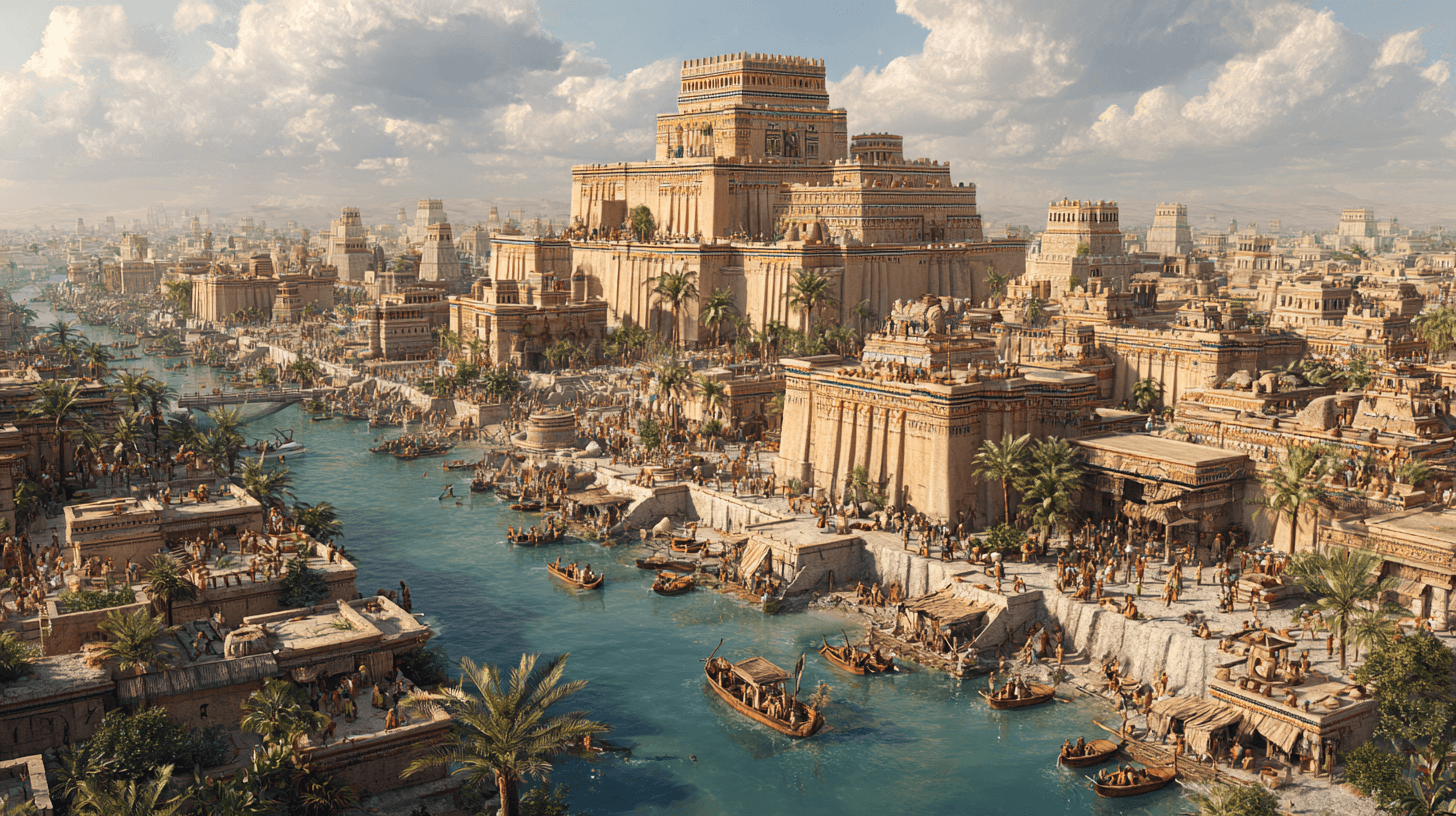
Nowhere shows this transition more clearly than the city of Uruk, located in what is now southern Iraq. By around 3100 BCE, Uruk had grown into what many archaeologists consider the first true city in human history, with a population that may have reached tens of thousands — an extraordinary concentration of people for the ancient world.
Uruk’s growth was not accidental. Reliable irrigation produced agricultural surpluses substantial enough to feed people who did not farm at all. That single fact changed everything. For the first time, communities could support full-time priests, craftsmen, soldiers, and administrators — people whose labor had nothing to do with growing food but who depended entirely on food grown by others.
This division of labor is often treated as a minor economic detail. It was not. A society where everyone farms has little need for accountants, judges, or kings. A society where surplus grain must be stored, protected, counted, and redistributed suddenly needs all three. Specialization did not merely make Uruk more prosperous — it made hierarchy structurally necessary.
Excavations show Uruk anchored around massive temple complexes, some devoted to the goddess Inanna, built from mudbrick and expanded over generations. These monumental buildings were not just religious centers. They functioned as warehouses, workshops, and administrative offices — the operational heart of the city’s economy.
Why Writing Was Invented for Bookkeeping, Not Literature
One of the most persistent myths about ancient writing is that it began as a tool for storytelling or record-keeping in the way modern readers imagine. It did not.
The earliest Mesopotamian writing, known as cuneiform, emerged around 3200 BCE, and its first uses were overwhelmingly administrative. Temple officials needed to track exactly how much grain, livestock, beer, and labor moved in and out of their storehouses. A verbal promise or a human memory could not reliably manage transactions across an entire city.
Cuneiform began as a system of pressed marks made with a reed stylus on wet clay tablets, evolving from an earlier practice of using small clay tokens to represent quantities of goods. Scribes gradually developed a repertoire of standardized signs, and the system slowly expanded from simple counting marks into a script capable of representing spoken language.
This is a case where the mundane explains the monumental. Writing did not arise because someone wanted to record poetry for future generations. It arose because a temple official needed to prove exactly how many sheep a shepherd owed the storehouse. Only later — over centuries — did this same technology become capable of preserving law, religious belief, and literature, including the Epic of Gilgamesh, one of the oldest surviving works of narrative writing.
Writing turned Mesopotamia’s economy from something remembered into something recorded — and a record, unlike a memory, could be checked, enforced, and disputed in front of a judge.
The Temple, the Palace, and the Birth of Bureaucracy
As cities grew, so did the apparatus needed to run them. Temples, originally religious institutions, evolved into major economic hubs that owned land, employed workers, and managed vast quantities of grain and goods. Priests functioned not only as spiritual leaders but as administrators overseeing complex operations.
Over time, political power increasingly separated from purely religious authority, giving rise to kingship as a distinct institution. Sumerian city-states such as Ur, Lagash, Nippur, and Kish each developed their own rulers, patron gods, and administrative systems, frequently competing — and sometimes warring — with one another over land, water, and trade routes.
This is where one of the central misconceptions about early Mesopotamia needs correcting. There was no single unified “Mesopotamian civilization” governed from one capital. For long stretches of its early history, Mesopotamia was a patchwork of independent, often rival city-states, each with its own government, temple hierarchy, and army. Unity, when it came, arrived later and rarely lasted — first briefly under Sargon of Akkad around the 24th century BCE, and centuries afterward under Babylonian and Assyrian rule.
By around 1754 BCE, the Babylonian king Hammurabi issued one of history’s most famous legal texts, a stele of engraved laws addressing everything from trade disputes to property damage to family obligations. The code addressed a diverse array of subjects, including women’s rights, slavery, and murder. Its punishments could be severe by modern standards, and scholars continue to debate how consistently it was actually enforced across Babylonian society. But the code’s existence reveals something significant: a society large and complex enough that disputes could no longer be settled through custom and reputation alone. They required a written standard that applied, at least in principle, to strangers as well as neighbors.
What “Civilization” Really Means Here
It’s worth pausing on a word that gets used casually: civilization. The term does not simply mean “an advanced society.” Historians typically define it by a cluster of features appearing together — dense urban settlement, specialized labor, organized government, monumental architecture, and, crucially, a system of writing sophisticated enough to record language rather than just tallies.
This is precisely why Mesopotamia holds its particular claim to priority. Complex societies existed elsewhere at roughly comparable times — Egypt was consolidating along the Nile, and the Indus Valley would soon produce remarkably planned cities of its own. What sets early Mesopotamia apart in the historical record is the combination of the earliest confirmed cities, like Uruk, together with the earliest confirmed writing system capable of recording connected language, not merely numerical accounts.
This distinction matters because popular retellings sometimes flatten a messy, centuries-long process into a single triumphant moment — as though a Sumerian farmer woke up one morning and decided to invent civilization. The reality was far less tidy: a slow accumulation of administrative workarounds, driven by flood control and grain accounting, that only in retrospect looks like a deliberate architectural achievement.
The Cost of Being First
Mesopotamia’s success came with a lasting vulnerability, and this is often the part left out of popular accounts. The region lacked many essential resources — stone for construction, timber for building, and metal ores for bronze tools and weapons. Its wealth in grain and manufactured goods had to be traded outward in exchange for these materials, creating extensive networks reaching into Anatolia, the Persian Gulf, and beyond.
At the same time, Mesopotamia’s flat, open terrain offered little natural defense. Unlike Egypt, shielded by deserts on either side of the Nile, or the more geographically contained Indus Valley, Mesopotamian cities sat exposed on a plain that outside powers could cross with relative ease. This is part of why the region’s political history reads as an almost continuous cycle of rising and falling empires — Sumerian, Akkadian, Babylonian, and later Assyrian — each replacing the last, often within a few centuries.
Mesopotamia did not build the first civilization and then coast on that achievement. It built a civilization that had to keep rebuilding itself, generation after generation, against pressures it could never fully eliminate.
The Legacy Still Embedded in Daily Life
Much of what emerged from this pressured, improvisational process quietly persists today. The Mesopotamian base-60 numerical system is the reason a clock has 60 minutes and a circle has 360 degrees. Early Mesopotamian astronomers tracked lunar cycles closely enough to shape calendar systems that influenced later cultures across the region. The wheel, the plow, and systematic irrigation all trace meaningful roots to this same landscape.
None of these innovations were the product of one inventor’s insight. They were solutions accumulated by a society that had no choice but to solve the problem of survival between two unpredictable rivers — and then, having solved it, discovered it needed writing, law, and government to hold the solution together.
That is the real answer to why Mesopotamia became humanity’s first civilization. It was not a triumph of ambition. It was the accumulated result of thousands of ordinary decisions made under pressure — decisions about water, grain, and record-keeping — that quietly assembled the basic architecture every later civilization would build upon.