Did Magellan Actually Sail Around the World?
Ferdinand Magellan is remembered as the man who circled the globe. Statues, textbooks, and even a strait bear his name, all celebrating a voyage that supposedly proved the Earth could be sailed around in a single continuous journey. There is just one problem: Magellan never finished it.
He died in a shallow bay in the central Philippines, more than a year before his fleet’s last surviving ship limped back into a Spanish harbor. The man who actually brought that ship home, a Basque sailor named Juan Sebastián Elcano, is barely known outside Spain. Meanwhile, the expedition’s actual results were even stranger than the myth: of roughly 250 to 270 men who left Spain in 1519, only about 18 returned three years later.
So did Magellan circumnavigate the world, or did history simply attach his name to someone else’s finish line? The answer turns out to be more interesting than a simple yes or no, and it says a lot about how popular memory tends to simplify complicated history into a single heroic name.
The Problem Europe Was Trying to Solve
By the early 1500s, Portugal controlled the sea route to Asia’s spice markets by sailing around the southern tip of Africa. Spain, shut out of that route by treaty, wanted its own path to the same riches. Christopher Columbus had already shown that sailing west led to land, but not the land anyone expected. The question that remained was whether a ship could keep going west, past the Americas, and reach Asia from the other side.
Magellan, a Portuguese-born navigator with experience in the East Indies, believed he had found the answer: a strait somewhere near the southern end of South America that would open into an unknown ocean leading to the Spice Islands. Portugal’s king had already turned down his proposal, so Magellan took it to Spain instead, along with a claim that the Spice Islands actually fell within Spain’s half of the world under the 1494 Treaty of Tordesillas. King Charles I agreed to fund the expedition.
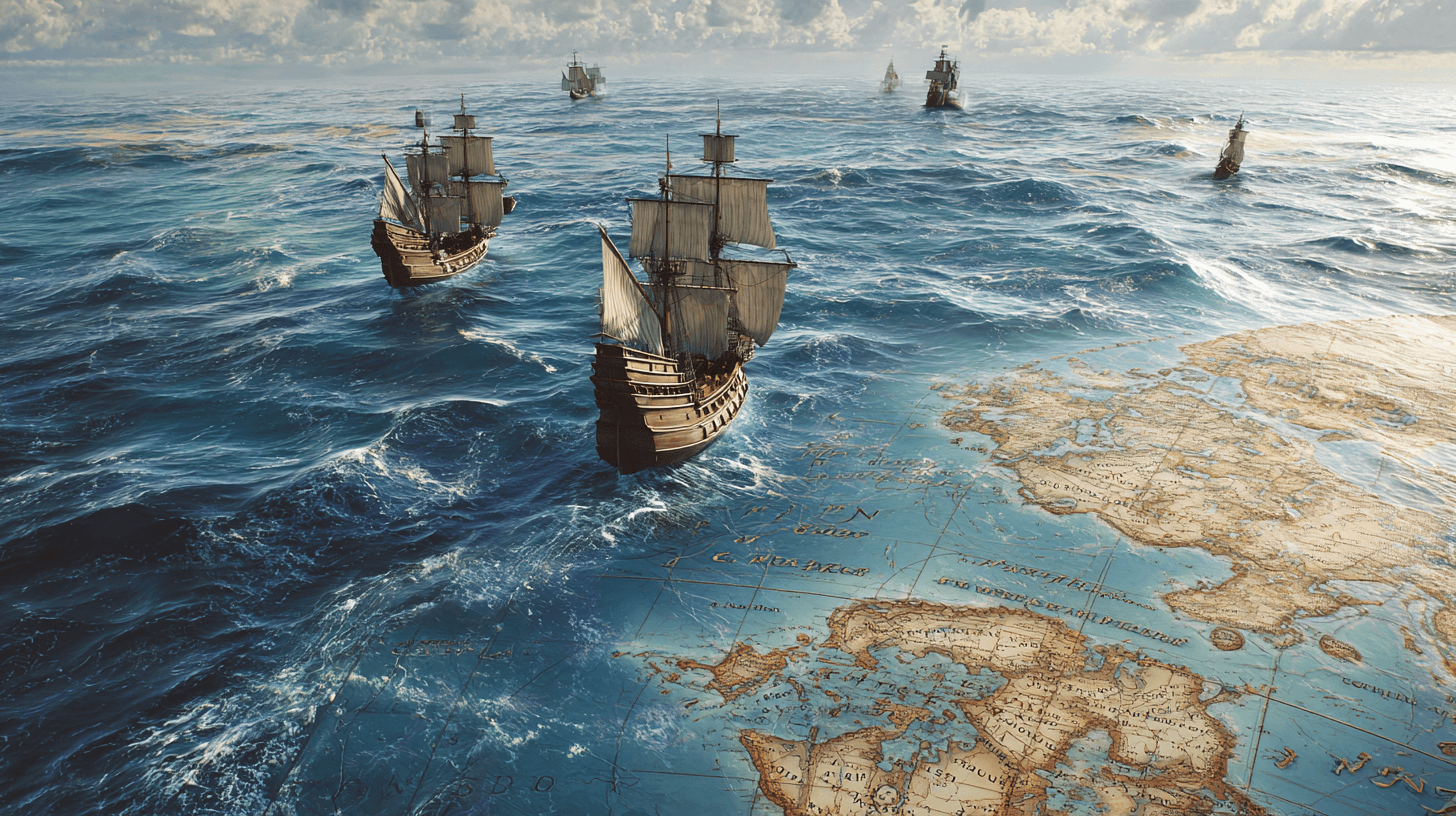
On September 20, 1519, five ships and roughly 250 to 270 men left the Spanish port of Sanlúcar de Barrameda. Nobody involved fully understood the size of the ocean they were about to enter.
Finding the Strait, Losing the Fleet
The Atlantic crossing was difficult but familiar. What followed was not. Magellan spent months probing the coast of South America for a passage that might not even exist, while cold, hunger, and doubt spread through the crews. A mutiny broke out among Spanish officers who suspected their Portuguese captain-general was leading them toward disaster. Magellan crushed it, executing one ringleader and marooning two others.
In October 1520, the fleet finally found the passage now known as the Strait of Magellan, a maze of channels near the southern tip of the continent. One ship wrecked exploring it. Another deserted and sailed back to Spain. By the time the remaining three vessels emerged into the ocean on the other side, in November 1520, Magellan had already lost nearly half his ships without firing a shot at an enemy.
He named the new ocean the Pacific, for its calm surface, without knowing how vast it truly was.
A Crossing That Nearly Ended the Expedition
The Pacific crossing is the part of the story that best explains why the voyage nearly failed before it could succeed. Magellan expected islands within days. Instead, the fleet sailed for roughly 98 days without reaching any place that could resupply them.
Food ran out. Sailors ate sawdust, leather softened in seawater, and rats when they could catch them. Scurvy, caused by a lack of vitamin C, swelled men’s gums until they could no longer eat, and killed several crew members before the ships finally reached land in March 1521, in what is now the Philippines. Antonio Pigafetta, an Italian chronicler who sailed on the voyage and left the most detailed surviving account, described a crossing so punishing that it is one of the main reasons historians consider this leg of the journey more dangerous than the storms near South America.
The fleet had crossed the largest ocean on Earth. What happened next ended Magellan’s part in the story.
The Fight That Killed Magellan
In the Philippines, Magellan allied himself with a local ruler, Rajah Humabon of Cebu, who had converted to Christianity along with several of his followers. Magellan then involved his men in a local power struggle, aiming to compel a rival chieftain named Lapu-Lapu, on the nearby island of Mactan, to submit to Humabon and accept Spanish authority.
On April 27, 1521, Magellan led a landing party of roughly 60 men against Lapu-Lapu’s much larger force. The attack failed. Magellan was struck down on the beach and killed, along with several of his men, in what is now remembered in the Philippines as the Battle of Mactan.
The expedition’s captain-general died having crossed the Pacific but never having sailed home. Command passed through several officers in the chaotic weeks that followed, and the surviving crew, now reduced to two ships, continued on toward the Spice Islands without him.
The Voyage Elcano Actually Finished
By the time the fleet reached the Moluccas, the Spice Islands they had crossed an ocean to find, only two ships remained: the Trinidad and the Victoria. The Trinidad, damaged and leaking, attempted to sail back east across the Pacific and failed; most of its crew were eventually captured by the Portuguese.
The Victoria, loaded with cloves, took a different and far riskier path. Rather than retrace the outbound route, its new commander, Juan Sebastián Elcano, sailed west across the Indian Ocean and around Africa’s Cape of Good Hope, staying far from the coast to avoid Portuguese ships that would have seized the cargo and crew as trespassers on Portugal’s trade routes.
The final stretch was brutal. Pigafetta’s journal describes starvation and sickness so severe that the crew debated surrendering to the Portuguese at Mozambique simply to survive, before deciding to press on rather than lose the fruits of the voyage. On September 6, 1522, the Victoria limped into Sanlúcar de Barrameda, the same port the fleet had left almost exactly three years earlier. Of the roughly 250 to 270 men who had departed, only about 18 European survivors, along with a handful of others picked up along the way, completed the full circuit.
Elcano, not Magellan, had done it. He had left Spain as a mutineer under suspicion and returned as the man who closed the first loop around the planet.
So, Did Magellan Circumnavigate the World?
By the strict, literal meaning of the word, no. Magellan died in the Philippines, roughly two-thirds of the way through the outbound voyage, and never crossed the Indian Ocean, rounded Africa, or saw Spain again. The ship that finished the journey was under someone else’s command.
But the popular version of the story is not simply a myth invented out of nothing. There is a genuinely interesting wrinkle that historians sometimes raise: before this expedition, Magellan had already sailed east to the Malay Peninsula and nearby waters as a young man in Portuguese service. If his death in the Philippines fell close to the point his earlier eastern travels had reached, then across two separate voyages, made years apart in opposite directions, Magellan may have personally covered every degree of longitude on Earth. That is a real and debated claim about his lifetime of travel. It is not the same as saying he circumnavigated the globe, which specifically means completing one continuous voyage all the way around, something Magellan never did.
Magellan proved the ocean route existed. Elcano proved a ship could survive it.
That distinction matters because it changes what the voyage actually demonstrated. The mission’s original goal was never abstract glory; it was a practical, commercial question of whether Spain could reach the Spice Islands by sailing west and bring the profits home. Answering that question required completing the full loop, and the man who did that was Elcano.
Why Magellan Got the Credit Anyway
If Elcano finished the voyage, why does Magellan’s name dominate the story? Part of the answer is that Magellan was the expedition’s original visionary and the one who overcame its hardest technical problem, discovering a workable strait through a continent nobody had mapped. Explorers are often remembered for the boldness of the idea rather than the difficulty of the final execution.
Part of the answer is also political. Elcano was a Basque commoner who had briefly been a suspected mutineer, a far less convenient hero for the Spanish crown than a titled captain-general who had already died in the line of duty and could not contradict any version of events. Charles I did reward Elcano with a coat of arms bearing a globe and the Latin motto “Primus circumdedisti me,” roughly “You were the first to circle me,” acknowledging his role. But that recognition never translated into the kind of lasting fame Magellan received.
The voyage did not fail because its leader died. It succeeded because someone else was willing to finish it.
This is a pattern that shows up elsewhere in the history of exploration and discovery: expeditions, unlike individual athletic feats, are rarely won or lost by one person. They depend on entire chains of command surviving long enough, and skilled enough, to complete what one person started.
Frequently Asked Questions
Did anyone from Magellan’s original crew make it all the way home?
Yes. Roughly 18 European survivors, out of the 250 to 270 men who set out, returned to Spain aboard the Victoria in September 1522, along with several non-European crew members picked up during the voyage.
Who actually gets credit for the first circumnavigation of the globe?
Juan Sebastián Elcano, who took command of the Victoria after Magellan’s death and sailed it home across the Indian Ocean and around Africa, is generally credited by historians as the commander who completed the first circumnavigation.
Why is the strait at the tip of South America named after Magellan if he didn’t finish the voyage?
The Strait of Magellan is named for him because he was the one who found and successfully navigated it, a genuine and difficult achievement in its own right, regardless of what happened later in the voyage.
How did Magellan die?
He was killed on April 27, 1521, in the Battle of Mactan, fighting alongside a local ally against the forces of a rival chieftain named Lapu-Lapu in what is now the Philippines.
The story of the first voyage around the world is not really the story of one man’s triumph. It is the story of an expedition that lost four of its five ships, most of its crew, and its own commander, and still somehow reached its destination. That the credit ended up attached to the wrong name is, in its own way, the truest thing about how history often gets remembered.