Why Monet Built a Garden He Would Paint for Thirty Years
In 1883, Claude Monet moved his household to a rented farmhouse in the Normandy village of Giverny, roughly forty miles from Paris. He had no formal plan for the property beyond a place to live and work. Within a decade, he had turned that same plot of land into something closer to a scientific instrument — a controlled environment engineered specifically to generate the visual problems he wanted to paint.
That distinction matters. Monet’s garden at Giverny is often remembered today as a pretty backdrop, the kind of place tourists visit to take photographs of lily pads and a green footbridge. But the garden was not incidental to his late career. It was the reason his late career happened at all.
Understanding why Monet built it — and kept rebuilding it for more than thirty years — means understanding a painter who had run out of new places to paint and decided to construct one instead.
A Painter Who Finally Had Money to Spend
By the time Monet settled at Giverny, he was no longer the struggling outsider of the 1870s. The art dealer Paul Durand-Ruel had begun buying his work in bulk and selling it to American collectors, and Monet’s prices climbed steadily through the 1880s. In 1890, he had enough income to buy the Giverny house and its surrounding land outright, ending years of renting.
This financial security is easy to overlook, but it explains a lot. Monet no longer needed to travel constantly in search of marketable landscapes — the coasts, cliffs, and haystacks that had defined his earlier career. He could afford to stay in one place and make that place interesting enough to paint for the rest of his life.
Buying the Land Nobody Else Wanted
The garden most people picture when they think of Monet — the pond, the water lilies, the arched bridge — did not exist yet in 1890. It was created in 1893, when Monet purchased a narrow strip of marshy meadow across a local road and a small railway line from his main property.
The land bordered a stream called the Ru, a minor tributary that fed into the larger Epte River. To turn that boggy meadow into a pond, Monet needed to divert part of the Ru’s flow and dig out a basin. This required formal permission from the local prefect, and it was not a formality he received easily.
Nearby farmers objected. They worried that Monet’s exotic plants would poison the water used by livestock downstream, and that diverting the stream would disrupt irrigation they depended on. Local officials granted the permit only after Monet agreed to specific conditions on how much water he could divert and how the pond would be maintained. It is a detail worth pausing on: one of the most famous gardens in art history began as a contested local zoning dispute.
A Garden Designed Like a Composition
Once the pond was dug, Monet did not simply let it fill with whatever grew. He ordered water lilies, willows, irises, and bamboo from nurseries in France and abroad, including species imported from Egypt and South America. He hired a team of gardeners — at times as many as six — and gave them instructions as precise as any he gave his own hand with a brush.
He arranged plantings by color the way another painter might arrange pigments on a palette. Beds were grouped so that blooms of similar or complementary hues would open near each other, creating color relationships he could then study and paint. The garden was not decoration. It was raw material, grown to order.
This is a useful corrective to the popular image of Monet as an old man contentedly puttering among his flowers. He was doing something closer to what a modern experimental scientist does when building a controlled test environment: removing variables he could not use and installing the ones he could.
Japan Without Leaving Normandy
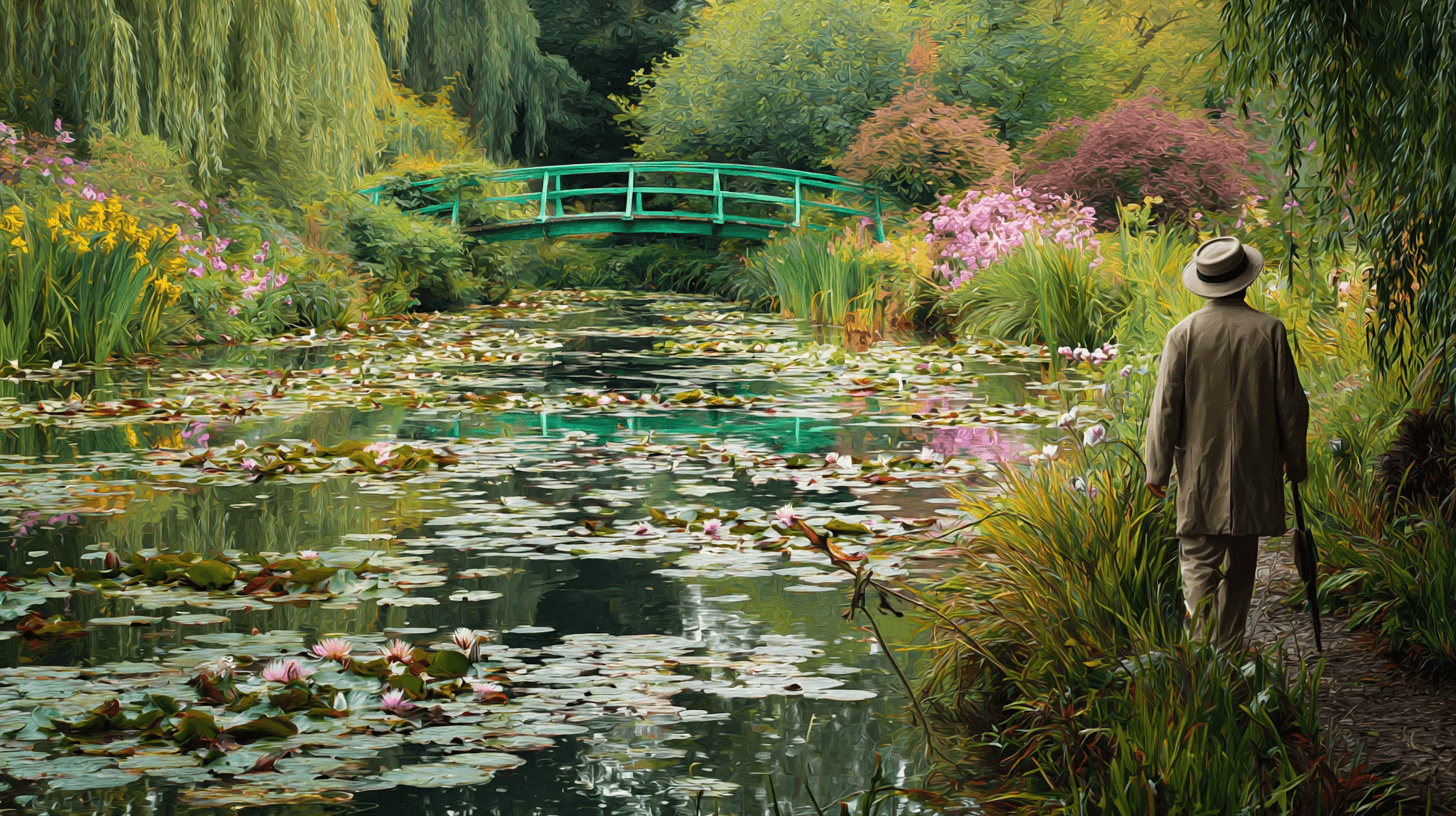
The arched wooden footbridge Monet built over the pond in 1895, and later trimmed with wisteria, is one of the most reproduced images in Western art. It was a direct response to Japanese woodblock prints, which Monet had been collecting since at least the 1870s, when such prints — by artists like Hokusai and Hiroshige — began circulating widely in Paris after Japan reopened to Western trade.
This enthusiasm for Japanese aesthetics, often called japonisme, shaped an entire generation of French painters, and Monet was among its most devoted collectors; by the end of his life he owned more than two hundred Japanese prints, many still displayed in his house at Giverny today. The bridge was his way of building the compositional structure he admired in those prints — flattened space, asymmetry, a raised viewpoint over water — directly into his own landscape, so he could paint it under real, changing daylight rather than reconstruct it from imagination.
The Pond as an Unsolved Problem
Around 1897, Monet began painting the water lily pond as a subject in its own right, and by the early 1900s it had become close to his only subject. The choice was not arbitrary. A still pond covered in lily pads presented a specific visual puzzle that had interested Monet for years: a surface that reflects the sky above while simultaneously showing plants growing beneath and on top of the water.
There is no horizon line in these paintings. There is no ground to stand on, no fixed point to orient the viewer. Reflection, transparency, and surface blur into a single plane. This was, in effect, a formal problem in perception — how much of what we see is the object itself, and how much is light bouncing off it — and Monet had built himself a private laboratory in which to keep testing it, morning after morning, for the rest of his life.
He worked on multiple canvases in a single day, moving from one easel to another as the light shifted, chasing an effect that might last only a few minutes before the sun moved and the color relationships changed again. Over the following three decades, he produced roughly 250 paintings of the pond and its water lilies, making it one of the most sustained single studies of one subject in the history of Western painting.
Grief, War, and a Garden That Kept Changing
The years in which Monet deepened his commitment to the garden were also years marked by repeated loss. His companion and later wife, Alice Hoschedé, died in 1911. His eldest son, Jean, died in 1914, the same year the First World War began. Monet, in his mid-seventies, chose to remain at Giverny throughout the war rather than flee east of Paris, even though the front at times came close enough that artillery could reportedly be heard from the property.
It was during this period of compounding loss that Monet conceived his most ambitious water lily project: a series of monumental canvases, later called the Grandes Décorations, intended to surround a viewer entirely, without a single fixed vantage point. He worked on these vast panels in a purpose-built studio at Giverny even as his own eyesight was failing him.
What Monet’s Late Eyes Actually Saw
Around 1912, Monet was diagnosed with cataracts in both eyes, a condition that progressively distorts color perception, often shifting how the eye registers blues and yellows and dulling contrast overall. For roughly a decade, he continued painting while his color vision changed, a fact that has fueled ongoing debate among art historians and ophthalmologists about how much of the darker, more saturated palette of his 1910s work reflects deliberate artistic choice versus altered perception.
Monet finally agreed to cataract surgery on his right eye in 1923, after years of reluctance. The surgery improved his vision but also introduced new distortions, including a temporary tendency to perceive colors with a yellow or blue cast depending on which lens he used. He adjusted some earlier canvases afterward and, according to conservators who have studied the works, was displeased with a number of paintings made during the worst of his vision problems, destroying several by his own hand.
A Gift to a Grieving Nation
Monet’s close friend Georges Clemenceau, who served as French prime minister during the final phase of the First World War, played a direct role in what happened to the Grandes Décorations. Clemenceau encouraged Monet to donate the completed panels to the French state as a public work, framed in the aftermath of the war as a gesture of peace and renewal rather than a private commission.
Monet agreed, and the government prepared two oval rooms at the Musée de l’Orangerie in Paris to house eight of the panels, arranged so that visitors would be surrounded by the water lily paintings on every wall. Monet died in December 1926, before the installation opened to the public in 1927. He never saw the finished result in its intended setting.
What Popular Memory Gets Wrong
The common image of Monet’s late years — a contented old man surrounded by flowers, painting whatever pleased him — undersells both the discipline and the difficulty behind the work. The garden was not a retirement hobby. It was a deliberately engineered subject, built through a legal dispute with neighbors, maintained by a paid staff following precise instructions, and painted by a man contending with grief, war, and failing eyesight, who kept working anyway.
It is also worth correcting a related assumption: that Monet painted the same pond over and over because he had run out of ideas. The opposite is closer to the truth. He had identified a subject complicated enough — reflection without a horizon, color shifting minute by minute — that a single human lifetime was not long enough to exhaust it.
Why the Garden Still Matters
Monet’s garden endures as more than a historical curiosity because it captures something true about how serious creative work often happens: not through constant novelty, but through returning to one difficult problem long enough to understand it from every angle available. He did not travel the world looking for new landscapes in his final decades. He built one landscape and refused to stop looking at it.
The water lilies at the Orangerie are frequently described as calming, even meditative, and many visitors experience them that way. But they were made by a man who spent thirty years treating his own backyard as an unfinished experiment — one final attempt to paint what light does to water, and what water does to everything it reflects.