Is a Just Society Possible?
Every generation inherits the same argument. A worker demands fair pay, a defendant demands a fair trial, a community demands a fair share of resources—and each time, someone else insists that fairness looks different from where they stand. The disagreement rarely comes from bad faith. It comes from something more unsettling: even people who agree that justice matters cannot agree on what it requires.
This is not a modern complaint. Philosophers have tried for more than two thousand years to define justice precisely enough to build a society around it. Some have argued that justice means giving people what they deserve. Others have argued that it means giving people what they need, or what they agreed to, or what a fair process would produce regardless of the outcome. Each definition sounds reasonable in isolation. Each one also runs into cases where it produces results that feel deeply unjust.
So the question worth asking is not simply whether societies can be more just than they are now. Most people already agree they can. The harder question is whether “a just society” is a coherent destination at all, or whether justice is better understood as a standard we can approach, argue about, and partially achieve—but never finally reach.
Why Justice Resists a Single Definition
The trouble starts with a basic fact: justice is not one idea. It is several competing ideas that happen to share a name.
Distributive justice asks how a society should divide wealth, opportunity, and burdens among its members. Procedural justice asks whether the rules and processes used to make decisions are fair, regardless of the outcome they produce. Retributive justice asks what people who cause harm owe in return. Restorative justice asks how harm can be repaired rather than simply punished.
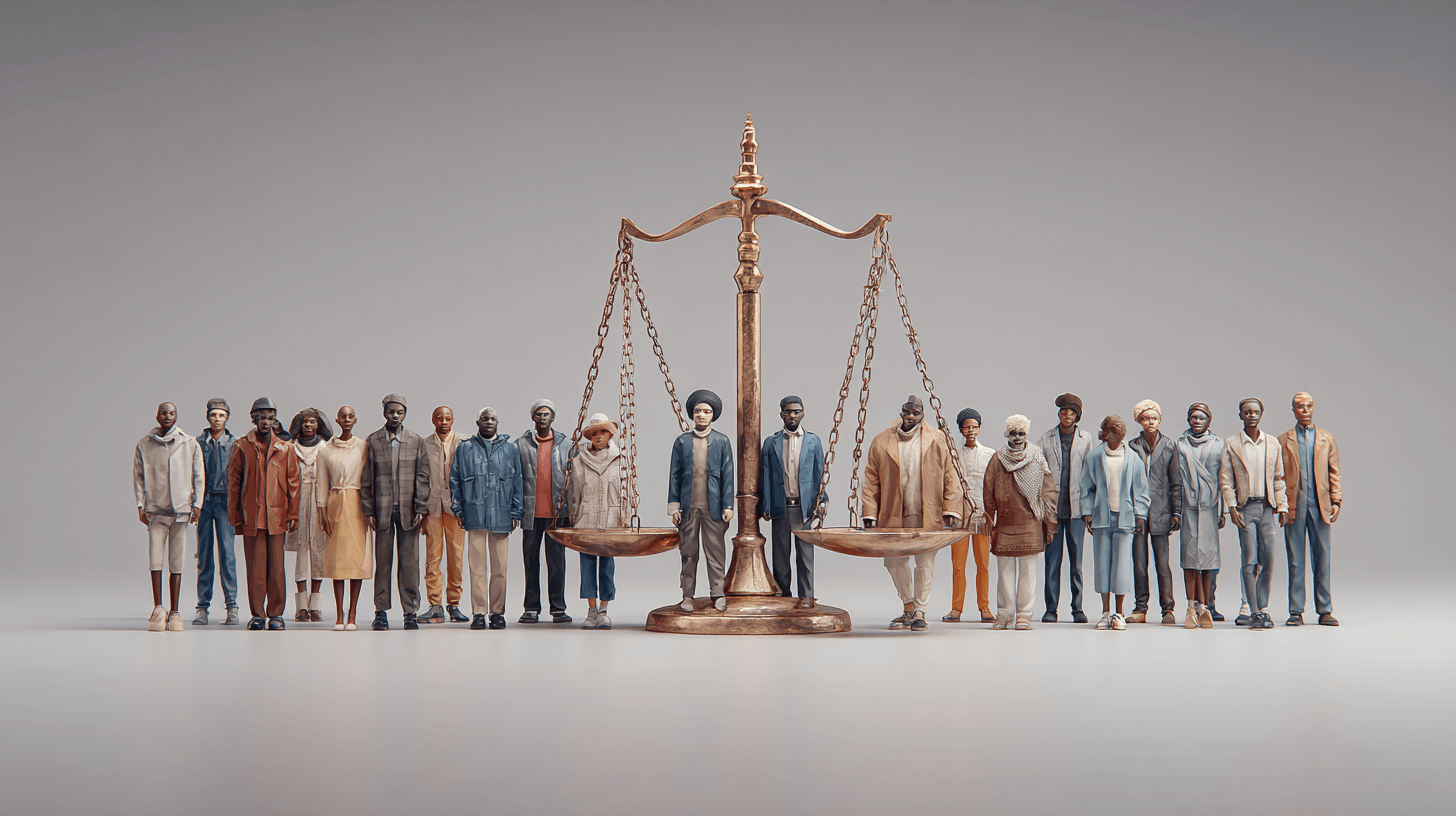
A policy can satisfy one of these standards while violating another. A criminal trial can follow every correct procedure and still produce a verdict that a community experiences as deeply unfair. A tax system can redistribute wealth effectively while relying on procedures that some citizens consider coercive. Justice, in other words, is not a single scale. It is several different scales that do not always point in the same direction.
This is why philosophical arguments about justice tend to circle back to one unavoidable question: what, exactly, are we trying to make fair—outcomes, opportunities, processes, or some combination that we have not yet learned how to balance?
Plato’s Warning and Aristotle’s Correction
The earliest serious attempt to answer this question in Western philosophy came from Plato, who used the Republic to argue that a just society requires a just soul first. For Plato, justice meant each part of a person—reason, spirit, and desire—performing its proper function without one overwhelming the others. He extended this idea to the city itself: a just society, he argued, requires each class of citizens to perform its proper role, guided by wisdom rather than appetite or ambition.
Plato’s vision was orderly, but it depended on an uncomfortable premise. It assumed that a small class of guardians could reliably identify the common good and govern accordingly, largely insulated from the desires of the people they ruled. Critics have long pointed out the risk built into this design: a system that trusts wise rulers to define justice has no clear mechanism for correcting those rulers when they are wrong.
Aristotle, Plato’s student, tried to correct this by grounding justice in something more concrete than an ideal ruling class. In the Nicomachean Ethics, he distinguished between distributive justice, which concerns how goods and honors are divided according to merit, and corrective justice, which concerns how wrongs are repaired regardless of who committed them. Aristotle’s insight was that justice is not one abstract virtue applied uniformly. It is a practical judgment that depends on context, proportion, and the specific relationship between the people involved.
This distinction still shapes legal and political thinking today. A modern debate over whether a tax system is fair, or whether a criminal sentence fits the crime, is really a debate between Aristotle’s two categories—distribution on one side, correction on the other.
The Veil of Ignorance: Justice as a Thought Experiment
The most influential modern attempt to solve this problem came from the American philosopher John Rawls, whose 1971 book A Theory of Justice reframed the entire question. Rather than asking what a just outcome looks like, Rawls asked what principles people would choose if they had to design a society without knowing what position they would occupy in it.
He called this thought experiment the “original position,” governed by a “veil of ignorance.” Imagine a group of people deciding on the basic structure of society—its laws, its economic system, its distribution of rights—without knowing whether they will be born rich or poor, healthy or disabled, part of a majority or a minority. Rawls argued that reasonable people in this position would not gamble on the arrangement that benefits the fortunate. Instead, they would choose principles that protect the worst-off, because any one of them might end up there.
From this reasoning, Rawls derived two central principles. First, each person should have an equal claim to the most extensive basic liberties compatible with the same liberties for others. Second, social and economic inequalities are only justified if they work to the greatest benefit of the least advantaged members of society, and if positions of advantage remain genuinely open to everyone under conditions of fair equality of opportunity.
Rawls did not claim that his theory produced a single, fixed blueprint for justice. He offered it as a method for reasoning about fairness that did not depend on assuming any particular religious or cultural worldview. That neutrality was precisely its appeal in a pluralistic society, and precisely what made it controversial.
The Strongest Objections
No theory of justice this influential escapes serious challenge, and Rawls’s framework faced two of the sharpest objections in modern political philosophy.
The philosopher Robert Nozick, in Anarchy, State, and Utopia, argued that Rawls’s focus on distribution ignored a crucial question: how did people come to hold what they have? Nozick proposed an entitlement theory of justice, arguing that a distribution of goods is just if it resulted from a just acquisition and a chain of voluntary, uncoerced transfers—regardless of how unequal the final outcome looks. On this view, redistributing wealth to correct inequality, even for good reasons, treats people’s legitimately acquired property as if it belonged to society to reallocate. Nozick’s challenge to Rawls became one of the defining disputes between egalitarian and libertarian visions of justice, and it remains active in debates over taxation, inheritance, and property rights today.
A different challenge came from communitarian philosophers such as Michael Sandel, who questioned the very premise of the veil of ignorance. Sandel argued that people are not, in reality, unencumbered choosers who exist independently of their communities, histories, and relationships. Our sense of what we owe one another is shaped by shared traditions and social roles that Rawls’s original position deliberately strips away. A theory of justice built on an abstract, historyless individual, Sandel suggested, may produce principles that feel coherent in the abstract but fail to capture how real communities actually understand fairness, loyalty, and obligation.
Together, these objections reveal something important: even the most carefully constructed theory of justice cannot satisfy every reasonable starting assumption about what a person is, what they are owed, and what a society exists to do.
What Popular Debate Gets Wrong
Public arguments about justice often assume that disagreement means someone is arguing in bad faith, or that one side simply does not understand fairness. The philosophical record suggests something less comfortable: reasonable people can define justice differently because they are answering different underlying questions—desert versus need, process versus outcome, individual entitlement versus collective responsibility—and each answer has serious philosophical support behind it.
This does not mean every position is equally defensible in every circumstance. Some arguments rest on weaker reasoning, incomplete evidence, or outdated assumptions about human behavior. But it does mean that lasting disagreement about justice is not necessarily evidence of confusion. It may be evidence that justice is a genuinely contested concept, not a fact waiting to be discovered.
So Is a Just Society Possible?
If “a just society” means a society in which every distribution, every punishment, and every rule satisfies all competing standards of fairness simultaneously, then the honest answer is almost certainly no. The standards themselves are not fully compatible with one another, and no institutional design has managed to reconcile them completely.
But that is not the only reasonable definition of the question. A more useful version asks whether societies can move closer to justice over time—by expanding who counts as an equal, by correcting procedures that produce systematically unfair results, by holding power accountable, and by revising their institutions when new evidence shows they fail the people they claim to serve. By that standard, the historical record offers real, if uneven, grounds for optimism. Slavery was once defended as compatible with justice by serious thinkers; it no longer is. Legal systems that once excluded entire groups from basic rights have been forced, often through long struggle, to expand those rights.
A just society may not be a destination any community can permanently reach. It may be closer to a direction—a standard societies can approach, argue about, and sometimes betray, but never finally complete. The philosophers who have spent centuries arguing about justice were not failing to solve a puzzle with a hidden answer. They were doing the only thing possible with a question this important: taking it seriously enough to keep asking it.