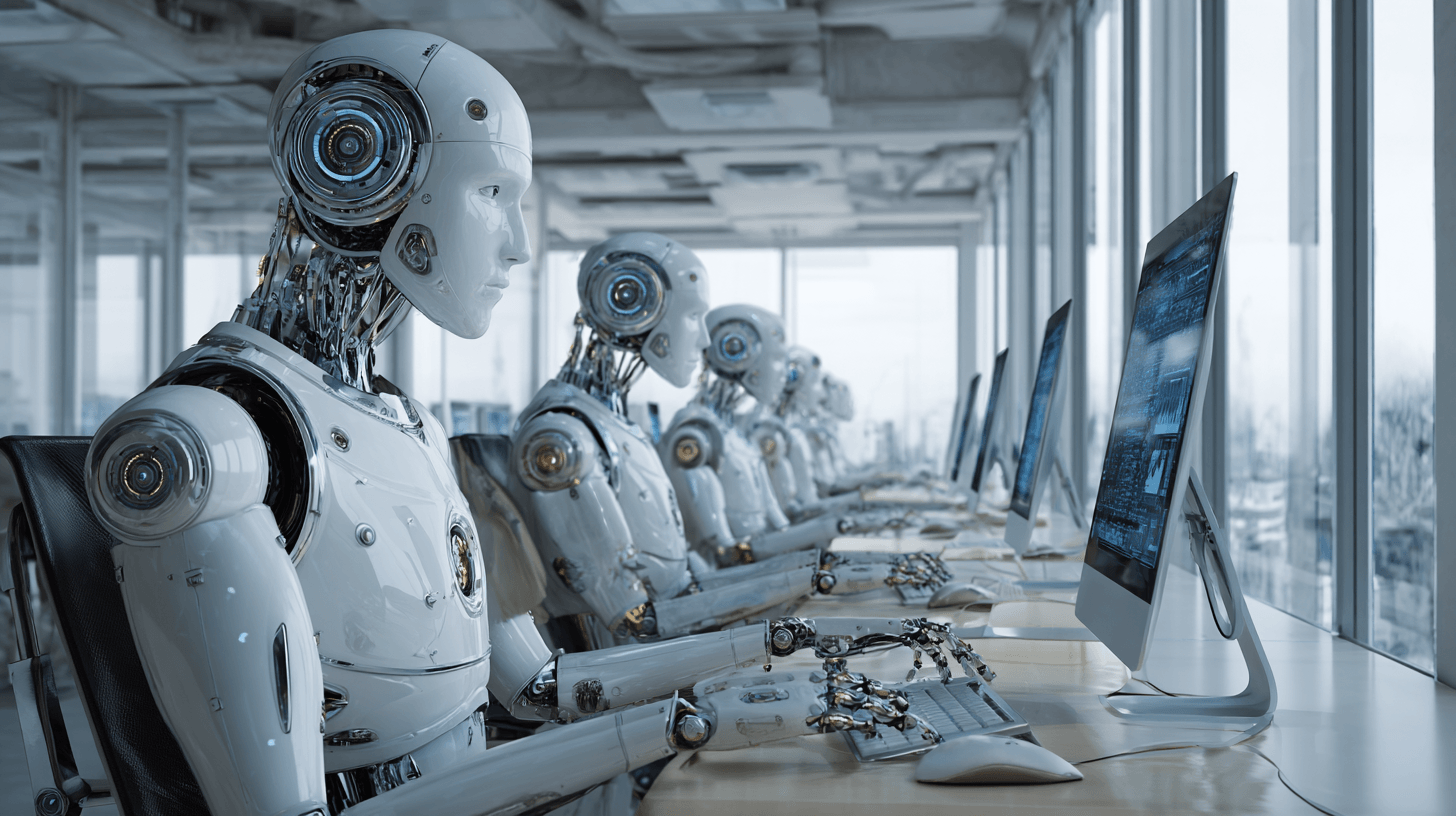
Why Automation Keeps Changing the Jobs Question, Not Just the Job Market
In the early 1970s, an American bank branch typically needed several tellers to handle a single day’s line of customers. Then came the automated teller machine. Within two decades, ATMs were common across the United States, and conventional wisdom predicted a quiet massacre of teller jobs. What actually happened surprised many economists: the number of bank tellers in the U.S. kept rising for years afterward, even as ATMs multiplied.
That counterintuitive story sits at the center of one of the most persistent economic anxieties of the modern era. Every time a new wave of automation arrives, from industrial robots to self-checkout kiosks to generative artificial intelligence, the same question resurfaces: will machines eventually take our jobs?
The honest answer is more complicated than either the alarmists or the optimists usually admit. Automation has never simply destroyed employment in the aggregate, but it has repeatedly destroyed specific jobs, reshaped what work looks like, and shifted who benefits and who is left behind. Understanding why requires looking past the headline fear and into how automation actually interacts with an economy.
The Fear Is Old, and So Is the Rebuttal
Anxiety about machines replacing human labor is not a twenty-first-century invention. In the early 1800s, English textile workers known as Luddites smashed mechanized looms they believed were destroying their livelihoods. In the 1930s, John Maynard Keynes coined the term “technological unemployment” to describe joblessness caused by machines outpacing the discovery of new uses for labor. In the early 1960s, a U.S. presidential commission was convened specifically to study whether automation would create mass unemployment.
None of these predicted catastrophes materialized in the way their most severe critics feared. Total employment in industrialized economies did not collapse. What changed was the composition of work. Agricultural employment in the United States fell from roughly 40 percent of the workforce in 1900 to under 2 percent today, largely because of mechanization, yet the country did not end up with 38 percent of its population permanently unemployed. Those workers, over generations, moved into manufacturing, services, and eventually information-based industries that didn’t yet exist when the shift began.
This history doesn’t prove the same pattern will always repeat. But it does establish an important baseline: automation replacing a task is not the same as automation eliminating employment, and the two get conflated constantly in public debate.
The Difference Between a Job and a Task
Most jobs are bundles of tasks, not a single repeated action. A bank teller in the 1970s didn’t just count cash. Tellers also handled customer questions, cross-sold financial products, and built relationships that brought business into the branch. ATMs took over the narrow, repetitive task of dispensing cash. That reduced the cost of running a branch, which made it profitable for banks to open more branches, which meant hiring more tellers overall, even though each branch needed fewer of them for routine transactions. Teller employment grew for years after ATMs became common, according to research by economist James Bessen, before eventually declining as other pressures, including online banking, reduced the need for physical branches altogether.
This distinction between task automation and job elimination is the single most important concept for understanding the modern robots-and-jobs debate. When a machine takes over one task within a job, the remaining tasks often become more valuable, and the lower cost of production can expand demand enough to require more workers, not fewer.
What the Best Available Evidence Actually Shows
The most influential attempt to quantify automation’s threat came from a 2013 Oxford study by Carl Benedikt Frey and Michael Osborne, which estimated that a substantial share of U.S. jobs were at high risk of computerization over the following decade or two. The study was widely cited and widely misunderstood. It measured which jobs contained tasks that were technically automatable, not which jobs would actually disappear. Later research, including work by the OECD, pointed out that most jobs combine automatable and non-automatable tasks, and that job transformation, rather than outright elimination, is the more common outcome.
Economists David Autor and Daron Acemoglu, who have studied labor markets and automation extensively, have shown a more specific pattern: automation tends to hit middle-skill, routine jobs hardest, while having smaller direct effects on both low-skill jobs requiring physical dexterity and judgment in unpredictable environments, and high-skill jobs requiring complex problem-solving and social interaction. This has contributed to what labor economists call job polarization: growth at the top and bottom of the wage distribution, and a hollowing out of the middle.
That hollowing out matters enormously for how people experience automation. In aggregate employment statistics, the economy can look healthy even as specific communities and specific kinds of workers absorb concentrated, painful losses. A national unemployment rate staying low provides little comfort to a factory town where the primary employer closed after replacing its production line with robots.
Winners, Losers, and the Speed of Adjustment
Research by Acemoglu and Pascual Restrepo, examining the introduction of industrial robots across U.S. commuting zones, found that local areas with heavier robot adoption experienced measurable declines in employment and wages relative to less-automated areas, at least in the years studied. This is an important corrective to overly reassuring narratives: automation’s costs are not evenly distributed, and the workers who bear them are frequently not the same workers who benefit from the new jobs automation eventually helps create.
The mismatch between who loses a job and who gets the next one is central to why automation feels threatening even when aggregate employment holds steady. A factory worker in Ohio does not automatically become a machine-learning engineer in California. Retraining is expensive, relocation is disruptive, and new industries often cluster in different regions than the ones being disrupted. Economic theory can point to eventual equilibrium; it says much less about how painful, or how long, the transition is for the people living through it.
Why This Time Gets Called Different
Every automation wave produces confident claims that “this time is different,” and generative AI has revived that argument with particular force. Earlier automation mostly replaced physical and routine cognitive tasks: assembly line motions, data entry, basic calculations. Large language models and related AI systems can now produce drafts of text, generate code, summarize documents, and handle customer interactions that previously required judgment and language skill, tasks long considered safely on the human side of the automation line.
Whether this genuinely represents a categorical break from prior automation, or simply extends the same pattern into a new domain, remains a subject of active debate among economists and technologists. Some research, including studies from MIT and elsewhere, has found that AI tools can meaningfully increase individual worker productivity in tasks like writing and customer support, particularly for less experienced workers. What that means for overall employment levels, as opposed to how existing jobs are performed, is considerably less settled, and estimates about job displacement from AI vary widely depending on the assumptions built into each model.
It’s worth being precise about what current evidence actually supports: AI systems are demonstrably capable of performing pieces of many white-collar jobs. Whether this leads primarily to task reassignment within existing roles, to genuine headcount reduction, or to entirely new categories of work is not something that can be answered with confidence yet, because the technology’s economic effects are still unfolding in real time rather than sitting in completed historical data.
What Popular Discussion Gets Wrong
A common misconception treats automation as a fixed quantity of work being redistributed from humans to machines, sometimes called the “lump of labor” fallacy by economists. Under this view, every task a machine performs is one less task available for a person, as if the total amount of work in the economy were a pie of constant size. Most economic evidence contradicts this framing. When automation lowers the cost of producing something, demand for that good or service often increases, which can create additional work, including entirely new roles that didn’t exist before the technology arrived. The job title “social media manager” meant nothing in 1995; it now employs millions of people worldwide.
The opposite misconception is equally common: assuming that because new jobs have always appeared in the past, they always will, in sufficient quantity, at a fast enough pace, and accessible to the specific workers displaced. This is an act of faith more than a settled empirical finding. Historical precedent is genuinely informative, but it isn’t a law of nature, and each transition has still involved real hardship for real people, even when the economy as a whole eventually adjusted.
What Actually Determines the Outcome
If history and current research suggest anything reliable, it’s that the effect of automation on jobs is not determined by the technology alone. It depends heavily on policy choices, labor market institutions, and how gains from higher productivity get distributed.
Countries and regions differ substantially in how they handle these transitions. Some emphasize retraining programs, unemployment support, and education systems designed to help workers move into new roles. Others leave displaced workers largely to fend for themselves, relying on the market to eventually generate demand for their labor elsewhere. The technology behind an industrial robot is identical whether it’s installed in Germany or in a region with weaker labor protections; the human consequences of installing it are not.
Automation also interacts with who owns the resulting productivity gains. If the profits from automating a task flow primarily to capital owners and shareholders, workers may see little benefit even in a scenario where aggregate employment holds steady. If gains are taxed, redistributed, or reinvested into new industries and retraining, the transition can look very different for the people going through it. This is why economists studying automation increasingly emphasize that the central policy question isn’t simply “how many jobs will be automated,” but “who captures the value that automation creates, and what happens to the people whose tasks it replaces.”
The Question Worth Keeping in Mind
Robots and AI systems are not taking “our jobs” in the singular, catastrophic sense that periodically dominates public anxiety. They are taking specific tasks, reshuffling specific roles, and creating specific new kinds of work, often for different people than the ones who lost the old work. That distinction matters because it points toward where the real leverage lies: not in stopping automation, which history suggests is rarely possible for long, but in shaping how its costs and benefits get distributed.
The bank tellers who kept their jobs after ATMs arrived didn’t survive automation by resisting it. Their roles survived because the tasks left over, judgment, relationship-building, problem-solving in ambiguous situations, turned out to be harder to automate and more valuable once machines handled the repetitive part. The open question for this generation’s automation wave is not really whether some version of that pattern will repeat. It’s whether enough workers, industries, and institutions will have the support they need to make the same kind of transition, and whether the gains automation produces will be shared widely enough to make the disruption worth it.