Why The Kiss Became the World’s Definitive Painting of Love
A Couple Made of Gold
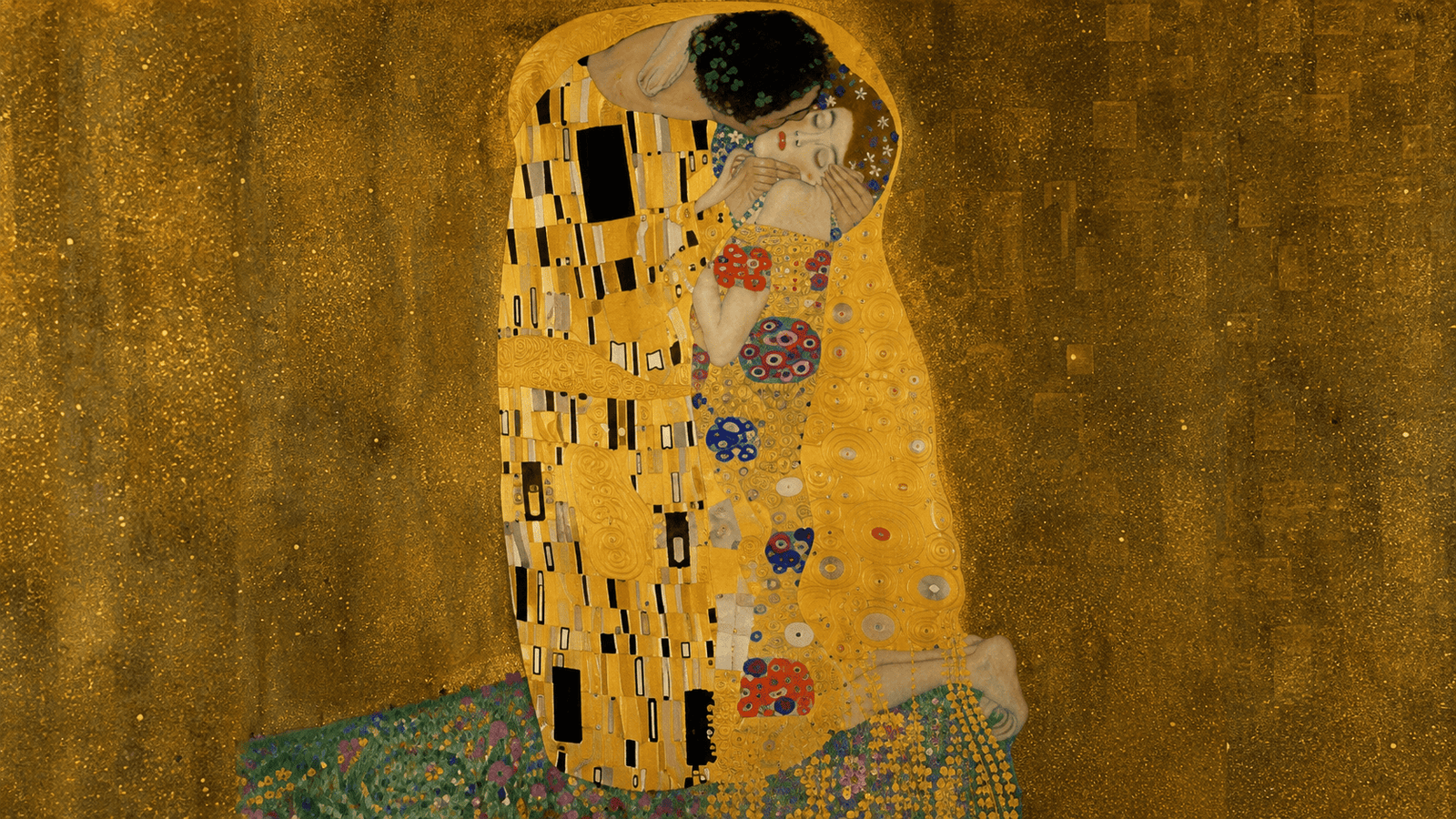
Two figures kneel at the edge of a flowered meadow, wrapped so tightly in gold that their bodies seem to dissolve into a single glowing shape. The man’s face is turned toward the woman, his hands cupping her cheek and jaw. Her eyes are closed, her head tilted back, one hand curled gently around his neck. There is no room, no landscape, no other person in the world. There is only the embrace.
Gustav Klimt painted this canvas, known as The Kiss, in Vienna between 1907 and 1908. He called it Liebespaar — “the lovers” — a plain, almost modest title for a work that would eventually become one of the most reproduced images in the history of art. It hangs today in the Belvedere Museum in Vienna, measuring 180 centimeters by 180 centimeters, painted in oil with added gold leaf, silver, and platinum.
The painting’s fame raises a real question, one that goes beyond admiring its shimmer. Countless artists have painted lovers embracing. Why did this particular image — stylized, ornamental, almost abstract — become the picture people reach for when they want to say this is what love looks like? The answer has less to do with romance itself than with timing, technique, and a very particular moment in Viennese culture when gold became a language for things that words could not quite say.
The City That Made the Painting Possible
Vienna at the turn of the twentieth century was an empire trying to hold itself together. The Austro-Hungarian monarchy governed a patchwork of nationalities, languages, and rival political movements, and the strain showed everywhere — in parliament, in the press, in the arts. Traditional academic painting, with its historical battle scenes and formal portraits, still dominated official taste. But a younger generation of artists had grown impatient with it.
In 1897, Klimt and a group of colleagues broke away from the conservative Vienna Künstlerhaus to found the Vienna Secession, a movement dedicated to a simple but radical idea: that art should follow its own internal truth rather than imitate the styles of the past. Their motto, carved above the entrance to their new exhibition hall, declared that to every age its art, and to art its freedom.
Klimt had already tested how far that freedom could go, and the test had gone badly. In the early 1900s, the University of Vienna commissioned him to paint three ceiling panels representing Philosophy, Medicine, and Jurisprudence. The results were dark, unsettling, and full of writhing, ambiguous bodies. Professors and critics condemned them as pornographic and incoherent. Klimt eventually withdrew the commission entirely, repaid the fee, and turned away from public, state-sanctioned art for the rest of his career.
That retreat mattered. It pushed Klimt toward private patrons — wealthy, often Jewish industrial families in Vienna who wanted portraits and decorative work for their homes rather than public approval. It also pushed him toward a style that could express sensuality and intimacy without inviting the same institutional backlash: not narrative, not anatomical, but ornamental. Gold, pattern, and abstraction let Klimt paint desire while keeping his critics at arm’s length.
Why Klimt Turned to Gold
The material that defines The Kiss did not come from nowhere. In 1903, Klimt traveled twice to Ravenna, where he saw the Byzantine mosaics of the Basilica of San Vitale, their surfaces covered in gold tesserae that seemed to hover somewhere between image and pure light. He returned to Vienna with a new visual vocabulary in mind.
Gold also had a personal resonance. Klimt’s father and younger brother had both worked in metal engraving before their deaths roughly a decade earlier, and gold leaf application was a technique Klimt had grown up around. When he began incorporating it into his paintings around 1899, critics started referring to this stretch of his career — roughly 1899 to 1910 — as his Golden Phase. The Kiss sits at its absolute peak, the painting in which decoration and emotion fuse most completely.
The technique itself is a study in contrast. Klimt reserved realistic oil painting for the parts of the composition where individual identity mattered: the faces, the hands, the woman’s bare feet curled over the edge of the flowered ground. Everything else — the robes, the halo-like field behind the couple, the meadow itself — dissolves into flat, patterned gold. The effect is deliberate. The human, vulnerable parts of the figures remain grounded in observed reality; the rest of them is swallowed by ornament, as if love itself were a force that erases the boundary between two separate bodies.
This is worth pausing on, because it explains why the painting reads as intimate rather than merely decorative. Klimt did not paint two lovers standing next to each other. He painted one shape made of two people, distinguishable only by the patterns on their robes — rectangles and dark bands for the man, circles and floral motifs for the woman. The composition itself argues that love dissolves individual identity into something shared.
A Man and a Woman Who May Never Be Identified
Almost from the moment it appeared, viewers wanted to know who the couple actually was. The most widely accepted interpretation holds that the man is Klimt himself and the woman is Emilie Flöge, his longtime companion, a successful fashion designer who ran a prominent salon in Vienna. Their relationship lasted for decades and defied easy categorization — neither purely romantic nor simply professional.
But the evidence for this identification is thin. Some scholars have suggested instead that the model was a different woman, sometimes referred to as “Red Hilda,” who appears in several of Klimt’s other paintings from the same years. Klimt himself never confirmed either theory, and he almost certainly intended the ambiguity. A specific couple would have made the painting a portrait, tied to two particular lives. An unresolved couple, faces half-obscured by an embrace, becomes something closer to an archetype — not these two people, but the condition of being in love, available to anyone who looks at it.
That refusal to specify is one reason the painting has traveled so easily across a century of reproduction, appearing on posters, mugs, phone cases, and wedding invitations in dozens of countries. A named couple belongs to history. An anonymous one belongs to the viewer.
The Sale That Made a Statement
The Kiss debuted publicly in 1908 at the Kunstschau Wien, a major exhibition organized by artists connected to the Secession movement. The exhibition as a whole was controversial, showcasing younger avant-garde artists including Oskar Kokoschka, but The Kiss itself met with something unusual for Klimt: immediate, near-universal admiration.
The Austrian government purchased the painting directly from the exhibition for 25,000 kronen, a price so far above previous sales in Vienna that it startled the art world. Some accounts describe it as roughly five times higher than any painting previously sold in the city, and note the striking detail that the state agreed to buy the work before Klimt had entirely finished it.
The purchase was not simply a matter of taste. It was a political signal. A state gallery buying a decorative, sensuous, gold-drenched painting — from an artist the university had recently treated as scandalous — amounted to an official endorsement of the Secession’s vision of Austrian culture, at a moment when imperial Vienna badly wanted symbols of unified national achievement. Klimt’s ornamental modernism, once dismissed as indecent, had become something the state wanted to claim as its own.
The irony deepened later. Decades afterward, one of Klimt’s less famous portraits, Adele Bloch-Bauer I, sold in 2006 for $135 million, at the time the highest sum ever paid for a painting. The 1908 purchase of The Kiss, once a record-breaking act of institutional daring, now looks like an extraordinary bargain — a reminder of how differently a culture can value the same body of work across a century.
What Popular Memory Gets Wrong
It is tempting to read The Kiss today as a simple, sentimental image of romantic devotion, the kind of universally comforting picture found on greeting cards. That reading flattens what made the painting startling in its own moment. Post-Victorian Viennese society, despite the fact that both figures are fully clothed, perceived the image as close to pornographic, precisely because of its physical closeness and the woman’s evident surrender to the embrace.
The painting also gets misremembered as purely joyful. Look closely and the woman’s posture is ambiguous: her body curves away even as her arm pulls him closer, and her expression, eyes shut and face upturned, could be read as ecstasy, submission, or something more uneasy. Klimt’s earlier work — including the destroyed university ceiling panels — had explored eroticism as something dangerous and unsettling. The Kiss channels the same undercurrent, but wraps it in gold until the discomfort becomes almost invisible. That, arguably, is the painting’s real technical achievement: it makes desire feel safe to look at.
Why the Image Still Works
Klimt died in 1918, weakened by a stroke and later pneumonia during the influenza pandemic that swept through Europe that year. He left behind an unusually small body of finished paintings for an artist of his renown, and The Kiss remains, by wide consensus, the one people know without having ever visited Vienna.
Part of its staying power is formal. A nearly square canvas, a couple locked at its center, a field of gold with no horizon or background to distract the eye — the composition is built for instant recognition, which makes it unusually well suited to posters, book covers, and phone screens. Part of it is historical accident: a government purchase that turned a private, ambiguous image into a national treasure almost overnight.
But the deeper reason may be that The Kiss never insists on a single interpretation. It does not depict a wedding, a specific myth, or a recognizable historical moment. It offers only the shape of an embrace, rendered in a material — gold — that has signified sanctity, wealth, and transcendence for a thousand years before Klimt ever touched a brush to canvas. Painted at the edge of an empire that was quietly coming apart, in a city torn between academic tradition and modern experiment, it turned one uncertain couple into a symbol flexible enough to mean whatever love has meant to whoever is looking at it since.