How the Mongols Built the Largest Land Empire in History
A Fractured Population Conquers the World
In 1206, a confederation of steppe clans gathered on the banks of the Onon River in what is now Mongolia and declared a herder named Temujin their supreme ruler. They gave him a new name: Genghis Khan. At the time, the total Mongol population numbered perhaps a million people, scattered across a landscape better suited to raising sheep and horses than building empires.
Within seventy years, the descendants of that same population controlled the largest contiguous land empire in human history, stretching from the Sea of Japan to the outskirts of Vienna. They toppled the Jin and Song dynasties in China, destroyed the Khwarazmian Empire in Central Asia, sacked Baghdad, and defeated the armies of Poland and Hungary. Conquered territories held populations many times larger than the Mongols’ own.
That imbalance raises the article’s real question. Numbers, wealth, and technology all favored the settled civilizations the Mongols invaded. So how did a comparatively small, decentralized, and nonliterate steppe population defeat empires with centuries of administrative experience, walled cities, and professional armies?
The answer is not raw ferocity, though ferocity played its part. It is organization, information, and an unusual willingness to absorb the knowledge of the very people the Mongols conquered.
The Steppe Before Genghis Khan
Before 1206, “Mongol” did not describe a unified people. The Mongolian steppe was home to competing clans, including the Mongols, Merkits, Tatars, Naimans, and Keraits, who fought each other over pasture, livestock, and blood feuds that could last generations. Alliances shifted constantly, and no single leader had ever managed to hold the confederation together for long.
Meanwhile, the settled powers surrounding the steppe had little reason to worry about it. The Jin dynasty in northern China treated steppe raids as a manageable nuisance, occasionally paying tribute to keep the peace. The Khwarazmian Empire, centered in Persia and Central Asia, was preoccupied with its own rivalries. None of these powers anticipated that steppe infighting would end in a single dominant force capable of turning outward.
Temujin’s early life gave little hint of what followed. His father was poisoned when Temujin was a boy, and his family was abandoned by their own clan, left to survive without livestock or protection on the open steppe. That experience of exclusion appears to have shaped his later approach to power: he built his authority not on inherited clan loyalty, which had failed him, but on personal merit and direct obligation to himself.
Unifying the Steppe Meant Breaking the Clan System
Temujin’s first great achievement was not a battlefield victory. It was an administrative one. Traditional steppe armies were organized around clan and family lines, which meant loyalty flowed to a chief’s relatives before it flowed to any larger leader. Temujin dismantled this structure. He reorganized his followers into military units of ten, a hundred, a thousand, and ten thousand, deliberately mixing men from different clans and tribes within the same unit.
This decimal system did more than reshuffle soldiers. It severed the link between military command and hereditary clan status, and it made advancement depend on loyalty and performance rather than bloodline. A capable herder’s son could rise to command a thousand men. A disloyal aristocrat could be demoted or executed.
The system also created redundancy. If a commander died, his unit did not collapse, because command structures were standardized rather than personal. An army built this way could absorb losses and keep functioning, which conventional steppe coalitions, held together by personal loyalty to individual chiefs, generally could not.
By 1206, when the clans proclaimed Temujin as Genghis Khan, the steppe had a single army for the first time in generations, one designed to outlast any single leader’s death.
Speed, Discipline, and the Logic of Mounted Warfare
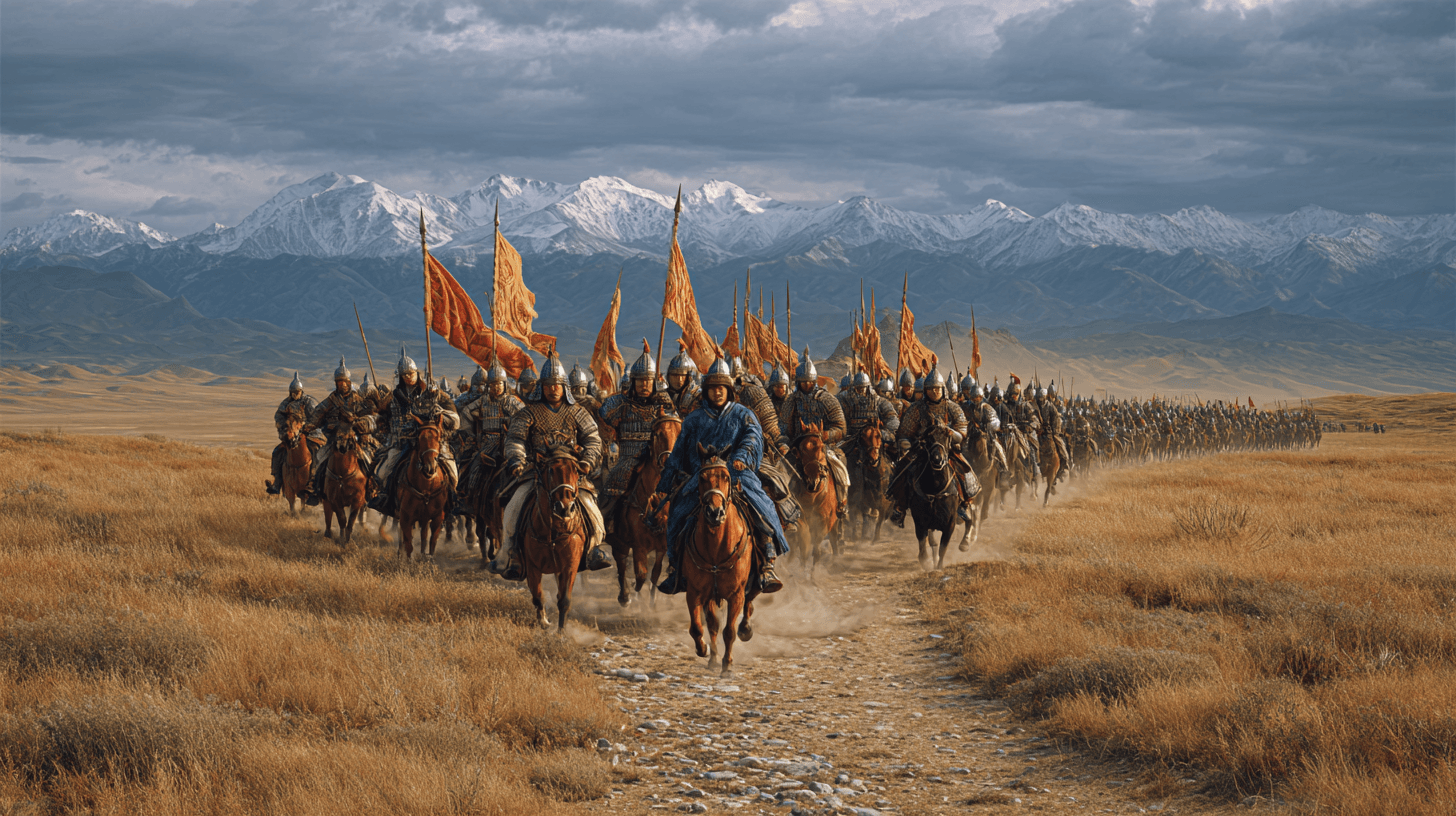
Mongol armies fought differently from their neighbors, and the difference was not simply that they rode horses. Steppe warfare had relied on mounted archery for centuries. What set Genghis Khan’s forces apart was discipline layered onto that tradition.
Mongol soldiers trained from childhood in mounted archery, often practicing coordinated maneuvers during communal hunts that doubled as military exercises. Units learned to execute complex battlefield formations, including feigned retreats designed to draw pursuing enemies into ambushes, a tactic that required extraordinary discipline because it meant deliberately appearing to lose.
Mongol armies also moved faster than their opponents expected. Each rider typically brought multiple horses, allowing columns to switch mounts and maintain pace over long distances without exhausting any single animal. Armies that European and Chinese commanders assumed were weeks away could appear in days.
Speed changed the strategic picture entirely. Enemy commanders built their defenses around realistic assumptions about how quickly an army could cross a given distance. Mongol forces broke those assumptions, arriving before defenses were ready and striking multiple fronts at once.
Terror as a Calculated Instrument, Not Simply Cruelty
Mongol campaigns are remembered, accurately, for their brutality. Cities that resisted were sometimes destroyed almost entirely, their populations killed or enslaved. But the terror was not simply the product of unrestrained violence. It functioned as a strategic tool.
Before besieging a city, Mongol commanders typically offered terms: surrender and pay tribute, and the population would largely be spared; resist, and the consequences would be severe. This was not an idle threat. Cities such as Merv and Nishapur in Central Asia, which resisted after earlier promises of surrender were broken, suffered massacres that chroniclers describe in devastating terms, though the precise death tolls reported in medieval sources are almost certainly inflated and remain debated among historians.
The strategic logic was straightforward. Sieges were expensive and slow, and the Mongols could not afford to spend months outside every fortified city they encountered. A reputation for horrific consequences following resistance made many other cities surrender without a fight, saving the Mongols time, resources, and casualties.
The invasion of the Khwarazmian Empire illustrates how quickly this system could escalate. In 1218, the governor of the border city of Otrar executed a Mongol trade caravan, apparently believing its members were spies. Genghis Khan demanded the governor be handed over for punishment; when the Khwarazmian ruler refused, the resulting war destroyed one of the wealthiest empires in the Islamic world within roughly two years.
Borrowing Brilliance From the Conquered
One of the most consequential Mongol decisions had nothing to do with combat. Mongol commanders were unusually willing to recruit skilled people from conquered populations, regardless of their ethnicity or religion, and put them to direct use.
The Mongols had no tradition of siege warfare when Genghis Khan began his campaigns, since steppe conflicts rarely involved walled cities. Chinese and Persian engineers, captured or recruited during early campaigns, brought expertise in siege engines, counterweight trebuchets, and fortification design. Administrators from conquered Chinese, Persian, and Central Asian bureaucracies were absorbed into Mongol governance, since running a settled empire required skills no steppe society had previously needed.
This willingness to incorporate outside expertise meant the Mongols did not need to invent every capability themselves. They needed only to recognize useful knowledge and place it under centralized command. An empire that began with almost no experience governing farmland, taxing merchants, or besieging stone walls acquired all three within a generation, largely by absorbing the people who already possessed that knowledge.
An Empire Run on Information
Conquest was only the first challenge. Holding an empire spanning thousands of miles required something steppe society had never needed before: a reliable way to move information faster than an army could march.
The Mongols built the Yam, a relay system of way stations spaced roughly a day’s ride apart across the empire. Messengers carrying urgent orders could switch to fresh horses at each station, allowing information and instructions to travel across the empire far faster than any comparable system in Europe or the Middle East at the time. Merchants, envoys, and administrators used the same network, which also made the empire’s vast trade routes safer and more predictable than they had been in centuries.
Genghis Khan and his successors used this network for intelligence as much as for administration. Before major campaigns, Mongol forces gathered detailed information about a target’s political divisions, military strength, and internal rivalries, often through merchants and spies who had traveled the same trade routes the Yam protected. Enemies were frequently defeated as much by what the Mongols knew about them in advance as by what happened on the battlefield.
Governing What They Conquered
Genghis Khan issued a code of law known as the Yassa, which historians know mainly through later references rather than a single surviving original text, since no complete copy has been confirmed to exist today. What does appear consistently in surviving accounts is a policy of religious tolerance: Buddhists, Christians, Muslims, and shamanists lived under Mongol rule without being forced to convert, and religious leaders from multiple traditions were often exempted from taxation.
This tolerance was not primarily an act of open-mindedness for its own sake. It reduced the risk of religiously motivated uprisings across an empire that spanned Buddhist, Muslim, Christian, and shamanist populations, and it allowed the Mongols to rule through existing local elites rather than replacing every regional authority with steppe administrators who lacked local knowledge.
What Popular Memory Gets Wrong
Popular imagination often reduces the Mongol Empire to an unstoppable horde that appeared out of nowhere and destroyed everything in its path. That picture misses two important corrections.
First, the empire’s success depended heavily on organization, intelligence gathering, and the absorption of foreign expertise, not simply on numbers or ferocity. Mongol armies were often smaller than the forces they defeated.
Second, the empire did not remain unified for long. After the death of the fourth khan, Möngke, in 1259, a succession dispute known as the Toluid Civil War split the empire into four increasingly independent khanates: the Yuan dynasty in China, the Ilkhanate in Persia, the Golden Horde in Russia and the Ukrainian steppe, and the Chagatai Khanate in Central Asia. These khanates soon fought each other as often as they cooperated, and within a century most had either weakened, fragmented further, or been absorbed by local dynasties.
The Costs and Consequences
The human cost of the Mongol conquests was severe. Estimates of total deaths during Genghis Khan’s campaigns and those of his immediate successors vary enormously depending on methodology and source reliability, and historians generally treat medieval chroniclers’ figures with caution, but even conservative modern estimates place the toll in the tens of millions across Asia, the Middle East, and Eastern Europe. Some regions of Central Asia and Persia, including major cities that had been centers of learning and trade for centuries, took generations to recover.
The consequences were not only destructive. The century of relative stability that followed consolidation, often called the Pax Mongolica, made overland trade across Eurasia safer and more predictable than it had been in centuries. Merchants, including the Venetian traveler Marco Polo, could cross thousands of miles of Mongol-controlled territory under something resembling consistent law and protection. Goods, technologies, and ideas, from gunpowder to papermaking to astronomical knowledge, moved between China, the Islamic world, and Europe with unusual speed.
Some historians have also proposed that Mongol-controlled trade routes contributed to the westward spread of the bubonic plague in the fourteenth century, though this remains one hypothesis among several rather than a settled conclusion, and the precise mechanisms of the Black Death’s spread are still actively debated.
Frequently Asked Questions
Did Genghis Khan invent the Mongol military system entirely on his own?
He built on existing steppe traditions of mounted archery and communal hunting, but the decisive innovation was organizational: reorganizing the army by merit rather than clan lineage. That structural change is generally credited directly to him.
Why did the Mongols stop expanding into Western Europe?
Historians debate this. Mongol forces withdrew from Hungary and Poland in 1242 shortly after news arrived of the death of the Great Khan Ögedei, which required senior commanders to return home for the succession process. Some historians see this as the decisive cause, while others argue the campaign may have concluded around that time regardless, given logistical limits on sustaining cavalry armies far from steppe pasturelands.
How large did the Mongol Empire eventually become?
At its greatest extent, in the mid-thirteenth century, the empire covered roughly 9 million square miles, making it the largest contiguous land empire in recorded history, though it soon fragmented into separate khanates.
Is it accurate to call the Mongols simply destructive conquerors?
That framing captures only part of the picture. Mongol campaigns caused enormous destruction and loss of life, but Mongol rule also included religious tolerance, integration of conquered administrators and engineers, and a trade network that reshaped exchange across Eurasia for a century.
Why the Mongol Conquests Still Matter
The Mongol Empire did not last as a single political unit for very long. Within a century of its greatest extent, it had already split into rival khanates pursuing separate interests. Judged purely by longevity, it was less durable than empires a fraction of its size.
Yet its influence outlasted its unity. The Yuan dynasty reshaped Chinese governance for a century. The Golden Horde’s dominance over Russian principalities shaped Russian political development for generations after Mongol power receded. Trade and technology exchange accelerated across Eurasia in ways that outlived the empire’s political structure entirely.
The Mongols did not conquer the largest empire in history because they had more soldiers, more wealth, or more advanced weapons than their opponents. They conquered it because they organized loyalty around merit instead of bloodline, treated captured knowledge as a resource rather than a threat, and built the fastest information network of their age. Understanding how the empire was built explains more about its scale than counting how many people it defeated.