How Did Life Begin? Tracing Chemistry’s Long Path to the First Cell
A Planet With No One to Ask
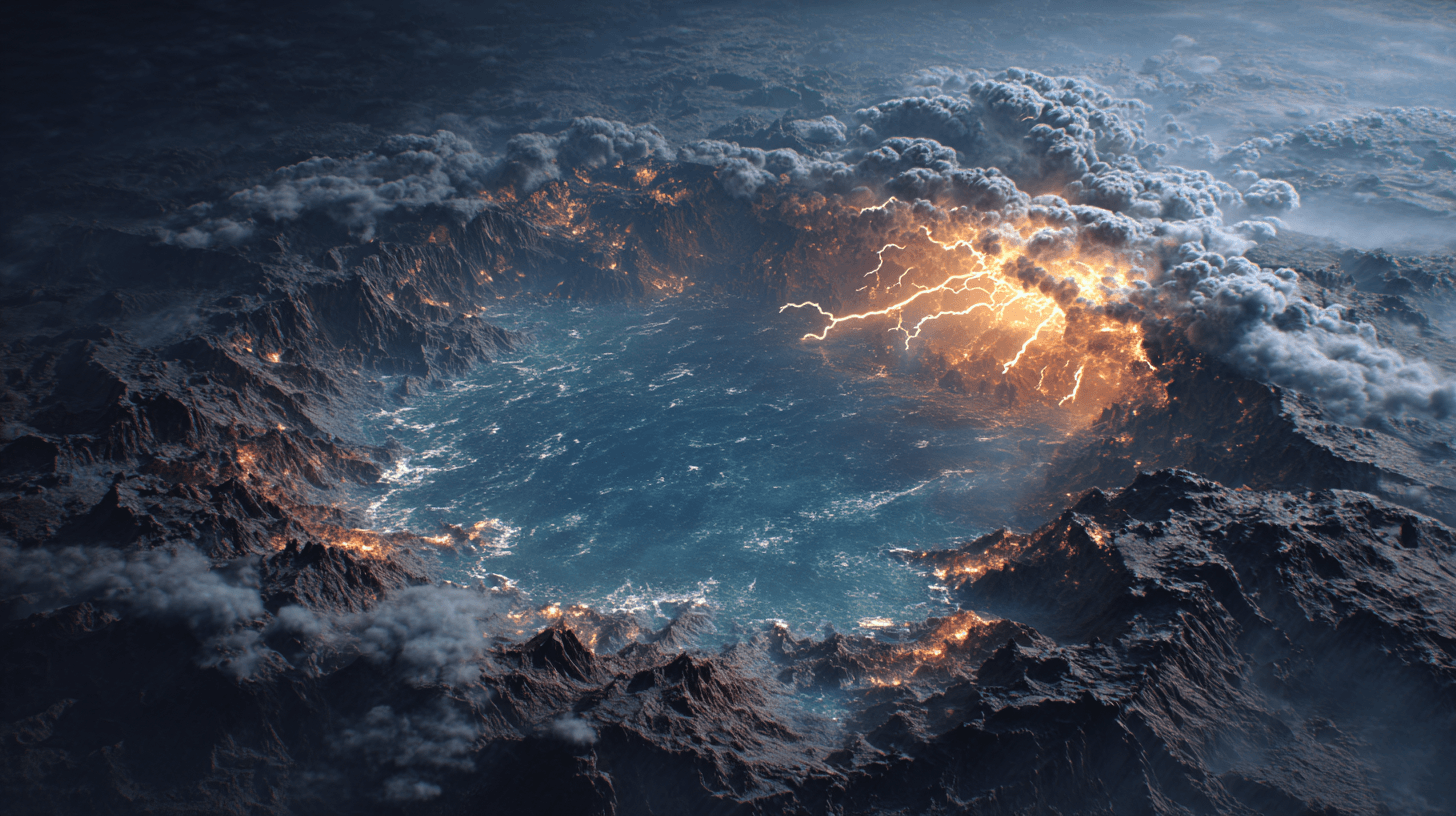
Four billion years ago, Earth had oceans, volcanoes, and a thin, unbreathable atmosphere. It had no forests, no bacteria, not even a single cell drifting in its waters. Then, at some point that no rock has recorded and no fossil has preserved, that changed. A cluster of molecules crossed a line that separates chemistry from biology, and it never crossed back.
Nobody was there to see it happen, and nothing simple enough to have been that first spark could have left a trace big enough to survive geological time. This is what makes the origin of life one of science’s hardest problems: the event that made everything else possible is also the event with almost no direct evidence.
Researchers have not solved this problem completely, and it would be dishonest to claim otherwise. But they have made real progress on the question that matters most: not exactly what happened, but what kinds of chemistry could have made it possible, and why those particular processes, out of countless alternatives, might have won out.
The Real Puzzle Isn’t a Spark, It’s a Loop
Popular culture often imagines the origin of life as a single dramatic moment, a bolt of lightning striking a primordial pond. That image is almost entirely wrong, and correcting it is the first step toward understanding what scientists actually study.
Life is not defined by any single ingredient. It is defined by a self-sustaining loop: molecules that store information, molecules that build and repair the organism, and a boundary that keeps everything together long enough for the process to repeat. In modern cells, DNA stores the instructions, proteins carry out nearly all the chemical work, and a fatty membrane holds it all in one place.
That arrangement creates a genuine chicken-and-egg problem. DNA cannot copy itself without proteins to help. Proteins cannot be built without instructions from DNA. Neither one, on its own, explains how the system got started, because each depends on machinery that only the other one can provide.
This is the actual question underlying the origin of life: not “what was the first molecule,” but “what kind of molecule could have played both roles at once, acting as both the instructions and the machine, long enough for evolution to begin refining it.”
Why RNA Became the Leading Suspect
By the 1980s, biochemists had found a partial answer hiding in a molecule that most people had filed away as DNA’s less important cousin.
RNA, like DNA, can store genetic sequences. But unlike DNA, some forms of RNA can also fold into three-dimensional shapes and act as chemical catalysts, speeding up reactions the way proteins do. Scientists call these catalytic RNA molecules ribozymes, and their discovery earned Thomas Cech and Sidney Altman the 1989 Nobel Prize in Chemistry.
That single fact reframed the entire problem. If one molecule could both hold information and perform chemistry, the chicken-and-egg dilemma had a possible resolution. Early life may not have needed DNA or proteins at all. It may have run, for some stretch of time, on RNA alone, an era researchers now call the RNA world.
Recent laboratory work has strengthened this picture considerably. In 2024, researchers at the Salk Institute engineered an RNA enzyme capable of copying other RNA strands with enough accuracy to preserve their function, while still introducing the occasional variation that evolution requires. In other words, they built, in miniature, a molecular system capable of heredity and mutation using RNA alone. It is not proof that this is how life actually began, but it demonstrates that the physics and chemistry required are genuinely possible, not merely convenient for a textbook story.
Researchers continue to debate how strict the RNA world was in practice. Some recent studies suggest that RNA and DNA, or RNA and simpler protein-like chains, may have coexisted and cooperated from very early on, rather than RNA operating entirely alone before DNA and proteins appeared. The chicken-and-egg problem may have had a messier solution than a clean, single-molecule answer, but the underlying logic, that some molecule needed to double as both information and machinery, still stands at the center of the story.
Where the Building Blocks Came From
An RNA-first world only helps if the raw materials for RNA, and for the rest of a cell, were actually available on the early Earth. This is where a second, equally important line of research comes in.
In 1953, a graduate student named Stanley Miller, working with his advisor Harold Urey at the University of Chicago, sealed water, methane, ammonia, and hydrogen inside a glass apparatus and ran an electrical spark through the mixture to mimic lightning. Within a week, the water had turned pink, then a deep, murky red. Analysis showed it contained several amino acids, the building blocks of proteins, formed from nothing but simple gases and electricity.
The Miller-Urey experiment became one of the most famous demonstrations in the history of science, but its legacy is more complicated than it first appears. Later research revealed that early Earth’s atmosphere was probably not the strongly hydrogen-rich mixture Miller and Urey had assumed. It likely contained more carbon dioxide and nitrogen, gases that produce amino acids less efficiently under the same conditions.
That correction does not erase the experiment’s importance. It shifted the question rather than closing it. Scientists now look to a wider range of environments, volcanic regions, comet and meteorite impacts, and mineral-rich clay surfaces, as places where the necessary organic molecules could have formed or arrived from space. Meteorites themselves have settled part of the debate directly: samples recovered from carbon-rich asteroids have been found to contain amino acids and other prebiotic compounds, confirming that space itself manufactures some of the ingredients of life without any help from Earth’s early atmosphere at all.
The Case for Deep-Sea Vents
A separate research tradition locates life’s starting point not in a sunlit pond but on the ocean floor, in structures called hydrothermal vents.
At sites like the Lost City field in the mid-Atlantic, seawater reacts with rock deep underground and re-emerges through porous, chimney-like mineral structures. These vents create a striking natural condition: a steady chemical and electrical gradient between the vent fluid and the surrounding seawater, similar in principle to the gradient that living cells still use today to generate energy.
This matters because every known living cell powers itself using a proton gradient across a membrane, a process fundamental enough that biologists consider it a near-universal signature of life. Hydrothermal vents naturally produce a comparable gradient without any biology at all, which raises a compelling possibility: rather than life inventing this energy-harvesting trick from scratch, early chemical systems may have exploited a gradient the vents were already producing, and only later evolved the biological membranes and protein pumps needed to reproduce that gradient on their own.
The vent hypothesis and the RNA world are not competitors so much as two puzzle pieces addressing different parts of the same problem. One explains where a workable source of energy could have come from. The other explains how information and chemistry could have merged into a single evolving system. Most serious origin-of-life researchers now assume that several such processes, energy, chemistry, and heredity, had to converge, rather than searching for one single decisive event.
What Turned Chemistry Into Something That Could Evolve
However the raw ingredients came together, one further step is required before you have anything resembling life: a boundary.
Loose molecules dissolved in open water cannot evolve, because nothing keeps a useful combination together long enough to be copied and improved. Laboratory experiments have shown that simple fatty molecules, similar to modern cell membranes, will spontaneously assemble into hollow spheres called protocells when placed in water. These structures are not alive. They cannot metabolize, and they cannot reliably reproduce. But they can grow, they can occasionally divide, and under the right conditions they can hold RNA or other molecules inside them, concentrating chemical reactions that would otherwise be too dilute to matter.
That combination, a self-replicating information-carrier enclosed in a simple membrane, is the threshold most origin-of-life scientists point to as the meaningful boundary between chemistry and biology. Crossing it does not require a miracle. It requires a long sequence of ordinary, well-understood chemical steps, occurring under conditions that were almost certainly common on the early Earth, repeated across enormous stretches of time and countless individual trials until, by chance, one combination worked well enough to persist.
Life did not begin with a single decisive event. It began when a form of chemistry finally became good enough at making imperfect copies of itself to start improving through trial and error.
What Popular Accounts Still Get Wrong
Several ideas about life’s origin persist in popular science writing despite weak or outdated support, and they are worth naming directly.
The claim that scientists have created life in a laboratory is not accurate. Researchers have synthesized individual components, self-replicating RNA enzymes, protocell membranes, amino acids from simple gases, but no laboratory has yet combined these into a complete, independently self-sustaining system starting from non-living chemistry alone.
The idea that Miller and Urey “solved” the origin of life is also outdated. Their experiment demonstrated an important chemical possibility, not the actual historical pathway, since the atmosphere they simulated does not match current geological evidence about early Earth.
Finally, the notion that scientists remain divided into two simple, opposing camps, RNA-world believers against everyone else, oversimplifies a field that has grown considerably more collaborative. Most current researchers treat the RNA world, hydrothermal energy sources, and membrane self-assembly as complementary pieces of a larger, still-incomplete puzzle rather than as rival, mutually exclusive theories.
Why the Question Still Matters
Understanding how life began does more than satisfy historical curiosity. It shapes how scientists search for life elsewhere in the universe. If life requires a rare, near-impossible sequence of coincidences, then Earth’s biosphere may be a cosmic accident, unlikely to be repeated anywhere else. If life instead emerges naturally from common chemistry under common planetary conditions, informative gradients, available organic molecules, membrane-forming lipids, then simple life may be far more widespread across the universe than most people assume, waiting in the oceans beneath the ice of moons like Europa or Enceladus.
The search for life’s origin is, in this sense, also a search for how common or rare we really are. Every experiment that shows a step of the process happening spontaneously under plausible early-Earth conditions nudges the answer slightly further toward common rather than rare.
Life did not arrive on Earth fully formed. It accumulated, one workable chemical trick at a time, until a threshold was crossed that nothing has crossed back since. Science may never recover the exact sequence of events in the exact order they occurred nearly four billion years ago. But it has done something almost as valuable: it has shown, piece by piece, that the transformation from lifeless chemistry to a living, evolving system did not require a miracle. It required chemistry, time, and an ordinary planet patient enough to keep running the experiment.