Why the Moon Always Shows Us the Same Face
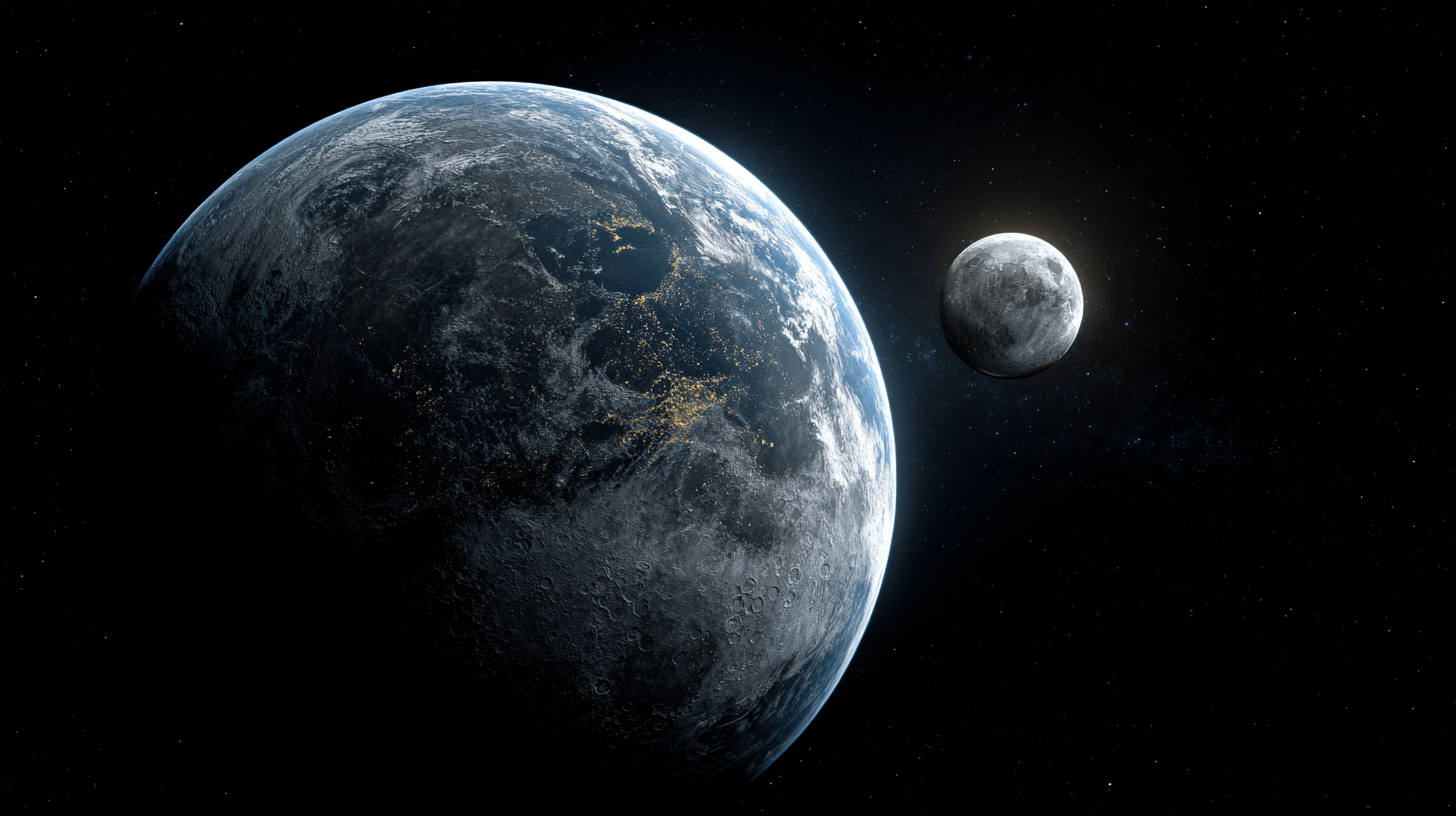
For as long as humans have looked up at the night sky, they have seen the same lunar features: the same dark patches, the same pale highlands, the same faint scars from ancient impacts. No one alive has ever seen the Moon rotate before their eyes to reveal a hidden side. That is not because the Moon stands still. It spins. But it spins in perfect lockstep with its orbit around Earth, and that synchronization is not a coincidence. It is the result of a slow gravitational negotiation that has been playing out for billions of years.
The phenomenon has a name: tidal locking. It explains why the “dark side of the Moon” is a scientifically misleading phrase, why every Apollo mission photographed the same general hemisphere, and why the lunar far side remained a total mystery until a Soviet spacecraft photographed it in 1959. Understanding how tidal locking works also reveals something larger: gravity does not just pull objects together. It can reshape their spin, their orbits, and even their long-term stability.
The Puzzle Hiding in Plain Sight
The Moon rotates on its axis once every 27.3 days. It also orbits Earth once every 27.3 days. These two numbers matching exactly is the entire reason we only ever see one face of the Moon.
If the Moon did not rotate at all, we would eventually see every side of it as it traveled around Earth, the way a ball on a string shows different faces to a stationary observer as it swings past. If the Moon rotated faster or slower than its orbital period, we would also see it rotate over time. Instead, the Moon’s rotation and revolution are matched so precisely that the same hemisphere always faces us.
This match is called synchronous rotation, and it is not unique to the Moon. Many large moons throughout the solar system, including several of Saturn’s and Jupiter’s satellites, are locked in the same way relative to their host planets. The pattern is common enough that astronomers consider it a predictable outcome of gravity acting over long timescales, not a rare accident.
How Gravity Creates Friction Across Space
To understand tidal locking, it helps to start with something more familiar: ocean tides.
Earth’s oceans bulge slightly toward the Moon because the Moon’s gravity pulls harder on the near side of Earth than on the far side. This creates two tidal bulges, one facing the Moon and one facing away from it. As Earth rotates underneath these bulges, friction between the moving water and the ocean floor gradually slows Earth’s rotation.
The Moon does something similar to Earth, except there is no liquid ocean to visualize the effect. Instead, the Moon itself deforms slightly under Earth’s gravity, stretching almost imperceptibly along the line connecting the two bodies. This is sometimes called a solid-body tide, and while it is far smaller than an ocean tide, it operates on the same basic principle.
Early in its history, the Moon likely rotated much faster than it does today. But Earth’s gravity continuously pulled on the Moon’s tidal bulge, creating a gravitational torque that acted like a brake. Every time the Moon’s rotation carried its bulge slightly out of alignment with Earth, Earth’s gravity tugged it back, slowing the Moon’s spin bit by bit.
This process did not happen quickly. Researchers estimate that tidal locking of the Moon likely took shape over tens of millions of years, though the exact timeline remains difficult to pin down given how long ago it occurred. Eventually, the Moon’s rotation slowed to match its orbital period exactly, at which point the tidal bulge stayed permanently aligned with Earth. Once that alignment was reached, there was no more torque to slow the rotation further, and the system settled into a stable configuration.
Gravity did not just pull the Moon toward Earth. It reshaped the Moon’s spin until the two motions fell into sync.
Why the “Dark Side of the Moon” Is a Myth
The far side of the Moon is often called the “dark side,” but this description is inaccurate in an important way. Every part of the Moon experiences day and night as it rotates, receiving roughly two weeks of sunlight followed by two weeks of darkness. The far side is not permanently dark. It is simply the hemisphere that never faces Earth.
The far side remained genuinely unknown to humanity until October 1959, when the Soviet Luna 3 spacecraft captured the first photographs of it. Those images revealed a landscape strikingly different from the near side. The far side has far fewer of the dark, smooth plains known as maria, and instead is dominated by rugged highland terrain and a much higher density of craters.
Scientists have proposed several explanations for this asymmetry. One prominent hypothesis involves differences in crustal thickness between the two hemispheres, which may have limited how much volcanic material could rise to the surface on the far side. Another line of research points to the effects of Earth’s gravity and heat during the Moon’s early molten period, which could have influenced how its crust formed unevenly. The exact cause remains an active area of study, and researchers have not settled on a single, universally accepted explanation.
What is clear is that the far side’s dramatically different appearance had nothing to do with darkness and everything to do with billions of years of separate geological history, hidden from human eyes simply because of orbital mechanics.
A Small but Real Wobble
Although the Moon shows the same general hemisphere to Earth, it does not present an absolutely fixed 50 percent of its surface. Over time, observers on Earth can actually see about 59 percent of the lunar surface due to a phenomenon called libration.
Libration occurs because the Moon’s orbit is not a perfect circle and its axis is slightly tilted relative to its orbital plane. These factors cause the Moon to appear to rock slightly back and forth, and up and down, as seen from Earth, revealing narrow slivers of territory near its edges that would otherwise remain hidden. This wobble does not undermine tidal locking. The Moon’s rotation and average orbital period still match precisely. Libration simply reflects small variations in the Moon’s orbital speed and orientation as it travels along its elliptical path.
This distinction matters because it shows that tidal locking is a statement about matching periods over a full orbit, not a claim that the Moon’s orientation relative to Earth never shifts at all.
The Same Force Is Reshaping Earth Too
Tidal locking is not a one-way relationship. Just as the Moon’s rotation has already synchronized with its orbit, Earth is undergoing a similar process, though it has not finished.
Earth’s rotation is gradually slowing because of the same tidal friction that locked the Moon in place, primarily driven by ocean tides rather than solid-body deformation. Measurements using techniques such as laser ranging, which bounce lasers off reflectors left on the Moon by Apollo astronauts, show that the Moon is slowly moving away from Earth at a rate of roughly 3.8 centimeters per year. As the Moon drifts farther away, Earth’s day is lengthening by a tiny amount over long timescales.
If this process continued for billions of years, and if the Sun did not evolve and expand long beforehand, Earth’s rotation would eventually slow enough to become tidally locked to the Moon as well, with the same side of Earth always facing it. However, this outcome would take vastly longer than the remaining lifespan of the Sun in its current form, so it is best understood as a demonstration of ongoing physical principles rather than a realistic future scenario.
The important insight is that tidal locking is not a finished event confined to the Moon’s ancient past. It is a continuing process, still measurably altering the Earth-Moon system today.
What This Reveals About Planetary Systems
The Moon’s synchronous rotation is often treated as a piece of trivia, a curious fact to mention at a planetarium. But it reflects something fundamental about how gravity organizes bodies in space over long timescales.
Tidal forces do not simply pull objects toward each other. They can drain rotational energy, reshape orbits, and lock celestial bodies into stable configurations that persist for eons. This same mechanism is thought to explain why many exoplanets discovered orbiting close to their host stars are likely tidally locked as well, permanently showing one hemisphere of scorching daylight and one of endless night. Understanding tidal locking in the Earth-Moon system gives scientists a local, well-studied example for interpreting far more distant and difficult-to-observe planetary systems.
The Moon’s fixed face is not evidence of a special or static relationship with Earth. It is evidence of a dynamic one that has already played out to its natural resting point, while a slower version of the same process continues to unfold in Earth’s own rotation.
A Familiar Sight With an Unfamiliar Explanation
The Moon we see tonight is the same Moon that ancient astronomers charted, that medieval scholars mapped, and that Apollo astronauts photographed from lunar orbit. Its unchanging face has always seemed like a simple, almost obvious fact of nature. But behind that familiar view lies a genuinely elegant piece of physics: two independent motions, rotation and orbit, gradually pulled into permanent alignment by the patient, continuous tug of gravity.
The Moon does not merely orbit Earth. It has been shaped by Earth, spun down over millions of years until stillness relative to us became its natural state. The next time the full Moon rises, it is worth remembering that its calm, unchanging face is really the visible outcome of an ancient and ongoing gravitational conversation between two worlds.
Frequently Asked Questions
Does the Moon rotate at all?
Yes. The Moon completes one full rotation on its axis roughly every 27.3 days. It simply rotates at the same rate it orbits Earth, so the same hemisphere continually faces us.
Is the far side of the Moon always dark?
No. The far side experiences the same cycle of day and night as the near side. It is called the “dark side” only in the sense of being unknown or unseen, not because it lacks sunlight.
Will Earth eventually become tidally locked to the Moon?
In theory, the same forces that locked the Moon could eventually slow Earth’s rotation enough to lock it as well. In practice, this would take far longer than the Sun is expected to remain in its current state, so it is not considered a realistic future outcome.
Are other moons in the solar system tidally locked?
Yes. Many large moons, including several orbiting Jupiter and Saturn, are tidally locked to their host planets. Synchronous rotation appears to be a common long-term outcome of gravitational interaction between a planet and a nearby moon.