Why Do Volcanoes Suddenly Erupt?
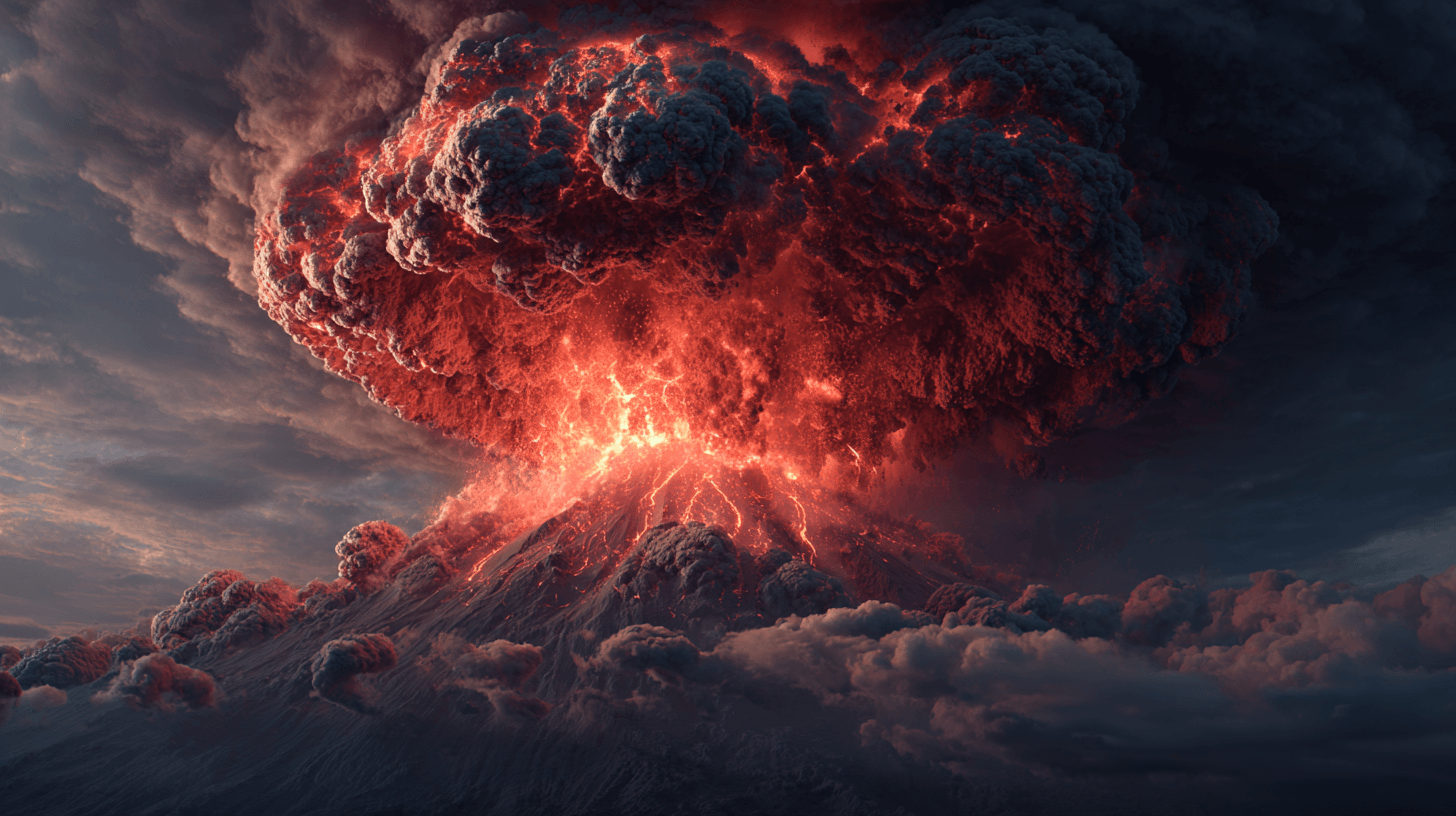
At 8:32 a.m. on May 18, 1980, Mount St. Helens looked almost exactly as it had a minute earlier: a snow-covered cone in southwestern Washington, bulging slightly on its north flank from weeks of underground swelling. Then a magnitude 5.1 earthquake shook the volcano, and the entire bulge broke away in the largest landslide ever recorded. Within seconds, the mountainside that had been holding back a pressurized magma system was gone, and the volcano exploded sideways with a force equivalent to hundreds of atomic bombs.
The eruption looked instantaneous. It was not. Mount St. Helens had been inflating for two months, its magma chamber slowly filling with gas-rich rock that scientists were actively monitoring. What changed in that instant was not the presence of pressure, but the release of it. Understanding why volcanoes erupt when they do requires answering a narrower and more interesting question than “why do volcanoes explode.” It requires answering why a system that has been quietly pressurizing for years, decades, or centuries suddenly crosses a threshold and lets go.
The Pressure Cooker Beneath the Mountain
Magma is not simply hot liquid rock. It is a mixture of molten rock, crystals, and dissolved gases — mainly water vapor, carbon dioxide, and sulfur compounds — held in solution the way carbon dioxide is held in a sealed bottle of soda. As long as the surrounding pressure stays high enough, those gases remain dissolved and the magma behaves like a thick, sluggish fluid.
The trouble starts when that pressure balance shifts. As magma rises toward the surface, or as it cools and crystallizes underground, the gases begin to come out of solution. Volcanologists call this exsolution, and it works exactly like opening a soda bottle: reduce the pressure, and dissolved gas turns into bubbles. This process is sometimes called first boiling, while a second version happens as magma cools and crystallizes, enriching the remaining liquid in gas until it too begins to bubble.
Bubbles take up far more space than dissolved gas. As they multiply, they push outward on the surrounding rock, building what scientists call overpressure inside the magma chamber. Eventually, if nothing interrupts the process, this overpressure can exceed the strength of the rock walls containing it. Researchers have modeled this directly: when the overpressure in a shallow magma chamber reaches roughly twice the tensile strength of the volcanic edifice above it, the rock fractures and an eruption or intrusion begins.
This is the fundamental engine of most eruptions. But it raises the real puzzle. Magma chambers take decades or centuries to pressurize. If overpressure alone decided the moment of eruption, volcanoes should erupt gradually and predictably, like a kettle reaching a boil. They don’t. They often erupt abruptly, sometimes within minutes of an external event. That gap between the slow buildup and the sudden release is where the most important science lies.
What Actually Flips the Switch
If pressure alone doesn’t explain timing, something else has to tip an already-primed system over the edge. Volcanologists have identified several distinct triggers, and real eruptions are usually the product of more than one acting together.
Fresh magma arriving from below. One of the most common triggers is not a change at the surface at all, but a delivery from deeper in the Earth. When new magma is injected into a shallow chamber that already contains a crystal-rich mush left over from previous activity, the added volume and heat can push the system past its pressure limit. This is somewhat like adding a final cup of water to a glass already filled to the brim — the system had no room left to absorb anything more.
Earthquakes and physical shaking. This is the mechanism that made Mount St. Helens historic, and it turns out to be far more general and far stranger than it first appears. Laboratory experiments have shown a genuinely counterintuitive effect: shaking a super-saturated magmatic liquid causes gas to come out of solution and the pressure inside to rise, even though nothing new has been added to the system. Vibration essentially agitates dissolved gas out of the melt, the same way tapping a shaken soda can encourages foam to form faster.
This isn’t just a laboratory curiosity. During a major dome collapse at the Soufrière Hills volcano in Montserrat in 2003, sensitive underground instruments recorded exactly this effect happening in real time. Within ten to twelve minutes of intense shaking detected by a seismic network — a timescale that matched the laboratory results almost precisely — the pressure inside the magma chamber measurably increased. A smaller dome collapse in 2006 produced a proportionally smaller pressure spike with the same timing pattern, reinforcing that the link was real rather than coincidental. Scientists now believe this mechanism helps explain a pattern volcanologists have long noticed but struggled to explain: many eruptions occur on the very same day as distant or local major earthquakes, even though the slow buildup of magma pressure has nothing to do with the earthquake’s timing.
Loss of structural strength above the chamber. Sometimes the trigger isn’t a change inside the magma at all, but a weakening of what’s holding it in. At Mount St. Helens, the landslide didn’t cause the pressure — it removed the rock that had been containing it, in effect uncorking the bottle. Once the confining wall was gone, the already gas-rich magma inside could expand almost instantly, since it no longer needed to overcome the strength of intact rock, only the much weaker resistance of loose rubble.
Slow degassing that quietly opens a path. A newer line of research complicates the picture further, suggesting that gas escaping a volcano during periods of apparent calm can itself set up the next eruption. As gas passively leaks out of a shallow reservoir during quiet periods, the resulting pressure drop can open pathways connecting deep and shallow magma chambers, allowing magma from below to begin its ascent. In this view, an eruption isn’t only pushed from underneath by fresh magma; it can also be pulled upward because the volcano’s own outgassing created a weakness in the plumbing above.
Gas being reabsorbed, not just released. Perhaps the most unexpected recent finding runs against the standard story entirely. A 2026 study proposed that in some large silicic eruptions, it may be gas dissolving back into the magma — rather than escaping from it — that generates the pressurization needed to trigger a major eruption. Using the Aso-4 eruption in Japan, which occurred roughly 86,000 years ago, as a case study, researchers found that this process of volatile resorption can increase pressure in large magma chambers even faster than the conventional exsolution mechanism, partly because it also reduces how compressible the magma is. This finding doesn’t overturn decades of research on gas exsolution, but it is a reminder that scientists are still refining the basic physics of how the largest eruptions get their power.
Why Timing Remains So Hard to Predict
Given how many separate mechanisms can tip a volcano into eruption — new magma, seismic shaking, structural collapse, degassing, gas resorption — it should be no surprise that predicting the exact moment of an eruption remains extraordinarily difficult, even when scientists know a volcano is dangerously pressurized.
Monitoring networks can detect many of the warning signs: swelling ground measured by GPS and tiltmeters, swarms of small earthquakes as rock cracks under stress, and changes in the gases seeping from vents. Mount Pinatubo’s catastrophic 1991 eruption in the Philippines was preceded by weeks of exactly these signals, giving scientists enough confidence to recommend evacuations that saved an estimated 20,000 to 30,000 lives. That success has become one of the field’s proudest achievements.
But detecting unrest is different from predicting the precise hour of eruption, because the final trigger is often something close to a coin flip. Some studies frame this directly in terms of a threshold: systems whose volatile content sits right at a “sweet spot” for pressure buildup are far more susceptible to being pushed into eruption by an outside trigger, such as an injection of new magma, than systems with either more or less dissolved gas. Two volcanoes that look almost identical on paper can behave completely differently depending on this narrow chemical window. Other research on the Axial Seamount, an undersea volcano on the Juan de Fuca Ridge, has approached the same problem from the perspective of the surrounding rock rather than the magma itself. These models track how stress accumulates in the rock hosting the magma reservoir and suggest that eruptions are triggered once the host rock reaches a point of critical mechanical failure, a threshold whose timing depends heavily on the specific properties of the rock in question.
In other words, a volcano isn’t a single pressure gauge with one clear red line. It’s a system where the melt’s chemistry, the surrounding rock’s strength, the arrival of new magma, and outside shocks like earthquakes all interact, and any one of them can be the final push. That interaction is exactly why volcanic eruptions can look sudden even to the scientists who have been watching the mountain most closely.
What Popular Memory Gets Wrong
Volcanic eruptions are often described in the media as coming “without warning,” language that suggests a volcano that was calm one moment and violent the next. In the vast majority of documented cases, that framing is misleading. Mount St. Helens showed clear signs of unrest for two months before its climactic explosion. Pinatubo gave weeks of warning. The chamber beneath Aso had been slowly accumulating gas and pressure for a very long time before its prehistoric eruption.
What actually happens is closer to the opposite: pressure builds gradually and, in many cases, detectably, while the final release is triggered abruptly by one of several distinct physical mechanisms — an earthquake’s shaking, a landslide’s removal of confining rock, a fresh pulse of magma, or a shift in how gas moves through the system. The eruption looks instantaneous because the trigger is instantaneous. The pressure that made the trigger dangerous was not.
This distinction matters beyond geology. It shapes how volcanic hazards are monitored and communicated to the public, and it explains why volcanologists speak in terms of probability and elevated risk rather than fixed predictions. A volcano showing signs of unrest is not a ticking clock counting down to a known moment. It is closer to a loaded system waiting for one of several possible triggers — and understanding which trigger is most likely, and how close the system is to its breaking point, remains one of the most active and genuinely uncertain frontiers in earth science.