Why Martin Luther Turned Against the Church He Once Served
In the fall of 1517, an Augustinian friar in the small German town of Wittenberg sat down to write a letter to his archbishop. He was not trying to start a revolution. He was a university professor troubled by what he saw happening in the towns and villages around him: ordinary people handing over their savings for pieces of paper that promised to shorten a loved one’s suffering after death. Martin Luther wanted a debate about a fundraising practice he considered dangerous. What he got, instead, was the unraveling of Western Christianity’s thousand-year unity.
The standard story remembers Luther nailing 95 theses to a church door and single-handedly launching the Reformation. That image captures a moment, but it misses the question that actually matters: what convinced a loyal monk, trained in Catholic theology and initially seeking only reform, that the institution he served had lost its way? The answer is not one grievance but several, compounding over years, until a dispute over indulgences opened into a fundamental disagreement about salvation, authority, and what the church was for.
The World That Shaped Luther’s Doubts
To understand Luther’s break with Rome, it helps to understand the anxieties of the world he grew up in. Late medieval Christians lived with an intense, often terrifying awareness of sin, judgment, and the afterlife. Plague, war, and high mortality made death a constant presence, and the church offered an elaborate system for managing the fear it produced: confession, penance, indulgences, the veneration of relics, and the doctrine of purgatory, a place where souls could be purified before entering heaven.
Luther absorbed this anxiety personally. As a young monk, he was, by his own account, obsessive about his own sinfulness. He confessed for hours, fasted beyond what his order required, and still could not convince himself that he had done enough to satisfy a righteous God. This was not unusual theology for the time; it was the logical outcome of a system that tied salvation partly to human effort. But for Luther, it became unbearable. He later described feeling that he hated God, because a just God seemed to demand a perfection he could never reach.
This personal crisis matters because it shaped everything that followed. Luther’s theological breakthrough, and his later criticism of the church, grew out of a search for peace he could not find within the religious practices he had been taught to trust.
The Discovery That Changed His Thinking
Sometime in the years before 1517, while lecturing on the Psalms and the Book of Romans at the University of Wittenberg, Luther arrived at a different reading of a familiar phrase: “the righteousness of God.” He had always understood it as the standard by which God judges and punishes sinners. Rereading Paul’s letters, he became convinced it meant something else entirely: a righteousness that God freely gives to those who trust him, not one they must earn.
This idea, which historians call Luther’s doctrine of justification by faith alone, is technical, but its implication was explosive. If a person is made right with God through faith rather than through accumulated good works, then confession, penance, pilgrimages, relics, and indulgences could not do what the church claimed they did. They might be useful spiritual practices, but they could not purchase salvation, because salvation was not for sale in the first place.
Luther did not immediately turn this insight into a public attack on the church. For a time, it remained a personal theological conviction, discussed with colleagues and students. What forced it into public view was a fundraising campaign that, for Luther, exposed exactly the abuse his new understanding warned against.
The Indulgence That Broke the Silence
In 1517, a Dominican friar named Johann Tetzel arrived in territories near Wittenberg selling indulgences to help finance the rebuilding of St. Peter’s Basilica in Rome, part of an arrangement that also helped a German archbishop repay debts he had taken on to secure his church office. Indulgences, in Catholic teaching, reduced the temporal punishment for sins that had already been forgiven through confession. In theory, they were tied to genuine repentance. In practice, Tetzel’s campaign advertised them as something closer to a transaction: pay a sum, and a soul’s time in purgatory shortens accordingly.
One line attributed to Tetzel’s preaching, whether or not he used those exact words, captures how the message was heard by ordinary people: that a coin dropped in the collection box could spring a soul from purgatory the instant it rang against the bottom. Historians debate exactly what Tetzel said and how much responsibility he personally bears for the crudeness of the pitch, but the broader pattern is well documented. Indulgence preaching across Europe had, by the early sixteenth century, drifted far from careful theology and toward aggressive fundraising.
For Luther, this was not a minor abuse at the edges of an otherwise sound system. It was a direct contradiction of what he now believed about grace. If salvation could not be bought, then a campaign telling peasants they could buy their grandparents out of purgatory was not just imprudent. It was a lie that exploited people’s fear of death and drained their limited resources.
Ninety-Five Questions, Not One Manifesto
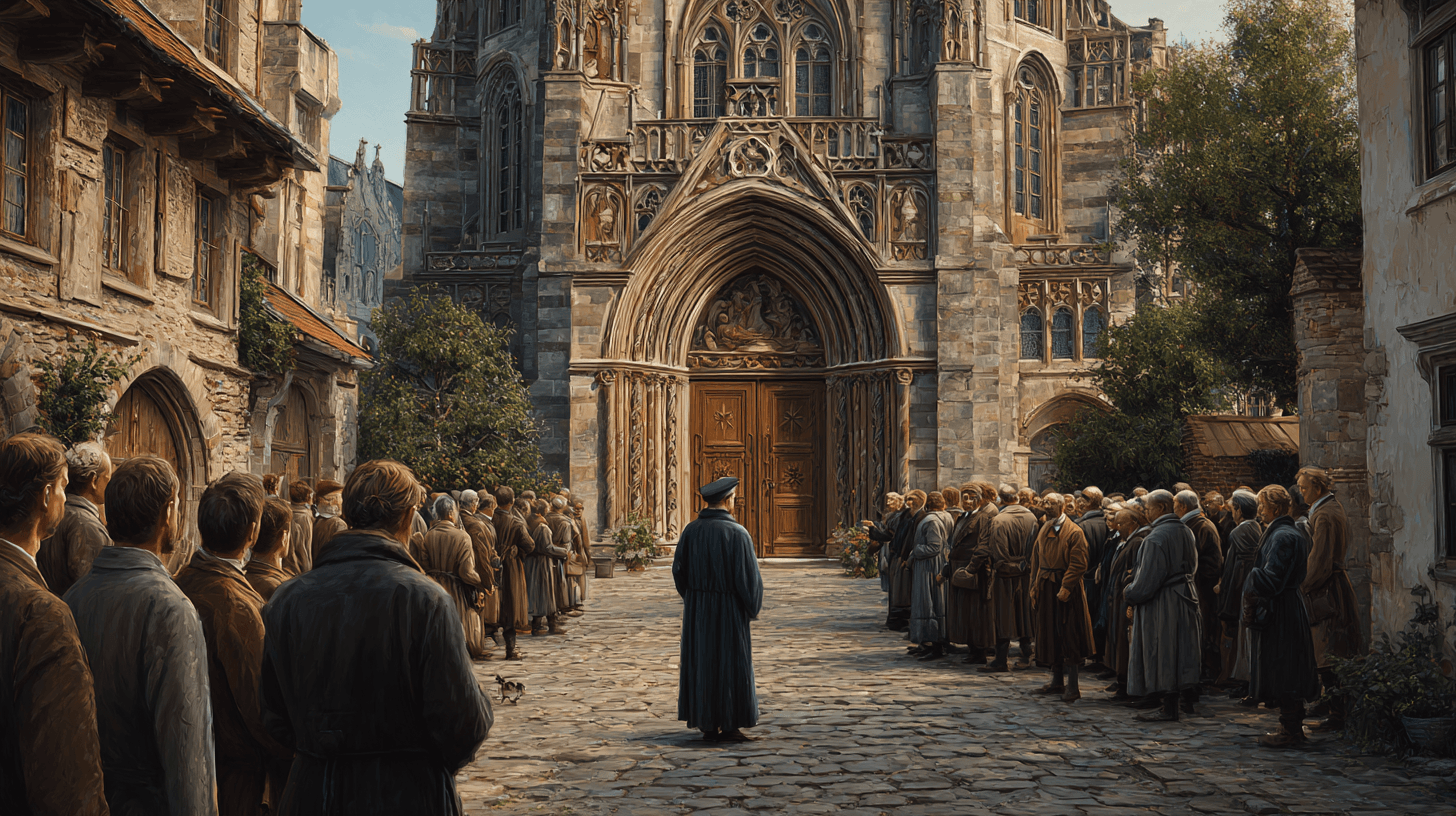
On October 31, 1517, Luther sent his archbishop a set of 95 theses, written in Latin for academic debate, and, according to long-standing tradition, posted them on the door of the Wittenberg Castle Church, which doubled as the university’s bulletin board. It is worth being clear about what the document actually was. It was not a declaration of independence from Rome. It was a list of propositions for scholarly argument, several of which affirmed the pope’s authority and none of which rejected core Catholic doctrine outright.
What the theses did was ask uncomfortable questions. If the pope could truly release souls from purgatory through indulgences, Luther asked, why not empty purgatory entirely out of pure charity, rather than for payment? Why did the pope, who was reportedly wealthier than the richest man in Germany, need money from poor believers to build a church in Rome? These were not the words of a revolutionary. They were the words of a professor pointing out that the church’s practice did not match its own stated theology.
The theses might have remained an academic exercise had they stayed within university walls. Instead, they were translated from Latin into German and, thanks to the printing press, spread through the German-speaking lands within weeks. Luther had not planned to become a public figure. The technology of print, combined with widespread resentment toward Rome’s fundraising in German territory, turned a local theological dispute into a continental controversy almost overnight.
From Reform to Rupture
Luther’s early hope was reform from within, and Rome’s early response treated the matter as a disciplinary problem rather than an existential threat. Church officials summoned him to explain himself, first to a cardinal in Augsburg in 1518, then into a series of debates that pushed him further than he had originally intended to go.
The turning point came in 1519, during a debate in Leipzig with the theologian Johann Eck. Pressed to defend his positions, Luther was maneuvered into acknowledging that some of his views resembled those of Jan Hus, a Bohemian reformer condemned as a heretic and burned at the stake a century earlier. Once Luther conceded that a church council could err, and that scripture, not papal authority, was the final judge of Christian truth, he had crossed a line that made compromise with Rome far harder to imagine.
What had begun as a dispute over indulgences had become a dispute over the foundations of religious authority itself: whether the pope and church councils held final interpretive power over scripture, or whether scripture stood above them and could be used to judge their decisions. This is the deeper reason Luther’s protest could not be contained the way earlier reform movements had been. He was no longer asking the church to correct an abuse. He was asking who had the right to decide what counted as an abuse in the first place.
Excommunication and the Point of No Return
In 1520, Pope Leo X issued a formal warning, threatening excommunication unless Luther recanted a list of condemned statements. Luther responded by publicly burning the document along with volumes of church law, a symbolic act that left no room for ambiguity about where he stood. Excommunication followed in January 1521.
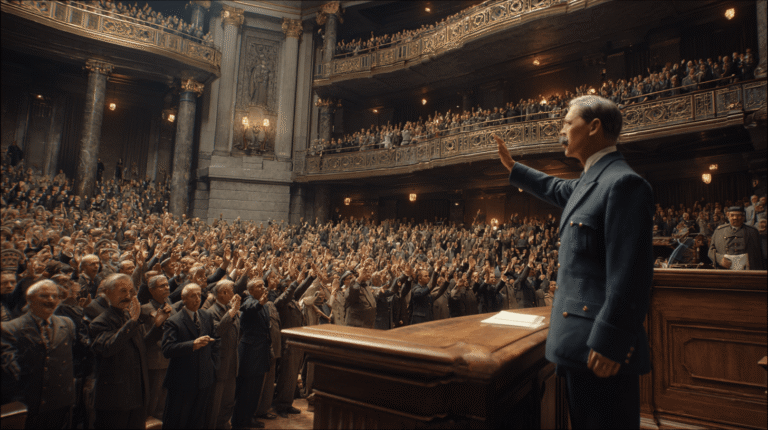
Later that year, Luther was summoned before the Diet of Worms, an assembly of the Holy Roman Empire’s political and religious authorities, and asked once more to recant. According to accounts written down after the event, he refused unless he could be shown by scripture or clear reason that he was wrong, adding that his conscience was captive to the word of God. Whether he spoke the famous words “Here I stand, I can do no other” exactly as later tradition remembers them is uncertain, since the earliest printed accounts of the speech do not all agree on the wording. What is well documented is the substance of his refusal: he would not submit his conscience to authorities he believed had misused their power.
The emperor declared him an outlaw. Only the protection of Frederick the Wise, elector of Saxony, who had Luther secretly taken to Wartburg Castle, kept him from likely execution. From hiding, Luther continued writing, including a German translation of the New Testament that would shape the German language itself for centuries.
What Popular Memory Gets Wrong
It is tempting to picture Luther as a lone rebel who single-handedly defeated a monolithic, corrupt institution. Both halves of that image need correcting. The Catholic Church of 1517 was not simply corrupt from top to bottom; it contained serious reformers, rigorous theologians, and long traditions of internal self-criticism that predated Luther by centuries. And Luther was never entirely alone. He depended on the protection of German princes who had their own political and financial reasons to resist interference from Rome, on university colleagues who supported and refined his ideas, and on printers whose commercial interest in selling his pamphlets helped spread them across Europe faster than any single person could have managed.
It is equally wrong to see Luther’s criticism as directed mainly at moral failings, greedy clergy, or lavish church buildings. Those complaints existed and were real, but they were symptoms, not the core disagreement. The center of Luther’s protest was theological: a conviction that the church’s practical system for delivering salvation contradicted what he read in scripture about grace. Corruption made the abuse visible. Theology explained why Luther thought it mattered enough to risk his life over it.
Why the Break Could Not Be Undone
Once the dispute became a question of authority rather than practice, reconciliation grew structurally difficult. The papacy could not concede that scripture outranked its own councils and decrees without undermining the basis of its authority over all doctrine, not just indulgences. Luther, for his part, had committed himself publicly and repeatedly to a position from which retreat would have meant abandoning a conscience he described as bound by conviction. Compromise would have required one side to surrender the foundation of its authority, and neither side was willing to do that.
Political circumstances hardened the split further. German princes who protected Luther gained a useful argument for keeping church revenue and authority within their own territories rather than sending money and jurisdiction to Rome. Ordinary believers who had long resented indulgence collectors found in Luther’s ideas a vindication of grievances that had nothing directly to do with theology. Religious conviction, political self-interest, and economic resentment reinforced one another until reunification became, in practical terms, nearly impossible.
The Legacy of a Question About Grace
Martin Luther’s criticism of the church did not begin as an attempt to divide Christianity. It began as a monk’s search for peace with a God he feared he could never satisfy, and it hardened into conflict only when that search collided with a fundraising practice that seemed to contradict everything he had come to believe about grace. The 95 theses were a professor’s invitation to debate, not a battle plan, and the schism that followed emerged from a chain of escalating confrontations that neither Luther nor his opponents fully controlled.
What makes this history worth understanding today is not simply that it produced Protestantism, though it did, reshaping the religious map of Europe within a generation. It is the underlying question Luther forced into the open: who has the authority to decide what a religious institution’s core practices should be, and what happens when an individual’s conscience concludes that the institution has gotten something essential wrong. That question did not end with the Reformation. It has resurfaced, in different forms, wherever institutions claim authority over conscience, and wherever individuals conclude they must answer to a higher standard than the one their institution enforces.
Luther set out to correct a practice he saw as a betrayal of Christian teaching. He ended up demonstrating how a single, carefully reasoned objection, arriving at the right moment and amplified by a new technology, could fracture an institution that had stood unchallenged for a thousand years.