Why Prices Keep Rising: The Hidden Machinery Behind Inflation
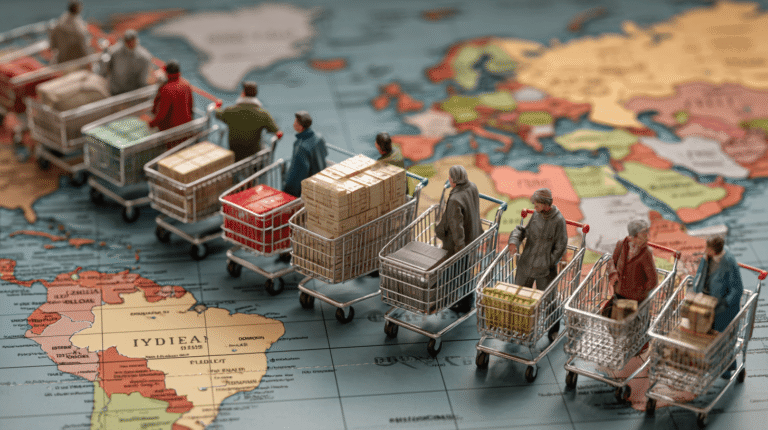
A cup of coffee that cost a dollar a generation ago now costs three or four. A house that a young couple could once buy on a single income now requires two incomes and a decade of saving. Wages have risen too, yet many people feel like they are running just to stay in place.
This is not a random accident of the market. It is the predictable result of how modern economies are built, financed, and managed. Prices rise almost every year, in almost every country, under almost every government, regardless of who is in charge. That consistency is the real mystery worth explaining.
Understanding inflation means understanding something most people never learn in school: money itself is not a fixed measuring stick. It is a moving target, deliberately managed by institutions that have decided a small, steady rise in prices is safer than the alternative.
The Question Behind Every Receipt
Ask most people why prices go up, and they will mention greedy companies, government spending, or “printing money.” Each of these plays a role, but none of them explains why inflation is a near-permanent feature of economic life rather than an occasional event.
The better question is not “what caused this month’s price increase.” It is why economies are structured so that prices are expected to rise every year, and why the alternative — falling prices — is treated by economists as more dangerous than rising ones.
Answering that question requires looking at what money actually is, how spending and production interact, and what central banks are trying to prevent.
Money Is Not a Fixed Ruler
It is tempting to think of a dollar or a euro the way we think of a mile or a kilogram: a fixed unit that measures something objectively. Money does not work that way.
A currency’s value depends entirely on how much of it exists relative to the goods, services, and productive capacity of the economy it circulates in. When more money chases the same amount of goods, each unit of that money buys less. That is the basic mechanism of inflation, and it holds true whether the money is created by a government printing press, a central bank’s digital ledger entry, or a wave of new bank lending.
This is why inflation is often described as a monetary phenomenon at its root, even though its immediate triggers can look very different from one episode to the next. A supply shock, a spending surge, or a wage increase can each set off rising prices, but the reason those increases translate into a lasting rise in the price level — rather than a one-time adjustment — usually comes back to how much money and credit are circulating through the system.
Two Engines That Drive Prices Upward
Economists generally describe rising prices as coming from two different directions, and most real-world inflation is some mixture of both.
Demand-Pull: Too Much Money Chasing Too Few Goods
When households and businesses have more money to spend than the economy can supply in goods and services, sellers raise prices rather than run out of stock. This is demand-pull inflation. It tends to appear when incomes rise quickly, when governments spend heavily, or when interest rates are low enough that borrowing and spending become easy.
The clearest recent example came after 2020, when governments around the world issued large amounts of stimulus spending to offset the economic shock of the pandemic. Consumers had more money in savings than usual, and once lockdowns eased, that money flowed into spending faster than factories, shipping networks, and labor markets could keep up.
Cost-Push: When Production Itself Gets More Expensive
The second engine works from the supply side. When the cost of producing goods rises — because of higher energy prices, disrupted supply chains, labor shortages, or scarce raw materials — businesses pass those costs on to consumers rather than absorb them as lower profit.
The 1970s oil shocks are the textbook case. When oil-producing nations restricted supply and prices for crude oil spiked, the cost of transporting, manufacturing, and heating almost everything rose with it. Inflation surged across the industrialized world, not because people were suddenly spending more freely, but because the basic input costs of the economy had jumped.
Real inflationary episodes rarely fit neatly into one category. The post-pandemic surge combined both: stimulus-driven demand met supply chains that were still recovering from shutdowns, port congestion, and labor shortages. Prices rose faster than either factor alone would predict, because the two forces reinforced each other.
Why Central Banks Don’t Aim for Zero
Given how uncomfortable rising prices feel, it might seem logical for governments to aim for completely stable prices, or even for prices to fall over time as productivity improves. Most central banks explicitly reject that goal. Instead, institutions like the U.S. Federal Reserve and the European Central Bank target a small, steady inflation rate, typically around 2 percent per year.
This is not an oversight. Central bankers consider mild inflation safer than the alternative for several concrete reasons.
Falling prices, or deflation, encourage people to delay purchases, since goods will be cheaper later. If a large share of the population does this simultaneously, spending collapses, businesses cut production and wages, and the economy can spiral into the kind of prolonged stagnation that defined Japan for much of the 1990s and 2000s.
A small buffer of inflation also gives central banks room to maneuver. When an economy slows down, central banks typically respond by cutting interest rates to encourage borrowing and spending. If inflation and interest rates are already near zero, there is little room left to cut before hitting the floor of zero percent, a situation known as the zero lower bound. A cushion of mild, steady inflation gives policymakers more room to respond to future downturns.
In other words, the goal is not to prevent inflation altogether. It is to keep it low, stable, and predictable enough that businesses can plan, workers can negotiate wages, and consumers do not panic.
The Wage-Price Feedback Loop
One of the more difficult dynamics to control is what happens once inflation becomes an expectation rather than a surprise.
If workers expect prices to keep rising, they push for higher wages to keep pace. If businesses expect wage costs to rise, they raise prices in advance to protect their margins. Each side is responding rationally to the other, but the combined effect can lock in a self-reinforcing cycle of price increases that becomes harder to break the longer it continues.
This is why central banks pay close attention not just to current inflation, but to inflation expectations — surveys and market indicators that reveal what businesses and consumers believe will happen to prices in the future. If people believe inflation will stay high, they act in ways that help make it true. Breaking that expectation, once it takes hold, often requires deliberately slowing the economy through higher interest rates, even at the cost of higher unemployment. That was the strategy the Federal Reserve pursued in the early 1980s under chairman Paul Volcker, who raised interest rates aggressively enough to trigger a recession in order to break a decade of entrenched inflation.
What People Commonly Get Wrong
Public debate about inflation tends to gravitate toward simple villains, but the full picture is more structural than that.
Blaming corporate greed alone struggles to explain why inflation surges and then recedes over time, since corporate profit motives do not meaningfully change from one year to the next. Rising corporate profits during inflationary periods are often a symptom of a system where demand is already outpacing supply, not the root cause of that imbalance.
Blaming government spending or “money printing” alone captures part of the story but misses timing. Money supply increases do not always produce inflation immediately, particularly if that money sits in savings rather than circulating through spending. The pandemic-era stimulus contributed to inflation not simply because it existed, but because it combined with constrained supply and a rapid return of consumer demand.
It is also a common misconception that inflation is primarily a modern or recent problem. Historical records show sustained inflation in societies stretching back centuries, including the debasement of Roman currency and the price revolution that swept across Europe after the sixteenth century, when a massive influx of silver from the Americas increased the money supply relative to available goods. Inflation is not a uniquely modern failure. It is a recurring feature of any economy that uses money as a medium of exchange.
Why This Still Matters
Understanding inflation changes how a person reads economic news. A rise in interest rates is not an arbitrary punishment; it is typically an attempt to cool demand before wage-price expectations become entrenched. A government’s pandemic-era relief spending was not simply generous or reckless; it was a trade-off between preventing an immediate economic collapse and risking a later surge in prices.
It also reframes what “the economy is doing well” actually means. Low, stable inflation is generally treated as a sign of health, not because rising prices are inherently good, but because the alternative extremes — runaway inflation or persistent deflation — tend to cause far more damage to jobs, savings, and long-term planning.
The Question Prices Keep Asking
Inflation persists because modern economies are built on a currency whose value is deliberately managed rather than fixed, and because the alternative to mild, steady inflation is not stability but the much sharper risks of deflation and economic paralysis.
The rising price of that cup of coffee is not simply a sign that something has gone wrong. It is evidence of a system constantly balancing two competing dangers, choosing the one that history suggests is easier to survive.
Prices will likely keep climbing next year, and the year after that. The real question was never whether they would rise, but whether the rise stays slow enough for people, businesses, and institutions to keep pace with it.